

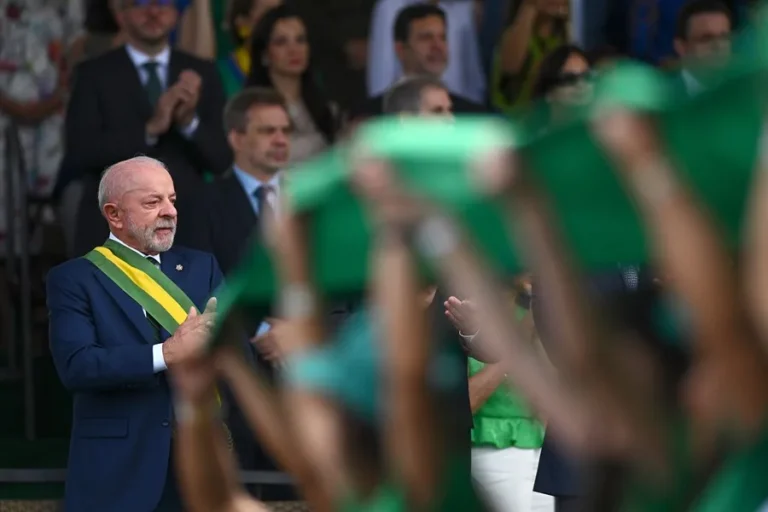
Lula Brazil election mobilization brings PT supporters into the streets as polls show a tight race with Flávio Bolsonaro before Brazil’s October vote.
Related: Brazilian Supreme Court Lifts Secrecy on Master Bank Fraud Probe
Lula Brazil Election Mobilization Intensifies Before October Vote
Lula Brazil election mobilization moved into a new phase on Sunday as President Luiz Inácio Lula da Silva called on supporters and citizens to take part in a nationwide day of popular organizing, three weeks before Brazil’s presidential election.
The initiative, led by Lula’s Workers’ Party (PT), includes marches, public meetings, discussion tables, information activities, and events in cities across the country.
The mobilization is designed to measure the campaign’s support in the streets and consolidate the president’s base before the first round of voting. Lula is seeking reelection in a race marked by political polarization and increasingly narrow margins.
The president called on PT members and citizens to occupy public spaces and support what he described as the Brazil he believes in. He also announced an online meeting with supporters at 6 p.m. local time, where he was expected to address major campaign issues and speak directly to voters.
The campaign’s central themes include public security, workers’ rights, women’s rights, and the defense of national sovereignty in the face of external economic pressure and tariffs.
In a message circulated on social media, Lula urged supporters to participate in local events and help demonstrate the strength of the movement.
“Today is the day to take the streets and show the strength of the Brazil we believe in,” the president said. He also promoted a new campaign jingle and encouraged supporters to produce and share videos using the song.
The Lula Brazil election mobilization comes as political parties intensify their presence in public spaces, digital networks, television, radio, and local communities. The final stage of the campaign is expected to focus on turnout, undecided voters, and the ability of each side to consolidate its coalition.[straitstimes][reuters]
The PT says the mobilization will help strengthen support for Lula’s reelection while presenting the administration’s record to voters. Government supporters are emphasizing macroeconomic indicators, employment, social programs, and Brazil’s international role.
The opposition, led by Senator Flávio Bolsonaro, is focusing its campaign on criticism of the judicial system, accusations of institutional overreach, and the consolidation of conservative voters.
The two campaigns are seeking to transform their respective narratives into electoral momentum. Lula’s side is presenting the election as a choice between social inclusion and a return to conservative rule. Bolsonaro’s supporters are emphasizing opposition to the Supreme Court and demanding what they call greater judicial independence.
Lula Brazil Election Mobilization Meets Tight Polling
See the latest Datafolha polling report on Lula and Flávio Bolsonaro.
The Lula Brazil election mobilization is taking place amid a highly competitive contest between the incumbent president and Flávio Bolsonaro, the eldest son of former President Jair Bolsonaro.
A Datafolha poll conducted between September 8 and 10 showed Lula with 39 percent support in a first-round scenario, compared with 35 percent for Flávio Bolsonaro. The survey questioned 2,002 people and had a margin of error of two percentage points.
In a potential runoff, Lula led Flávio Bolsonaro by 46 percent to 44 percent. The result represents a narrow advantage that remains within the poll’s margin of error.
Other surveys have shown an even closer contest. An AtlasIntel/Bloomberg poll placed Flávio Bolsonaro slightly ahead in a simulated runoff, with 46.4 percent compared with 46.2 percent for Lula.
A Quaest poll released earlier in September showed the two candidates tied at 41 percent each in a potential second round. A Nexus poll also placed Flávio Bolsonaro narrowly ahead, at 46 percent to Lula’s 45 percent.
The differing results show why both campaigns are treating the final weeks as decisive. Small changes in turnout, regional preferences, undecided voters, and support from smaller parties could determine who advances and who wins a second round.
The polling figures also reinforce the importance of public mobilization. A strong turnout at rallies and neighborhood events can help energize activists, attract media attention, and create the impression of growing momentum.
For Lula’s campaign, the objective is to translate the president’s national profile into an organized grassroots operation. The PT has historically relied on trade unions, social movements, community organizations, progressive parties, and local activists to reach voters beyond the major media networks.
The opposition is pursuing a similar strategy among conservative voters, particularly in regions where Bolsonaro remains influential. Flávio Bolsonaro is attempting to inherit his father’s political network while presenting himself as a candidate capable of uniting the right.
The election is also unfolding amid concern about the state of Brazil’s democracy and political institutions. The Supreme Court, the Federal Police, Congress, and the executive branch have become central actors in the political debate.
The PT presents judicial investigations involving conservative leaders as evidence that institutions are addressing corruption and financial crimes. Bolsonaro’s supporters, by contrast, accuse the judicial system of political interference.
Judicial Investigations and the Banco Master Case
External link: Read Reuters’ report on the investigation involving Flávio Bolsonaro and Banco Master.
The political context has been further complicated by the so-called Banco Master case, an investigation into alleged financial fraud, money laundering, corruption, and irregular financing.
The case became public after the Supreme Court lifted the confidentiality of investigation documents. The inquiry involves former Banco Master owner Daniel Vorcaro, who is accused of financial crimes, and has raised questions about financial relationships involving political figures.
Flávio Bolsonaro is under investigation over alleged efforts to obtain money from Vorcaro for the production of “Dark Horse,” a film about his father, Jair Bolsonaro.
According to documents cited by Reuters, the investigation was opened in July by Supreme Court Justice André Mendonça, who was appointed by Jair Bolsonaro. The case became publicly known after Chief Justice Edson Fachin ordered related documents to be unsealed.
Federal investigators are examining whether Flávio Bolsonaro committed money laundering, illegal foreign exchange operations, corruption, or other offenses. The investigation remains ongoing, and the senator has not been convicted of any crime.
The case has intensified the confrontation between Bolsonaro’s political movement and Brazil’s judicial institutions. Conservative leaders say the investigation reflects selective action against the opposition. The government and its allies argue that the inquiry must proceed independently and that no candidate should be above the law.
The allegations have also generated questions about the financing of political communication and media projects. The proposed film about Jair Bolsonaro was reportedly linked to millions of reais in financial transactions involving people under investigation.
The opposition campaign has sought to portray the case as part of a broader judicial crisis. The PT and its allies have highlighted it as evidence of the need for transparency and institutional accountability.
The timing of the case is politically sensitive because it emerged only weeks before the presidential election. Any new revelations could affect Flávio Bolsonaro’s campaign, although the investigation’s ultimate legal consequences remain uncertain.
Lula’s campaign is expected to use the controversy to question the opposition candidate’s judgment and political network. Bolsonaro’s supporters will likely argue that the case is being used to influence voters before they cast their ballots.
The dispute adds another layer to a campaign already marked by intense polarization, competing narratives about democracy, and disagreements over the role of the judiciary.
Geopolitical Context: Brazil’s Election and Regional Influence
The Lula Brazil election mobilization has implications beyond domestic politics because Brazil is the largest economy and most populous country in Latin America.
The result will influence regional debates over economic integration, relations with the United States and China, environmental policy, energy, and the future of South American diplomacy.
Lula has presented Brazil as a country committed to multilateralism, social development, environmental protection, and a more autonomous foreign policy. His government has sought stronger relations with BRICS countries and has supported greater representation for the Global South in international institutions.
Flávio Bolsonaro represents a more conservative and security-focused platform. His political movement maintains close ties with the right-wing coalition associated with Jair Bolsonaro and has emphasized alignment with the United States, opposition to progressive social policies, and criticism of regional left-wing governments.
The election will also affect Brazil’s approach to trade disputes. Lula’s campaign has highlighted national sovereignty and defended Brazil’s right to protect its industries and social programs in response to foreign tariffs.
Brazil’s relationship with Washington could change depending on the result. A Lula victory would likely preserve a pragmatic but autonomous relationship, while a Bolsonaro-aligned government could seek closer political and security ties with the United States.
The outcome will also matter for the Amazon and climate diplomacy. Brazil is a major actor in negotiations over deforestation, biodiversity, carbon markets, and sustainable development.
The political competition could influence the country’s position in regional organizations such as Mercosur, UNASUR-related initiatives, and the Community of Latin American and Caribbean States.
Within Brazil, the election will determine the direction of economic and social policy. Lula’s campaign is promoting employment, public investment, labor protections, women’s rights, and social programs.
The opposition is calling for greater fiscal restraint, stronger security policies, and a review of what it describes as excessive judicial intervention.
The tight polling means that neither campaign can rely solely on television advertising or digital messaging. The Lula Brazil election mobilization is designed to build visible public support and ensure that the PT’s organization reaches voters in neighborhoods, workplaces, universities, unions, and rural communities.
The opposition will seek to match that effort through conservative rallies, social media campaigns, and coordination with Bolsonaro’s political network.
As the vote approaches, public mobilization may become as important as polling. Elections are shaped not only by voter preferences but also by the ability of parties to register supporters, organize transportation, counter misinformation, and ensure turnout.
Lula’s call for a national mobilization therefore marks the beginning of an especially intense stage of the campaign. With the race close and judicial controversies dominating the political environment, both sides are preparing for a decisive contest that could shape Brazil’s domestic and international direction for years.
From teleSUR English via This RSS Feed.