

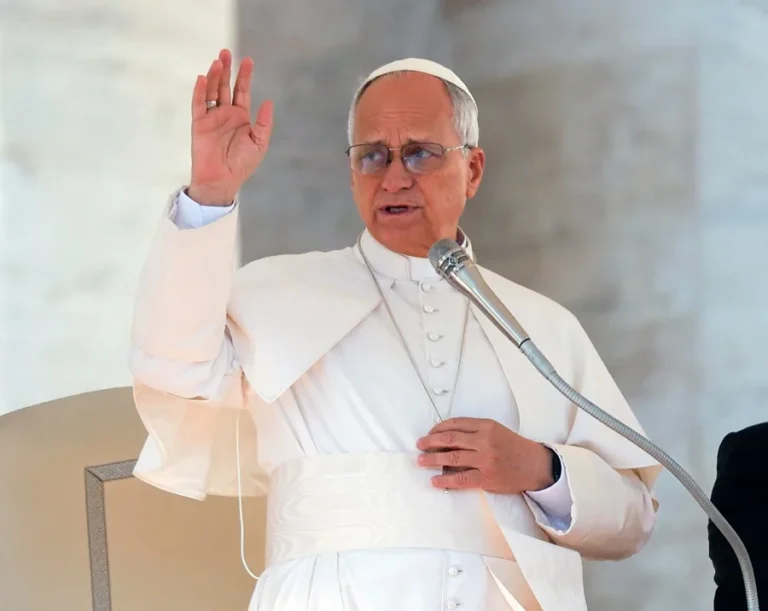
Pope Leo XIV 9/11 peace appeal urges forgiveness, diplomacy and reconciliation as he remembers victims of the attacks’ 25th anniversary amid global conflicts.
Related: Pope Leon XIV Ends Lebanon Visit with Mass Before More Than 150,000 in Beirut
Pope Leo XIV 9/11 Peace Appeal Calls for Global Reconciliation
The Pope Leo XIV 9/11 peace appeal was delivered on Sunday, September 13, during the Angelus prayer in St. Peter’s Square, where the pontiff remembered the victims of the terrorist attacks in the United States and called for forgiveness, reconciliation, and peace.
The appeal came two days after the 25th anniversary of the September 11, 2001 attacks. Pope Leo renewed prayers for those who died and for families and communities that continue to live with the consequences of violence.
Addressing approximately 15,000 faithful and pilgrims, the pope connected the memory of the attacks with his concern over the spread of wars, bombings, military interventions, and humanitarian crises in different parts of the world.
“Two days ago marked the twenty-fifth anniversary of the September 11th terrorist attacks in the United States of America,” Pope Leo said. “I renew my prayers for those who lost their lives and for those who continue to bear the wounds of that tragic day.”[vatican][usnews]
The attacks killed 2,977 people in New York, Washington, and Pennsylvania. The commemoration has traditionally focused on remembrance, mourning, and solidarity with survivors and relatives.
In his Angelus message, Pope Leo placed that historical memory within a broader appeal against the cycles of violence that continue to affect civilians across several regions.
“At a time when conflict and violence afflict so many of our brothers and sisters, I invite everyone to pray that the Lord will bestow his gift of peace upon the world,” he said.
The pontiff linked the anniversary to a moral responsibility to reject revenge and support efforts aimed at ending wars. He said the memory of September 11 should not be used to justify endless confrontation, but should inspire renewed efforts to prevent violence and protect human life.
The Vatican’s official transcript states that the memory of the tragedy should encourage a renewed commitment to peace, beginning with prayer and extending to concrete action.[vatican]
In his Angelus message, Pope Leo XIV reflects on the power of forgiving others like Christ has forgiven us in order to counter hatred, division and violence, and promote peace and love.https://t.co/Og2hbJ02lF
— Vatican News (@VaticanNews) September 13, 2026
Pope Leo XIV 9/11 Peace Appeal Centers on Forgiveness
Read the official Vatican transcript of Pope Leo XIV’s Angelus.
The Pope Leo XIV 9/11 peace appeal was closely connected to the Gospel reading of the day, in which Peter asks Jesus how many times he should forgive someone who has wronged him.
Jesus responds that forgiveness should extend beyond a limited number of times. Pope Leo explained that the biblical number seven symbolizes fullness, meaning that forgiveness should be offered without measure or fixed limit.
“Forgiveness is indispensable, and without it we cannot live in peace,” the pope said.
He warned that conflicts, accusations, resentment, and desires for revenge eventually emerge when forgiveness is absent. These emotions destroy relationships, divide families, and can ultimately generate wars.
The pope described forgiveness as a force capable of restoring light where moral and material suffering has darkened the future. He said it is not a sign of weakness but a necessary condition for rebuilding relationships and ending cycles of retaliation.
“Only forgiveness sets us free and restores the light,” he said. Pope Leo compared forgiveness to a gentle breeze that pushes away heavy clouds until the sun appears again.[catholicconnect][vaticannews]
The message addressed both personal relationships and international politics. Although the pope began with the Christian duty to forgive, he expanded the appeal to include societies, governments, and nations trapped in cycles of military confrontation.
He argued that reconciliation must be supported by dialogue and respect. In this framework, diplomacy is not merely a technical instrument but a moral obligation when civilian lives are at risk.
The pope also called on Catholics to ask the Virgin Mary, described as the Mother of Mercy, to help people forgive even when taking the first step is difficult.
He urged the faithful to spread “the serene and healing light of love that overcomes hatred and disarms all resentment.”
The message echoes previous calls from the Vatican to end armed conflicts, protect civilians, and open negotiations. Earlier in September, Pope Leo appealed for an end to violence and destruction in Ukraine and encouraged efforts to resume talks.[omnesmag]
The Pope Leo XIV 9/11 peace appeal therefore combines commemoration with a warning about the consequences of unresolved grievances. The message suggests that societies cannot build lasting peace if historical trauma is transformed into permanent hostility.
The appeal also reflects the pope’s broader emphasis on protecting vulnerable communities. In his statement, he referred to violence affecting people in different parts of the world and stressed that faith must translate into action on behalf of humanity.
For the Vatican, prayer is not presented as a substitute for political responsibility. Instead, it is described as the starting point for a commitment to peace, dialogue, humanitarian protection, and the defense of human dignity.
Geopolitical Context: Memory, War, and International Diplomacy
The Pope Leo XIV 9/11 peace appeal comes amid a period of intense international conflict, including wars and military confrontations in West Asia, Ukraine, Africa, and other regions.
The anniversary of the September 11 attacks has frequently been associated with the military campaigns launched by the United States in Afghanistan and Iraq. Those wars shaped international politics for more than two decades and contributed to continuing debates about counterterrorism, military intervention, civilian casualties, and the limits of state power.
By linking the anniversary to the need for peace, Pope Leo placed the memory of the attacks within a wider discussion about the consequences of retaliation and prolonged war.
The pope did not endorse a specific government’s position or identify particular conflicts in the Angelus message. However, his reference to the suffering caused by violence applies to civilians affected by bombings, occupation, displacement, sanctions, and military operations worldwide.
The appeal also reflects the Vatican’s traditional role as a diplomatic actor. The Holy See has repeatedly called for negotiations and humanitarian access in war zones while offering mediation, prisoner exchanges, and channels of communication.
Pope Leo’s emphasis on forgiveness may be especially significant in conflicts where each side presents itself as the victim of historical injustice. In such cases, political leaders often use past suffering to justify further military action.
The pope’s argument is that remembrance should protect the dignity of victims without becoming a basis for revenge. That distinction is central to international reconciliation efforts, including truth commissions, peace agreements, reparations, and transitional justice.
Forgiveness, however, does not remove the need for accountability. Human rights organizations and international courts maintain that peace must be accompanied by investigations into war crimes, protection for civilians, and guarantees that abuses will not be repeated.
The Pope Leo XIV 9/11 peace appeal can therefore be understood as a call for both moral reconciliation and political responsibility. Forgiveness may help societies move beyond hatred, but lasting peace also requires addressing the causes and consequences of violence.
The message also carries significance because Pope Leo is the first American pope. His reference to the September 11 attacks has a personal and national dimension, even though he presented the commemoration as a universal appeal for peace.
The pope was in Rome on September 11, 2001, attending a major gathering of his Augustinian religious order. His public remembrance on the 25th anniversary connects his own biography to one of the defining events of contemporary international history.[usnews][africanews]
At the same time, his call for peace places pressure on governments that invoke security concerns to justify military action. The appeal does not deny the threat posed by terrorism, but it warns against allowing fear and grief to become permanent sources of conflict.
For communities affected by war, the message may resonate as a call to protect life and reopen diplomatic channels. For families of the September 11 victims, it provides a religious expression of mourning and remembrance.
For policymakers, it reinforces the principle that security cannot be based only on military force. Without dialogue, justice, and attention to civilian suffering, military victories may leave behind new grievances and future violence.
The Pope Leo XIV 9/11 peace appeal concludes with a simple but demanding principle: peace requires more than the absence of fighting. It requires the difficult work of forgiving, listening, recognizing suffering, and refusing to turn memory into vengeance.
From teleSUR English via This RSS Feed.