

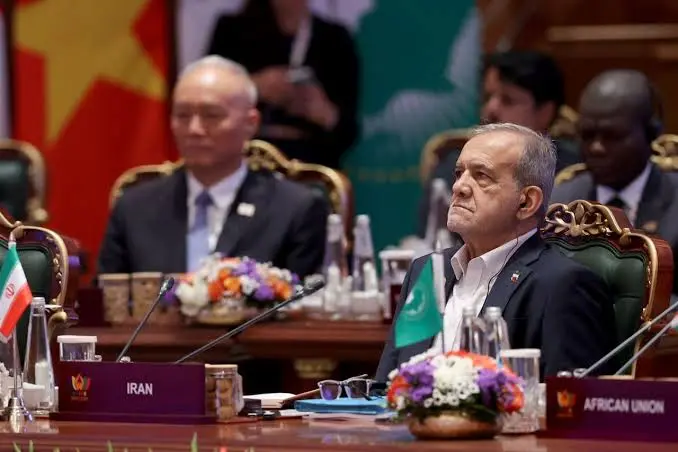
Iran BRICS state terrorism accusation: Pezeshkian condemns U.S.-Israeli attacks and warns over Hormuz as the bloc urges restraint, diplomacy and peace.
Related: BRICS Urges U.S. To End Cuba Blockade Over Humanitarian Toll
Iran BRICS State Terrorism Accusation Dominates New Delhi Summit
The Iran BRICS state terrorism accusation became one of the most forceful statements at the 18th BRICS Summit in New Delhi after Iranian President Masoud Pezeshkian accused the United States and Israel of carrying out state terrorism against civilian populations.
Speaking during an interview with India Today on Sunday, September 13, Pezeshkian criticized what he described as a double standard in the international campaign against terrorism.
He said Washington and Tel Aviv claim to be fighting terrorism while attacking civilians in Gaza, Lebanon, Syria, and Iran. According to the Iranian president, both powers enjoy impunity despite the scale of destruction caused by their military operations.
“They kill people very easily because of one person. They assassinate an entire family and destroy an entire building, and then say they have killed a terrorist,” Pezeshkian said.
He accused the United States and Israel of killing people at will and using advanced military technology to justify attacks on civilian targets.
“They are the real terrorists in the world,” Pezeshkian said in remarks reported by Indian media. He also described their conduct as state terrorism and argued that the international community applies different standards depending on which government is involved.
The Iranian president’s remarks came one day after BRICS leaders unanimously adopted the New Delhi Declaration 2026, which expressed deep concern over escalating tensions in West Asia and urged maximum restraint, dialogue, and diplomacy.
Although the declaration did not name the United States or Israel, it condemned attacks on civilian infrastructure and peaceful nuclear facilities. It also opposed unilateral coercive measures and called for respect for national sovereignty and territorial integrity.[indiatoday][iranintl][aljazeera]
Pezeshkian argued that the attacks by Washington and Tel Aviv were not isolated incidents but part of a broader regional pattern.
He referred to what he described as the destruction of homes, schools, hospitals, and essential infrastructure. He said that labeling victims as terrorists after attacks does not make the operations legitimate.
The Iranian government has repeatedly accused Israel and the United States of violating international law. Washington and Tel Aviv reject those accusations and maintain that their military operations are directed against armed groups and threats to national security.
Iran BRICS State Terrorism Accusation and Strait of Hormuz Tensions
Read about the IRGC warning over U.S. control claims in the Strait of Hormuz.
Alongside the Iran BRICS state terrorism accusation, the Islamic Revolutionary Guard Corps reinforced Tehran’s claim to exercise sovereign control over the Persian Gulf, the Strait of Hormuz, and the Gulf of Oman.
Colonel Ali Mohammadi, political affairs deputy of the IRGC Navy, challenged U.S. President Donald Trump’s claim that Washington controls the strategic waterway.
“Trump has claimed in his media propaganda that the Strait of Hormuz is under U.S. control. If that is the case, go ahead and bring one of your warships within 100 kilometers,” Mohammadi said, according to the semi-official Fars news agency.
The Iranian military official warned that any U.S. vessel entering the area could face a strong response. He said the IRGC Navy maintains continuous surveillance over the waterway and monitors ships traveling from Kuwait and Bahrain.
Mohammadi also claimed that no U.S. military forces or equipment are currently deployed directly in the Strait of Hormuz, the Persian Gulf, or the Gulf of Oman. He attributed that situation to preventive operations carried out by Iran’s armed forces.
The United States has not accepted Iran’s claim that Tehran has exclusive authority over the waterway. Washington has long argued that maritime navigation through the Strait of Hormuz must remain open in accordance with international law.
The dispute has become more serious following reports of attacks and disruptions involving commercial vessels. One incident near Qeshm Island reportedly left one person dead and several others injured after a ship caught fire following a projectile strike. Iran and the United States have offered competing accounts of the incident.[aa.com][turkiyetoday][tribune.com]
The Strait of Hormuz connects the Persian Gulf with the Gulf of Oman and the Arabian Sea. It is one of the world’s most important energy routes, carrying a significant share of global oil and gas shipments.
Any prolonged disruption could affect energy prices, insurance premiums, shipping routes, and food-import costs. It could also increase pressure on governments in Asia and Europe that depend on energy supplies transported through the waterway.
During the BRICS summit, Indian Prime Minister Narendra Modi raised concerns about freedom of navigation and the safety of commercial crews in the Strait of Hormuz during talks with Pezeshkian.
India has maintained that disputes should be resolved through dialogue while emphasizing the need to protect commercial shipping and seafarers. New Delhi therefore faces the difficult task of balancing its growing energy and strategic ties with Iran against its relations with the United States and Gulf countries.
Iran has linked the normalization of maritime traffic to the fulfillment of several conditions. Tehran demands an immediate end to military attacks against Iran and its regional allies, the withdrawal of U.S. troops from the Middle East, and the lifting of what it calls illegal unilateral sanctions.
Iran also wants its frozen foreign assets released and compensation paid for damage caused by military aggression. These demands go far beyond the immediate question of navigation and indicate that Tehran views the maritime dispute as part of a wider confrontation with Washington and Tel Aviv.
The Iranian position also includes demands for the removal of any naval blockade and guarantees against further military action. Iranian officials say these conditions are necessary to restore what they describe as a stable regional security environment.
Resistance Groups, BRICS Diplomacy, and Global Power
See the BRICS New Delhi Declaration on West Asia, trade, and energy.
The Iran BRICS state terrorism accusation was presented within a broader narrative of resistance to Western military dominance.
Mohammadi praised regional movements including Hamas in Palestine, Hezbollah in Lebanon, and Ansarolá in Yemen. He described them as liberation movements that have challenged the balance of power and increased political awareness across the Global South.
The United States, Israel, and several European governments classify Hamas and Hezbollah as terrorist organizations. Iran and its allies describe them as resistance movements opposing occupation and foreign intervention.
This difference in terminology reflects a fundamental divide over the political and legal meaning of armed resistance in Palestine, Lebanon, Yemen, and other parts of the region.
The BRICS declaration adopted in New Delhi avoided directly endorsing the positions of any one member. Instead, it called for restraint, the protection of civilians, respect for sovereignty, and peaceful dispute resolution.
The declaration also opposed forced displacement of Palestinians and changes to the geography or demographic composition of occupied Palestinian territory. It called for an end to Israeli violence in Gaza, support for the United Nations Relief and Works Agency for Palestine Refugees, and full UN membership for Palestine.[aljazeera][qazinform]
Iran’s statements nevertheless placed pressure on BRICS to address the military dimension of the West Asia crisis more directly. Tehran wants the bloc to condemn attacks on Iran and its allies, reject unilateral sanctions, and challenge the use of force by the United States and Israel.
Other members, particularly India and the United Arab Emirates, have favored language that preserves diplomatic flexibility. They support de-escalation and the protection of civilians but have avoided publicly adopting Iran’s full interpretation of the conflict.
The final declaration was reportedly achieved after intensive negotiations over differences involving Iran and the UAE. Its language allowed the bloc to criticize attacks on civilian and nuclear infrastructure without naming specific countries.
That compromise enabled Iran to endorse the document while allowing India to present the summit as a diplomatic success focused on dialogue and international law.
The Iran BRICS state terrorism accusation also reflects the transformation of BRICS into a larger political forum. The group now includes major energy producers, industrial powers, and countries from Asia, Africa, the Middle East, and Latin America.
Iran sees BRICS as a platform for challenging sanctions and advancing a multipolar international order. Tehran also wants to strengthen financial and trade mechanisms that are less dependent on U.S.-dominated institutions.
China and Russia have regularly rejected unilateral sanctions and criticized what they describe as Western interference in the affairs of sovereign states. India, Brazil, South Africa, and other members have supported reform of global institutions while preserving their own diplomatic relationships with Washington and Europe.
This mixture of shared opposition to unilateral pressure and differing national interests makes BRICS both influential and difficult to coordinate.
Desde la India, el presidente de Irán, Masoud Pezeshkian, sacudió la XVIII Cumbre de los BRICS al plantear una alternativa clara frente al hegemonismo:
Defensa intransigente de la Carta de la ONU y la soberanía de los Estados. arquitectura económica y financiera totalmente… pic.twitter.com/v7EaIjl3Y8
— teleSUR TV (@teleSURtv) September 12, 2026
Geopolitical Context: Energy Security and Multipolarity
The Iran BRICS state terrorism accusation has consequences far beyond the summit’s political statements because it connects the Gaza and Iran conflicts to global energy security, maritime trade, and international governance.
If tensions around the Strait of Hormuz continue, the effects could spread across global markets. Higher freight and insurance costs could affect oil, natural gas, food, and manufactured goods.
For Iran, control or restriction of maritime traffic is a tool of deterrence and a response to military pressure. For the United States and its allies, freedom of navigation is a central security principle and a condition for maintaining global trade routes.
The dispute also reveals a deeper confrontation over who has authority to define international security. Washington frames its operations as counterterrorism and protection of navigation. Tehran describes them as aggression, state terrorism, and attempts to impose foreign control over regional resources.
The BRICS summit provided Iran with an international platform to challenge the U.S.-Israeli narrative. Pezeshkian’s statements were made before an audience that included leaders from China, Russia, India, Brazil, South Africa, and the Gulf region.
The New Delhi Declaration did not endorse all of Tehran’s demands, but its references to civilian protection, nuclear facilities, sanctions, and peaceful diplomacy echoed several Iranian concerns.
The coming weeks will test whether BRICS can play a meaningful role in de-escalating the conflict. India has an interest in protecting energy supplies and maritime routes, China depends heavily on stable Gulf energy flows, and Russia seeks to expand its influence in a region where U.S. power is being challenged.
At the same time, Iran’s conditions for reopening or normalizing navigation appear difficult for Washington to accept. The demand for a complete U.S. military withdrawal from the Middle East, an end to sanctions, and financial compensation would require a major restructuring of regional relations.
The risk is that military rhetoric could continue to outpace diplomacy. A confrontation involving commercial ships or naval vessels could rapidly produce a wider crisis, especially if casualties occur or energy infrastructure is damaged.
For now, Iran is using both diplomatic and military messages. Pezeshkian delivered his accusations at BRICS, while the IRGC warned U.S. forces against approaching Hormuz.
Together, those messages portray Iran as defending national sovereignty, regional allies, and the principles of the Global South against what it calls Western domination.
Los países del BRICS adoptaron la Declaración de Delhi en su 18ª cumbre e instaron a los Estados emisores a eliminar las sanciones unilaterales y secundarias por ser ilegales frente al derecho internacional.
#BRICS #teleSUR #12Sep pic.twitter.com/aQr1SiNA3M
— teleSUR TV (@teleSURtv) September 12, 2026
From teleSUR English via This RSS Feed.