



Last week I gave two talks at Western Michigan University related to my forthcoming book (co-written with Bhaskar Sunkara and Mike Beggs), The Blueprint: How Socialism Can Work in the Real World. (Very quickly forthcoming—it comes out on September 29th!) The first was a public lecture at the WMU Ethics Center called “Is Capitalism the Best We Can Do?” That was recorded, and you can watch it here:
The next day, I gave a more academic talk at the Philosophy Department called “Moral Egalitarianism and Viable Socialism.” This is the transcript of that one, lightly edited for length and clarity.
Thank you so much for that introduction! It’s really amazing to be back here. As I mentioned last night, I graduated in 2005, and this is the first time I’ve set foot on campus since then. It feels more than a little strange to be here talking about socialism instead of, like, discussing the Kalam cosmological argument or the metaphysics of time with Quentin Smith or Arthur Falk. As it happens, my interest in socialism and Marxism considerably predated my interest in analytic philosophy, but during the part of my life when I was here, I honestly didn’t have much interest in crossing those streams. That came way later.
In fact, I remember Tim McGrew—not exactly ideologically aligned with me, but one of my all-time favorite professors!—giving me a ride somewhere in maybe 2004 and saying something like, “Ben, I know what your political views are, I’ve seen you wear a Che Guevara t-shirt, are you interested in political philosophy?” and I told him, no, not really, I keep those compartments pretty separate.
I think part of the reason I kept them separate for so long is that in contemporary analytic political philosophy, at least as I’d encountered it as an undergraduate and then as a graduate student, the leftmost point on the map of philosophical debate seemed to be taken up by Rawslian welfare-state liberalism, or perhaps by people criticizing Rawslianism in the name of various kinds of identity politics. The core concerns about how societies are organized on a fundamental economic level that had always shaped my politics just didn’t quite seem to be on the table for debate.
I think I first encountered the phrase “analytical Marxism” in 2009, when I read about the death of G.A. Cohen in a Leiter Reports blog post. And by then my philosophical interests were pretty settled. I was deep into writing a dissertation on the Liar Paradox and the philosophy of logic. Which, by the way, is a project that can be traced back to two classes I took at Western Michigan—Arthur Falk’s Aristotle seminar, where I wrote a paper about truth-value gaps as a solution to the sea battle problem, and a class from Marc Alspector-Kelly where he assigned Paul Horwich’s book Truth and Horwich’s approach drove me crazy. Marc gave me the best possible advice you can give to a graduate student about a reading they find frustrating, which is, and I quote, “Get mad and write a paper about it.” And then I got to Miami for my PhD program and I read Graham Priest’s book In Contradiction and I got so mad about that I wrote a whole dissertation about it. And throughout this whole time I still had some level of fealty to socialism as a political program, and even to some vague version of the Marxist theory of history, but it basically never occurred to me to philosophically explore any of it in an academic context. The only way my politics really mattered for my life was getting into a lot of arguments with my liberal friends at the bar about Obama and drones. What changed was the world around me. In 2015, after Bernie Sanders started running for president, socialism became politically relevant in a way that it just hadn’t been in the United States for at least several decades.
I joined DSA during at the end of 2015 and I watched it balloon into a vastly larger and more significant organization after the first Trump election. Little by little, my longstanding socialist politics became a vastly more important part of my life. Eventually, it slowly dawned on me that perhaps all this analytic philosophy training in taking arguments apart and putting them back together again could be put to some kind of public political use, which led to writing a strange sort of critical thinking manual for left-wing activists. And it also brought me, in the part of my life that was still spent doing analytic philosophy, to engage much more seriously than I ever had before with that tradition of “analytical Marxism,” a la the two books on the slide.
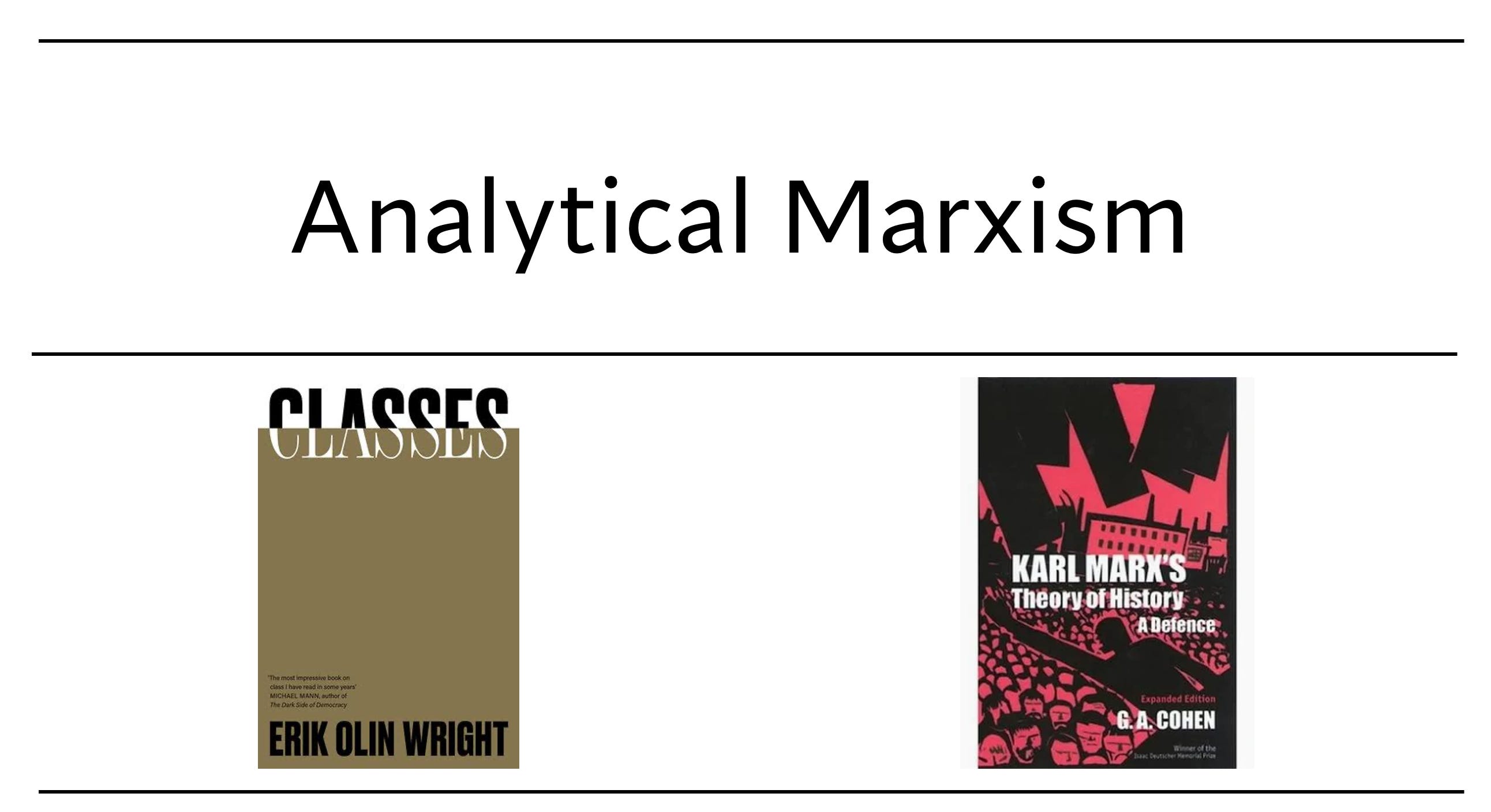
The first is one of several books about class analysis by the sociologist Erik Olin Wright. The second is G.A. Cohen’s classic defense of historical materialism. And if you read the Cohen book, in the introduction to the 2000 edition, he has this great discussion of what “analytical” Marxism is and how it’s different from other kinds of Marxist thought. And this is my own heavy paraphrase but I’d say that what the distinction boils down to is that to be an “analytical” Marxist is to reject the pretension of there being some kind of special “dialectical” method that gives Marxists a different way of discovering the truth than bourgeois philosophers and social scientists, and accepting that people who want to defend socialist and Marxist conclusions are down on all fours with everyone else, using the same methods of carefully disambiguating similar ideas, prodding arguments for logical holes, and examining the evidence for empirical premises as mainstream empirical sociologists, analytic philosophers, and so on. And I think that approach paid off pretty magnificently in books like these two, about in the first case how to think sociologically about class analysis, and in the second is to a great degree about how to think conceptually about what kinds of assumptions about causation are going on in Marxist claims about historical change. Those are important projects to me.
But the part that’s going to be relevant to this talk is that, in Cohen’s case in particular, he realized that committing yourself to helping along that process of historical change, being passionate about the class struggle to end capitalist domination and exploitation, was basically inexplicable without a core of moral commitment, and if some Marxists are in denial about that and want to insist that they care only about scientific analysis of what is and not moral commitment to what should be, they’re lying to themselves.
After reading Robert Nozick, who he said “awoke” him from his “dogmatic socialist slumber,” Cohen realized that socialist values required a rigorous philosophical defense. He dedicated himself to that over the course of many books, but I’ll just mention three here. Self-Ownership, Freedom, and Equality is an absolutely decisive brick-by-brick demolition of Nozicks’s case for libertarianism. Rescuing Justice and Equality criticizes Rawlsianism from the left. And his final book, Why Not Socialism?, which was being prepared for publication when he died, is by far the most accessible version of his normative case for socialism. You can read it in an hour or two, and it goes down easily, though I think the argument has a lot more depth than certain, ahem, careless readers have appreciated.
OK, but I want to back up, because a few minutes ago, I said something pretty careless myself. I used the phrase “Rawslian welfare-state liberalism.” And, sure, in some sense this is obviously a real thing. But in another sense, as we’re about to see, it’s a huge misnomer.
The sense in which it is clearly a real thing is that there exist any number of philosophers—some of them may be with us in the room right now!—who have basically Democratic Party-ish political views, they accept moderate mixed-economy capitalism as a pretty reasonable social arrangement, though perhaps they want a significantly more generous European-style welfare state than we have right now, and who, if you asked them to explain the normative foundations of their politics, would probably start talking about Rawls’s theory of justice as an obvious reference point.
So, let’s take just a moment to talk about that theory of justice. I’m not going to waste the time of a roomful of professional philosophers rehearsing the basics, it’s not like anyone here doesn’t already know what the veil of ignorance is, but I’ll just take two minutes or less to make sure the parts that are most salient to where I’m going are fresh in everyone’s memories.
Rawls thinks that agents trying to maximize their welfare from the Original Position, behind that Veil of Ignorance, would be generally hostile to material inequalities, for obvious reasons. You don’t want to design a world where all green-eyed people automatically make twice as much money as all brown- and blue-eyed people, for example, because for all you knows you’ll be born one of those blue-eyed unfortunates. More generally: Inequalities are guilty until proven innocent. But he thinks that some inequalities do indeed succeed in vindicating themselves.
They have to be attached to “fair equality of opportunity,” and the harder we think about that phrase, the more cans of worms we open, but whatever exactly it means it surely at least means that you can’t have things like eye-color discrimination. And that word “fair” is there to make clear that, for example, it’s not ok to have people who are technically legally equal but who have a much harder time making their way in the world and getting middle-class jobs because they grow up going to such under-funded, substandard schools. But as long as the better-off positions are available to all under conditions of “fair equality of opportunity,” Rawls thinks some inequalities might pass muster with agents in the Original Position if they pass the crucial Difference Principle test of benefiting the worst off. So, the rough but I hope not too simplistic way I always explain that last requirement to my students is that, even if you know from behind the Veil of Ignorance that you might end up holding the short end of the stick, you might still take your chances if you know the short end is still going to be longer than any of the equal-sized sticks available to you in a more egalitarian alternative arrangement.
And this certainly feels, on a vibes level, like a defense of moderate mixed-economy welfare-state capitalism on the Northern European model. It feels like the kind of thing defenders of the New Deal and the Great Society who were also Cold Warriors would say in explaining why they disagreed with, sure, the libertarian Right that didn’t care enough about fairness, but also the silly utopian Left who didn’t take economic efficiency seriously enough. We need capitalist processes to create the growth that lifts the floor for everyone, and we can do some tax-and-spend redistribution later to make it fairer. Trying to go beyond that combination is hopeless. Just look at Russia!
But here’s the thing. The sense in which “Rawslian welfare-state liberalism” is a huge misnomer is that Rawls himself wasn’t a welfare-state liberal! Or at least he certainly didn’t die as one. The degree to which that’s the impression of Rawls that lingers in philosophical academia, and certainly in the larger culture, seems to be downstream of the simple fact that even most people who have read at least one book by Rawls have also read only one book by Rawls, which is of course A Theory of Justice. And who could blame them? That one is already a doorstopper, it feels like the Bible of Rawlsian Liberalism, and frankly Rawls isn’t riveting enough on a sentence-by-sentence stylistic level that people who finish it are generally desperate to go out and find a couple hundred more pages of Rawls’s prose to devour.
But if you read the last book he wrote, which actually came out a couple years before I started up at Western Michigan, Justice as Fairness: A Restatement, in that one he explicitly rejects even the nicest most social-democratic forms of capitalism as involving an unacceptable level of economic and hence also political inequality. In that book, he considers five types of possible regimes for organizing an economy to see how each does, even in principle, in measuring up against his theory of justice. (a) Lasseiz-faire capitalism, (b) welfare-state capitalism, © Soviet-style authoritarian state socialism, (d) something called “property-owning democracy,” and (e) a form of socialism based on liberal democratic political institutions. He goes on to reject (a), (b), and ©, on various grounds. In particular, he rejects even welfare-state capitalism on the grounds that it permits “very large inequalities in the ownership” of productive assets and natural resources. So that leaves (d) and (e). It’s not entirely clear, or at least it isn’t to me, exactly what he had in mind for (d), but presumably you’d still have significant individual property in the means of production—without that, it’s not clear how it would be different from (e)—but you don’t have those “very large inequalities” in ownership he finds objectionable even in welfare-state capitalism, and hence you don’t have the inequalities he’s worried about in the fundamental distribution of power.
In principle, we can imagine an economy in which everyone is a small farmer or a small craftsman, so the means of production aren’t in any sense socialized, but also there aren’t significant class divisions at the heart of the system. Arguably there was a time in colonial America, for example, where at least some chunks of the country did look something like that, although even then lots didn’t, even outside of the slave-holding South. But if the entire economy being organized like that was ever on the table as a serious option for our society, that window of historical possibility closed a long time ago. In any high-tech modern economy, most work is going to be done by groups of people, and sometimes very large groups, working together. Even independent, non-chain grocery stores in what count as pretty small towns by the standards of the United States in the 21st century tend not to be like the classic “general store” that could be run by a single shopkeeper. They tend to be collective workplaces with a whole group of employees keeping the place running, sheets posted every week to keep track of people’s shifts, all of that. In the kind of world we live in, at the scale at which we live together at right now, becoming a society of small independent farmers and shopkeepers is just not on the table of empirical possibility. It would probably take something on the level of a thermonuclear exchange or the level of social collapse portrayed in zombie movies to make regressing to that a real option.
So, if Rawls is right that (d) and (e) would be just in a way that (a)-© would not be…and I’m right that (d) isn’t a real empirical option…then it sure sounds like justice demands fighting for (e)!
But this is a place where you could lodge an obvious objection. Why am I assuming that (e) is a serious possibility? Put differently, whether an economically viable and politically democratic form of socialism would be preferable to the status quo if we knew how to engineer such a thing might be an uninteresting question if the lesson you take from the twentieth century is that any attempt to go beyond capitalism is doomed to failure and any effort to remake the foundations of the economy in a fundamentally more egalitarian way is going to lead straight to bread lines, and from there to gulags because the bread lines will cause so much discontent, and from there the whole thing will inevitably collapse right back into capitalism. And as much as I’m hamming up that description, I honestly don’t think it’s that far off from the picture of this stuff that sits in a lot of people’s heads, which they’re expressing when they say, “Hey, what are you talking about with this socialism stuff in 2026? We tried it and it failed. We ran the experiment already. Move on.”
And look. As anyone who made it to the Ethics Center talk last night knows, I don’t at all deny that the Soviet model of economic planning was a failure in crucially important ways. (Basically: It was successful as a developmental project for peasant societies. But that’s a very different thing from working well enough to be a stable, long-term alternative to capitalism.) But what I would urge is that we see that failure as a specific historical event that happened for specific contingent reasons we can analyze at the level of nitty-gritty details, and not elevate the failure to the level of a kind of timeless fable about the folly of defying the economic laws of nature and trying to organize society in a different way. We can try to have an attitude more like that of scientists or engineers running actual literal experiments, who can try something, fail, analyze the failure, and see how they might toggle a variable on the next round.
So, in the talk last night, I suggested that one way to think about capitalism is as the conjunction of two kinds of economic relationships. You have a horizontal relationship of market competition between different units of production, and a vertical relationship of domination and exploitation of the working class within those units of production. Put differently, modern capitalism is a class society, which is what it has in common with previous modes of production like medieval feudalism and ancient slave societies, but it’s built out of market relationships in a different way. There were markets in medieval towns where even peasants might take a surplus they made but didn’t want to buy things they wanted but couldn’t make. And of course ancient slave-owners bought slaves from slave-traders, that’s a market transaction. But the kinds of labor exploitation that fundamentally organized these societies wasn’t market-based on the same way. Usually—not always, but usually—ancient slaves and medieval serfs were producing for the immediate consumption of their masters rather than producing for the market. If you read Capital Vol. 1, in Ch. 10 Marx makes an argument that you tend to get a far more intense degree of exploitation under capitalism, because unlike the ancient Roman aristocrat or a medieval lord, the capitalist who runs production in the modern era isn’t just trying to keep himself and his hangers-on living in luxury. He’s engaged in competitive accumulation. He has to worry that if he doesn’t extract enough profit from his workforce, he’ll be beaten by his competitors. That’s why the length of the working day under capitalism tends to be like a goldfish that expands according to the parameter of the bowl it lives in. Back in nineteenth century Massachusetts, a major early labor victory was limiting working hours specifically for children to no more than 12 hours a day. The 40-hour workweek for everyone was finally instituted by the Fair Labor Standards Act in 1938 and it hasn’t gone down one minutes since then. It’s not as if technological progress stopped in 1938, but 40 hours—not 39, not 39 and ½, but 40—is still the standard workweek today, because the regulatory state hasn’t stepped in since 1938 to force it to go any lower. And as we’ve seen throughout the history of capitalism (see Ch. 15 of Capital), and we’re maybe about to see in a big new way now in the era of rampant AI development, in any system where labor is separated from ownership, the incentive of owners for implementing labor-saving technology that cuts the human labor they need in half is never to halve everyone’s hours while keeping their incomes steady. It’s to either increase production if they think the market can bear more, or if they don’t think it can bear more, it’s to lay off half the work force and work the remaining half as hard as ever. The absolute worst combination, Marx notes, are hybrid regimes like slavery in the antebellum South where pre-capitalist forms of direct coercion of immediate producers were combined with the competitive pressures of the world market. Full-blown capitalism is a lot better than that. But even that is still very bad for the working class.
So, I argued last night, we have a dilemma. On the one hand, in-principle worries about information and calculation issues first raised by our ideological enemies but which turned out to be annoying prescient give us some reason to suspect that we don’t yet know how, in Cohen’s terminology in Why Not Socialism?, to “make the wheels turn” in a marketless economy, or at least we don’t know yet. Perhaps one day we’ll figure it out but no one has made a remotely convincing case that we’re there yet. On the other hand, the level of inequality baked into capitalism is morally indefensible. If you accept both premises, an obvious way out of the dilemma is to toggle the second variable while keeping the first in place.
And the new book that the event yesterday was previewing, it technically isn’t out for a few weeks but Verso was nice enough to send us some advance copies, is a 432-page attempt to motivate, explicate, and defend exactly that kind of economic model. Just to do the two minutes or less version here, we start where the high-water mark of Nordic-style social democracy leaves off, with a big welfare state directly providing several important goods outside of the market. Many decades of real-world beta-testing have told us that those goods can in fact be planned just fine by the state sector. We also put what socialists have called “the commanding heights” of the economy in the public sector, crucially including the banking system. And for sectors of the economy where we think market mechanisms are important for efficiently allocating capital goods and nimbly coordinating production with consumer preferences, we have a system of worker-owned firms that are financed by public banks in such a way that, at a first approximation, you can think of the means of production as owned by the public as a whole but rented out to collectives of workers, who are then evaluated for being re-upped in their public-bank grants on a single metric of financial performance. Wage benchmarks set by labor boards prevent the race to the bottom that some socialists call “self-exploitation.” (For the record, I don’t think this should actually count as a form of exploitation. But I do agree that it would be very bad.) Firm failure still exists. We think you need it to avoid some of the efficiencies that plagued not only the Soviet economy but even places like Yugoslavia that had implemented extensive market reforms but still had soft budget constraints keeping inefficient firms in place forever. But we don’t think the price of failure has to be destitution. You can fall back on an extensive safety net, and the public sector still plays an extensive role in trying to match-make former worker-members of failed firms with new cooperatives.
(Hey, I think I made it in two minutes or less!)
I’m very happy to argue in Q&A about whether this is a plausible model of a post-capitalist economy. The next few months of my life are going to be all about defending this model so honestly you’ll be doing me a favor if you help prep me for that by throwing hard objections at me. But for the remainder of the talk I’m going to focus just on the in-principle question of the extent to which what the model describes is a just society, and how we should think about the gap between this and perfect justice where it falls short.
In both talks I’ve emphasized the moral importance of equality as a reason to reject capitalism and embrace socialism. And an obvious worry you might have hear is that, if we have to allow some market competition into our model of socialism in order to make it plausible that it would be economically viable, that model might itself be vulnerable to egalitarian objections. After all, even if the units of production are worker-owned and internally democratic, markets by their nature create winners and losers. So, let’s think about different possible sources of inequality that our left in this model.
The most important source of inequality in capitalist societies is class inequality between workers and capitalists. By definition, that one’s gone here.
There’s also inequality between more and less profitable sectors of the economy. There’s an awful lot that can and should be done to smooth out those differences in this model, though. To start with, we have all the tax-and-transfer tools of social democratic states under capitalism, which we’re optimistic could be far more easily and effectively implemented in an environment where wealthy capitalists could no longer put a thumb on the scale of the political process. Also, we can set things up so that payments the firms have to make to the public banks that finance them can vary between sectors.
There are, however, a couple of other sources of inequality that might be more persistent. The inequalities between better- and worse-performing firms within a single industry would be limited by the wage benchmarks and other tools we describe, certainly, but they would still be real. In fact, they had better be, or we’re not going to get the benefits of introducing market mechanisms into the model. You don’t have much of an incentive to do a better job of responding to consumer demand than other firms if you prosper as much as those other firms even if you don’t. So, if those incentives are going to stay in place, there’s a limit to how much we want to redistribute away those inter-firm inequalities. And finally, there are intra-firm inequalities. Within a worker-owned cooperative, you’re not going to get some people being paid hundreds of times what others do like you get in capitalist corporations. But you also aren’t going to get completely flat wage scales, for a few reasons.
For one thing, you might have to entice people with higher wages to take particularly dirty and dangerous jobs no one would otherwise want. Under capitalism, the mechanism for filling those jobs is the sheer desperation of that portion of the workforce. No one whose mom or dad is a philosophy professor, never mind a corporate lawyer, never mind genuinely wealthy, ends up working at a meat processing plant. But meat processing plants still find a steady stream of volunteers because lots of people are in financial circumstances where they’ll take whatever work they can get. In a more egalitarian society, you might have to pay people a lot more money to clean toilets than you’d have to pay them to be a philosophy professor. And on the other end, there are jobs that involve lots of stress and responsibility, or that require forms of training that simply wouldn’t be worth it without the promise of a higher salary. (Sadly, the state of the academic job market, and the willingness of so many philosophers to work as adjuncts, suggests that getting a Ph.D. in philosophy is not like this!)
So, how unjust are these remaining forms of inequality? If we go back to Justice as Fairness: A Restatement, Rawls himself seems to imagine “liberal democratic socialism” as some form of market socialism. Inequalities between more and less successful firms might well pass his tests, in so far as you need them to create a flourishing economy that raises the floor for everyone. And *Blueprint-*style socialism certainly shores up the position of that floor, and shrinks the distance between floor and ceiling, much more than even the nicest and most social-democratic form of capitalism would be able to.
It also seems to me that whatever intra-firm inequalities you get under conditions of workplace democracy, where the workforce gets to vote on wage scales, are going to at least roughly coincide with inequalities that pass a firm-specific version of Rawls’s Difference Principle test. If you can get a majority of your fellow worker-members to vote to pay you more, and hence each of them a little bit less, that’s probably because you’ve made a convincing case that they’ll be better off than they would be if the firm were deprived of your contributions. That’s a very different situation than one where capitalists can use their structural position of power within firms to simply take an enormous share of the proceeds. You wouldn’t get that under circumstances of economic democracy. If Amazon were a worker cooperative, if you came to the annual meeting to discuss wage scales before everyone voted on the next operating agreement—think like a union contract, but unilateral, no boss on the other end of the negotiating table—and you said, “hey, guys, I’ve been thinking about it, and this whole thing was Jeff’s idea, so I think he should get the biggest share, in fact not just the biggest share but so much more than the rest of us that he’ll be able to literally afford his own spaceship,” I don’t think you’d win that vote.
So far, we’re in the clear. But perhaps you’re not convinced by Rawls. Perhaps you’re convinced by the criticisms of the Rawslian view made by Cohen, which I alluded to earlier. I won’t rehearse those criticisms here, never mind try to adjudicate whose right, in the limited amount of time we have today, but I do want to at least make sure everyone has a good sense of Cohen’s own view of egalitarian justice and the respects in which it’s more stringent than Rawls’s theory, and then see what follows if we just go ahead and assume for the sake of argument that Cohen is right and Rawls is wrong.
I said a couple times earlier than Rawls’s notion of “fair equality of opportunity” sounds clear when you first hear it but that the harder you think about it the less clear it gets. The way Cohen lays it out in Why Not Socialism? is that there are at least three ways you could think about equal opportunity.
“Bourgeois” equality of opportunity means that there are no legal impediments to people at the bottom climbing upward through the distributive hierarchy. This is, on some level, the kind of thing Anatole France was rolling his eyes at when he said that “[t]he law, in its majestic equality, forbids rich and poor alike to sleep under bridges, to beg in the streets, and to steal their bread.” But also, let’s not sneer at it too much. To the imperfect and uneven extent that this kind of equality has been achieved, that’s absolutely the most important bit of progress in all of human history so far. Achieving this kind of equality is what differentiates South Africa today from apartheid South Africa in the 1980s. It’s what differentiates modern liberal capitalism from medieval feudalism. It matters, a lot.
Even so, those “Rawlsian welfare-state liberals” I talked about earlier feel the tug of the Anatole France point, that this isn’t a substantive enough kind of equal opportunity to count as fair equality of opportunity, and that gets to what Cohen calls “left-liberal equality of opportunity,” where we worry not just about formal institutional impediments to the worse-off rising in the world but also social impediments. He gives the example of Head Start programs that provide no-cost early education and health and nutritional assistance to children from low-income families to try to ameliorate some of those early-in-life disadvantages, as an attempt to move toward this kind of equality of opportunity.
But Cohen thinks even this conception of equality of opportunity doesn’t fully get to the nub of the matter. He advocates what he calls “socialist equality of opportunity.” This is the principle that says that inequalities are unjust if they’re outside of the control of whoever gets the short end of the stick. That’s a plausible theory of why on a fundamental moral level we find racial discrimination and gender discrimination and feudal systems where different people have different rights and obligations depending on arbitrary facts of their birth so odious. These are all inequalities that don’t trace back in any way to anything that the person at the bottom end of the inequality have a say about.
In far less popularly accessible contexts, like in the essays in his collection On the Equality of Egalitarian Justice, Cohen calls socialist equality of opportunity by its more technical name “luck-egalitarianism,” and it’s his answer to long-running debates among egalitarian philosophers about what it is we should be trying to equalize. Absolute distribution of resources? Happiness? What? Cohen thinks we should be trying to equalize “access to advantage.” It’s one thing to have less because you aren’t willing to contribute as much. It’s quite another to be assigned the short end of the stick against your will.
The reason that in Why Not Socialism?, he calls this “socialist” equality of opportunity is that this kind of demanding egalitarianism is pretty obviously incompatible with capitalist property relations. A basic feature of the property rights regimes that are integral to any form of capitalism that’s ever existed, for example, is the right of inheritance, which means that Person A can inherit a factory from his father like a medieval king inheriting his throne, while due to nothing but that difference in genetic luck between him and A, Person B might grow up in circumstances such that he’s grateful to even get a job at that factory. Meanwhile, due to a different kind of difference in genetic luck, Person C might grow up just as poor as Person B but be better positioned to climb the educational and career ladders that lead into the professional-managerial middle classes, just because of different starting points in terms of unevenly distributed natural talents.
The idea that there’s an injustice in the inequality between B and C might be less intuitive than idea that there’s injustice in the inequality between A and B, because our whole society is soaking in meritocratic ideology. Even our progressive liberals tend to care about removing identity-based barriers to the best and brightest from each group meritocratically climbing to the top than questioning the justice of the ladder itself. But the point might become clearer when we remember that, given the same difference in starting points in natural talents, in a different set of social circumstances Person A’s unchosen advantages might serve A better than B’s unchosen advantages would serve B. In a society where the only form of upward mobility was winning a spot in the ruling warrior caste by trial by combat, for example, the skills that help some poor kids to become doctors and lawyers and philosophy professors in advanced corporate capitalist societies would be completely unhelpful, whereas in the society we actually live in, outside of certain vanishingly rare athletic contexts, physical strength doesn’t do much to help you be upwardly mobile.
So, where Rawls and Cohen really diverge, is that Rawls identifies justice with whatever set of basic institutional arrangements agents would sign off on in the Original Position. That means that if they would decide that they’d be better off by allowing through some Difference Principle-tolerated inequalities, there’s nothing unjust about the result. Cohen defines justice by equality of access to advantage, so in so far as some Difference Principle-tolerable inequalities materially reward some people over others for unchosen advantages, he thinks this involves some measure of injustice.
Where things get more complicated is that Cohen doesn’t say that he would never support any economic system that’s even slightly unjust in this way. He thinks that egalitarian justice is one extraordinarily important value. It’s clearly the one that gets him in particular up in the morning! But, he doesn’t think it’s the only value that matters. And he acknowledges that real history and real politics often necessarily involves messy tradeoffs. Sometimes a reasonable moral tradeoff can even involve sacrificing some degree of egalitarian justice to avoid unacceptable losses of economic efficiency. If the floor is in danger of being set too low, we might have swallow some degree of injustice in terms of the gap between the floor and the ceiling.
But one way of understanding his disagreement with Rawls, or at least the aspect of that difference we’ve been discussing (Cohen makes a lot of criticisms of Rawls!) is that Cohen doesn’t want to define our terms in a way that he thinks would obscure the moral substance of that tradeoff between competing values. Even if in some circumstances we have to accept some degree of injustice to “make the wheels turn,” Cohen wants us to keep our eyes on the North Star of full socialist equality of opportunity. He wants to acknowledge that we are swallowing some degree of injustice, and to keep looking for ways to move closer to that North Star whenever we figure out how to do so. And if you buy Cohen’s argument then yes, we should be dissatisfied with some of the inter-firm and intra-firm inequalities that I’ve suggested can’t be completely eliminated in the Blueprint model of socialism. The amounts of inequality involved are tiny compared to, say, average CEO-to-worker inequalities under advanced corporate capitalism. But there’s still some injustice there on a Cohenian conception.
So, again, accepting for the sake of argument that Cohen is right about all of this, market socialism of the Blueprint variety is a giant leap forward in the direction of that luck-egalitarian ideal, but it doesn’t yet make it all the way there. And so, what Cohen himself says in a few places, in Why Not Socialism?, certainly, and even fifteen years earlier in a New Left Review article called “Back to Socialist Basics,” is that (i) working through models for how at least market socialism could work is a worthwhile project, but (ii) we shouldn’t confuse it with the North Star of full justice. And, on some level, I could just leave it there. As someone who very deeply loves Cohen’s work, I’ve shown my permission slip from the man himself to think The Blueprint was a good book for me and Mike and Bhaskar to have spent a lot of the last six years of our lives working on writing and revising. But I’m a little greedy. I want more than that. Even accepting that Cohen is right about all this, I want to show that moving toward a post-capitalist society, even one that doesn’t dispense with markets entirely, isn’t just something that people who subscribe to more demanding forms of egalitarianism than Rawls’s should commend as a step in the right general direction. It’s something they should be extremely excited about.
And what the intuition I’m trying to express gets down to, I think, is that inequalities stemming from fundamental class divisions strike me as a particularly morally significant kind of inequality to me. And since I still think of this campus as a place to explore interesting, unsolved philosophical problems, I’ll just frankly acknowledge my uncertainty here about how to unpack that claim of special significance. One way of doing it would be to rehearse the straightforward empirical case I made last night that, if you want to diminish inequality in the distribution of consumption, tackling inequality in control of the means of production is an especially efficacious way to do that. It’s not as if there are a lot of ways of building up hundreds of billions of dollars in personal wealth that don’t route through private ownership of capital! But to be honest I don’t think that just saying that and leaving it at that really captures the point I want to make here. Even aside from its impact on income equality, there seems to be something especially morally significant about inequality in economic power.
And I’m saying all of this with the uncomfortable awareness of two things. First, any time we’re talking about one kind of injustice being “worse” than other, we’re either making a quantitative claim—the kind we’re making, for example, if we go into the utility calculus and just determine that the consequences are worse—or we’re making a qualitative one. And, second, unpacking the qualitative version of the claim can be awfully tricky. What does “qualitatively worse” actually mean? You can talk, if you like, about “weighing” the badness of one kind of injustice against another, but that metaphor clarifies very little (especially since, whatever might be true about metaphorical moral “weight,” literal weight is very much quantifiable). Similarly, some philosophers like to talk about “levels” when they’re trying to make qualitative distinctions. And it can certainly feel like I know what you’re saying if you say that one injustice is objectionable “on a deeper level” than another. But don’t ask me to explain exactly what you mean.
Perhaps someone can suggest a better way of thinking about all of this when we get to the Q&A. For now, I’ll just say that, just like murder does seem to be in some sense qualitatively worse than lying, basic structural disparities in economic power seem worse in principle to me than the kind of disparities in income and consumption that won’t completely go away (even if they would be very dramatically reduced) under Blueprint-style socialism. And in a shameless attempt to milk that intuition, I’ll just reference a quote made famous by Mark Fischer’s book “Capitalist Realism.” He says there that he isn’t sure if Fredric Jameson or Slavoj Žižek said it first. But at any rate, what they both said is that it’s “easier to imagine the end of the world than the end of capitalism.”
Let’s think a little harder about that quote. Surely, it’s not such a massive challenge to imagine regressing to something like feudalism, perhaps after a nuclear or ecological catastrophe. That exact scenario is the premise of enough science fiction novels for me to think imagining that doesn’t strain most of our imaginations too badly. The really hard imaginative leap isn’t about returning from one form of class society to another. It’s about progressing from capitalism to a society that isn’t shaped by the basic structural inequalities between producers and exploiters that have structured most human societies for thousands of years. That’s the injustice that’s seeped so deeply into our bones that we have trouble even imagining ending it. And I can’t help but think that ending it would be an awfully big deal.
Philosophy for the People w/Ben Burgis is a reader-supported publication. To receive new posts and support my work, consider becoming a free or paid subscriber.
From Philosophy for the People w/Ben Burgis via This RSS Feed.
Long way to go to say “market socialism”, but I’m glad I went along for the journey.
Equality of luck (or access to advantage) is a good clarifying lens for calling out the problems with simple “equal opportunity”.