

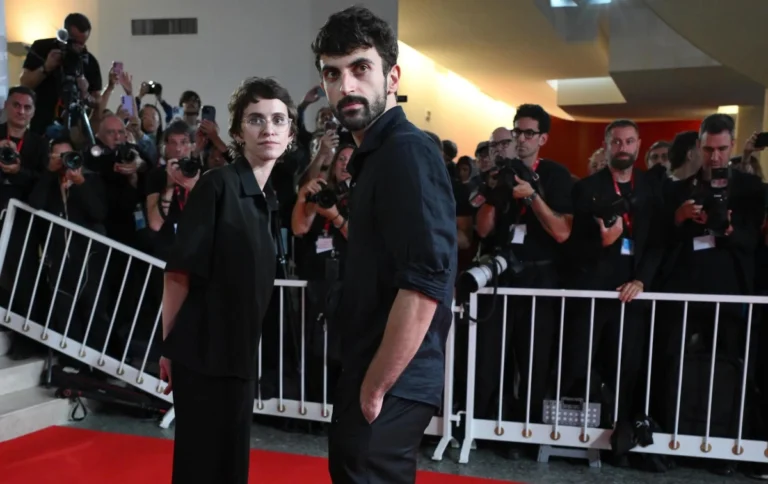
NAZA Gaza documentary wins Venice’s Special Jury Prize after a record 25-minute ovation, exposing alleged systems behind mass civilian deaths in Gaza.
Related: Venice Festival: Israeli Filmmakers Reveal Zionist Crimes in Gaza
NAZA Gaza Documentary Wins Special Jury Prize in Venice
The NAZA Gaza documentary won the Special Jury Prize at the 83rd Venice International Film Festival on Saturday, September 12, after its directors, Israeli filmmakers Yuval Abraham and Rachel Szor, presented an investigation into the systems and procedures used during Israel’s military operations in Gaza.
The 80-minute film examines what its creators describe as a systematic strategy behind the mass killing of Palestinian civilians. It draws on testimony from 24 Israeli soldiers and intelligence personnel who participated in military operations against the besieged enclave.
The witnesses appear anonymously. Their identities are concealed, their faces and voices were altered, and many of the interviews were filmed at night on rooftops in Tel Aviv.
At the award ceremony, Abraham paid tribute to the Palestinian journalists who documented the war from inside Gaza. He said their reporting had made the reality of the conflict known from the beginning, despite the killings of more than 200 Palestinian journalists, according to the filmmakers and Palestinian media organizations.
“This truth was documented and known from the first day thanks to Palestinian journalists,” Abraham said. “Their voices were silenced and denied.”
He argued that denying a crime helps allow it to continue. For that reason, he said it was important for Israelis to watch the film because “our country is committing these crimes.”
Abraham also criticized the role of the United States, urging American audiences to see the documentary because their government is “financing a large part of the massacres.”
The film received a standing ovation lasting approximately 25 minutes, reportedly the longest in the history of the Venice festival. It had been considered a strong contender for the Golden Lion after its premiere, where the audience applauded the directors for an extended period.[i24news][cbc][reuters]
The NAZA Gaza documentary was added to the festival lineup only one week before the event began. It was the sole documentary competing in the main race for the Golden Lion.
NAZA Gaza Documentary Examines Military Targeting Systems
Read The Guardian’s report on the systems examined in NAZA.
The title NAZA refers to a term reportedly used by Israeli military commanders and intelligence personnel to describe the expected number of “collateral casualties” associated with an attack.
The documentary’s central argument is that civilian deaths were not always unintended consequences of military operations. Instead, the filmmakers say, the testimony points to a system in which expected civilian casualties were incorporated into decisions about targets and strikes.
The 24 sources describe surveillance systems, target selection, remote operations, and procedures for approving attacks in which large numbers of civilians were expected to die.
One testimony comes from the creator of a system that uses algorithms and artificial intelligence to determine where people are concentrated inside a building targeted by Israeli weapons.
The film does not simply present the technology as a neutral tool. It examines how automated or semi-automated systems may be used in decisions involving human life, particularly when military personnel operate remotely and have limited direct knowledge of the people in a target area.
The filmmakers say they spent nearly three years collecting the interviews. The project was produced by The Guardian and James Wilson, with Abraham and Szor working as two of the four directors of No Other Land, which won the Academy Award for Best Documentary in 2025.
The directors’ previous film focused on Israeli settler violence and the destruction of Palestinian communities in the occupied West Bank. NAZA shifts the focus to Gaza and the internal testimony of Israeli military and intelligence personnel.
The documentary’s testimony is presented as an investigation, not as a judicial ruling. Its allegations are disputed by Israeli officials and the Israel Defense Forces, which has rejected the claim that its military policy deliberately targets civilians.
The IDF has also denied the film’s central allegation that civilian deaths are knowingly incorporated into the conduct of military operations. The filmmakers maintain that the accounts gathered from former and current insiders show a consistent pattern that requires independent investigation.[reuters][timesofisrael][worldisraelnews]
The NAZA Gaza documentary places particular emphasis on the distance between those who make targeting decisions and the civilians exposed to the attacks. The interviews were conducted with people involved in surveillance and intelligence work, including personnel whose activities were carried out remotely.
That structure raises questions about responsibility in modern warfare. When artificial intelligence, databases, and predictive systems help identify targets, responsibility can become divided among commanders, analysts, software designers, and operators.
The film argues that technological language can also obscure the human consequences of military decisions. Terms such as “collateral damage,” the directors say, can turn the deaths of civilians into abstract calculations.
Abraham said the documentary was created to challenge that process of dehumanization. “With NAZA, we wanted to show how this mass killing is systemic, not the result of an accident, but of a deliberate plan based on the total dehumanization of Palestinians,” he said.
The film’s presentation in Venice generated an immediate political response. Supporters viewed it as an important act of testimony, while critics accused the directors of adopting a one-sided interpretation of Israel’s military campaign.
The festival’s recognition gives the documentary international visibility and may increase pressure for broadcasters, distributors, journalists, and rights organizations to examine its allegations.
Geopolitical Context: Cinema, Accountability, and the Gaza War
The NAZA Gaza documentary arrives as international legal and political disputes over Israel’s military operations in Gaza continue. The film’s release adds a cultural dimension to debates already taking place before the International Criminal Court, the International Court of Justice, the United Nations, and national courts in several countries.
Its directors use the testimony of Israeli insiders to challenge official accounts and argue that the destruction of Gaza must be understood as a structured policy rather than a series of isolated battlefield mistakes.
The film’s claims appear amid a conflict that has killed more than 70,000 Palestinians since October 2023, according to figures cited in the original report. The toll includes thousands of children and has been accompanied by widespread destruction of homes, hospitals, schools, places of worship, and civilian infrastructure.
The killing of journalists is a particularly important part of the documentary’s political message. Palestinian reporters have played a central role in documenting the war, often working without reliable communications, protective equipment, or access to safe locations.
Abraham’s statement at Venice emphasized that the international public learned about events in Gaza largely through Palestinian journalists. His remarks also reflected the broader concern that the deaths of reporters can weaken accountability by removing witnesses from the scene.
The documentary’s criticism of the United States has wider geopolitical implications. Washington has provided Israel with military, financial, and diplomatic support, while repeatedly defending Israel’s right to security and its military operations.
The United States has also faced criticism for blocking or opposing international measures directed at Israel. As a result, the film’s argument that U.S. support contributes to civilian deaths speaks directly to disputes over responsibility and complicity.
The NAZA Gaza documentary also follows another Gaza-related film recognized in Venice. The Voice of Hind Rajab won the Silver Lion the previous year and portrayed the death of six-year-old Hind Rajab, who was trapped in a vehicle after Israeli forces attacked her family’s car.
According to the film’s account, Hind survived the initial attack, called for help, and was later killed before rescuers could reach her. The case became an international symbol of the vulnerability of Palestinian children and the dangers faced by emergency workers attempting to reach them.
Together, the two films show how cinema has become part of the global struggle over memory, evidence, and accountability. They transform individual testimonies and recorded events into narratives that can reach audiences beyond diplomatic statements and official military briefings.
The award also reveals divisions within Israel. Abraham and Szor are Israeli filmmakers who are using testimony from Israeli sources to criticize the actions of their own government and military.
That position may expose them to political pressure, public attacks, or attempts to discredit their work. At the same time, their Israeli identity gives the documentary particular significance because it challenges the idea that criticism of military conduct comes only from external or hostile sources.
The Venice prize does not establish criminal responsibility, but it gives the film a prominent international platform. The evidence cited in the documentary will now face further public scrutiny, including questions about the identity of the witnesses, the authenticity of their testimony, the operation of the systems described, and the legal framework surrounding their use.
For the filmmakers, however, the purpose is not limited to winning an award. Abraham said the central objective was to make clear that mass civilian deaths should not be treated as unavoidable or accidental when systems and decisions may have made them foreseeable.
The award therefore represents both a cultural recognition and a political intervention. The NAZA Gaza documentary asks audiences to examine how technology, military doctrine, political language, and international support can combine to normalize civilian suffering.
From teleSUR English via This RSS Feed.