

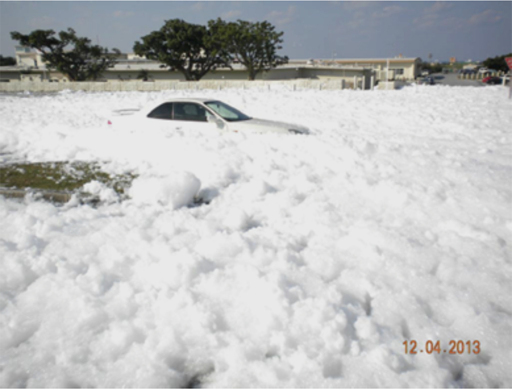
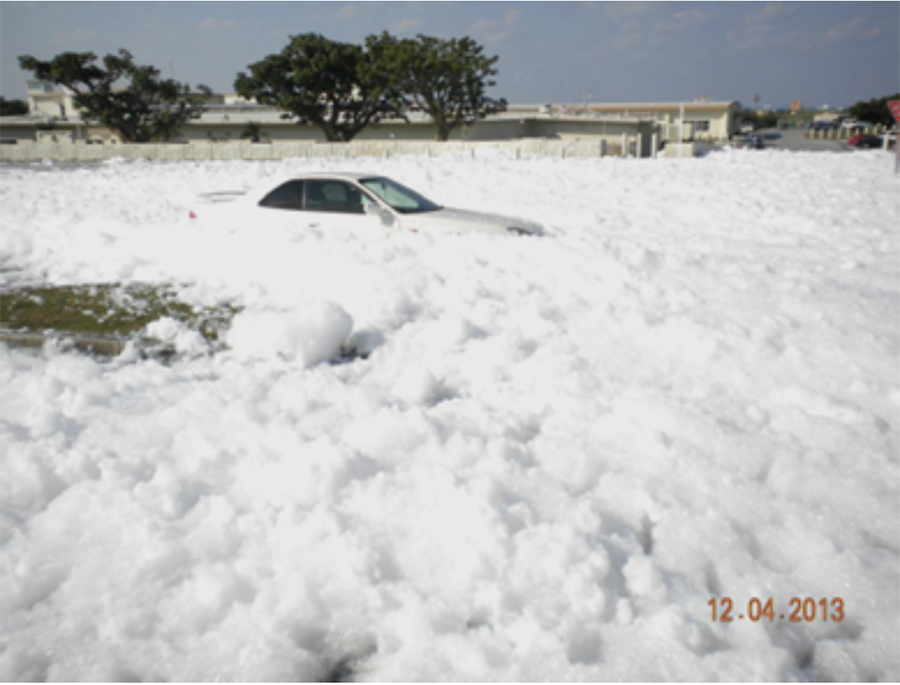
Carcinogenic aqueous film-forming foam at US Kadena Air Base coats the parking lot after an overhead sprinkler system in a hangar accidentally discharged on December 4, 2013.
By Pat Elder, Military Poisons, September 13, 2026
Independent water testing around U.S. military installations in Okinawa has exposed a specific chemical signature—a 3M fingerprint—that strips away the Pentagon’s shield of plausible deniability. For years, the United States military and the Japanese central government have deflected requests from Okinawa Prefecture for on-base environmental inspections, citing a lack of causal evidence linking the bases to localized PFAS contamination. However, explosive reporting from the Asahi Shimbun recently revealed that U.S. officials had privately admitted to Tokyo as early as 2023 that aqueous film-forming foam (AFFF) used at Kadena Air Base and Marine Corps Air Station Futenma was the likely source of pollution.
While governments actively concealed this admission from the public, definitive water testing from outside the base fences has cracked the case wide open, tracing the contamination directly back to legacy 3M electrochemical-fluorination chemistry.
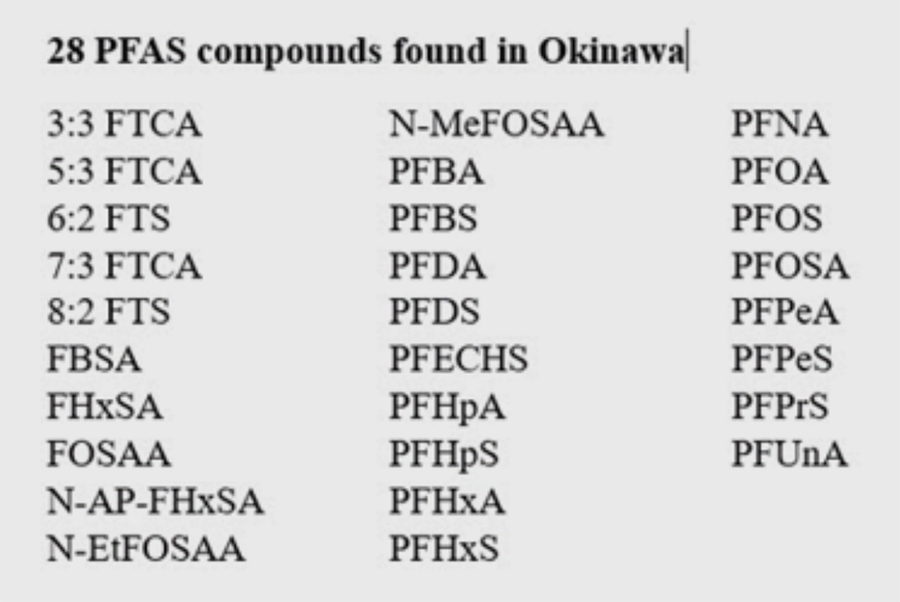
Military Poisons’ 2023 sampling found 28 PFAS compounds in Okinawan environmental samples, not merely PFOS and PFOA. The profile includes PFOS, PFHxS, PFDS, PFOSA, FOSAA, N-EtFOSAA, and N-MeFOSAA—compounds and related precursor materials associated with older PFOS chemistry made by electrochemical fluorination. Before 2000, 3M was the dominant global producer of the PFOS precursor chemistry used in this legacy AFFF formulation.
This profile makes the U.S. explanation of an unspecified source for PFAS contamination implausible. Coupled with the U.S. government’s reported acknowledgment that foam at Kadena and Futenma was likely responsible for PFAS contamination in the Okinawan environment, it establishes a compelling case for what Okinawa has requested for years: independent access, full sampling, and a public accounting of PFAS use, releases, and cleanup inside the bases.
Further proof – Marine Corps Air Station Futenma
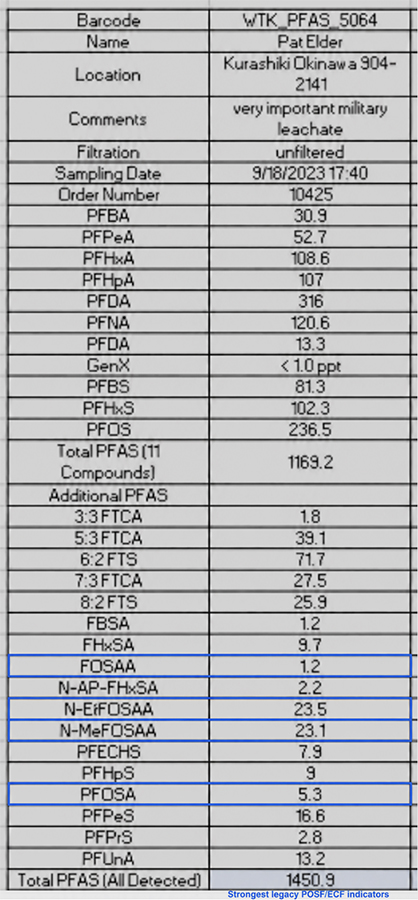
142 tons of aqueous film-forming foam from Marine Corps Air Station Futenma was buried at the Kurashiki industrial-waste landfill in 2014-2015. In 2023 Military Poisons tested the waters draining from the site and found high levels of PFAS with a distinctive 3M stamp.
The clearest legacy 3M/POSF electrochemical-fluorination (ECF) signature in this sample is the group I marked:
- FOSAA — 1.2 ppt
- N-EtFOSAA — 23.5 ppt
- N-MeFOSAA — 23.1 ppt
- PFOSA — 5.3 ppt
Note: POSF is short for perfluorooctane sulfonyl fluoride: C₈F₁₇SO₂F.
These are PFOS-related sulfonamide compounds/precursors tied to the older POSF chemistry that 3M historically dominated. Their presence together is much more meaningful than PFOS by itself.
Supporting, but not distinctive on their own: PFOS (236.5), PFHxS (102.3), PFDS (9), PFBS (81.3), and possibly PFHxSA (9.7). They fit an older ECF/PFOS-related profile.
POSF was the key chemical building block in 3M’s older PFOS chemistry. 3M used electrochemical fluorination to make POSF, then used it to manufacture PFOS and related compounds for products including older PFOS-based AFFF, Scotchgard-type treatments, paper coatings, and industrial surfactants.
In environmental samples, compounds such as PFOSA, FOSAA, N-EtFOSAA, and N-MeFOSAA point back to that larger POSF-derived chemical family. They tend to transform over time into PFOS.
So “a POSF/ECF signature” means a pattern consistent with the older 3M-style PFOS chemical family—not merely PFOS alone. The AFFF from Futenma came from 3M. The Navy/Marine Corps purchased and used massive quantities of AFFF from 3M.
Further Proof – Kadena Air Base
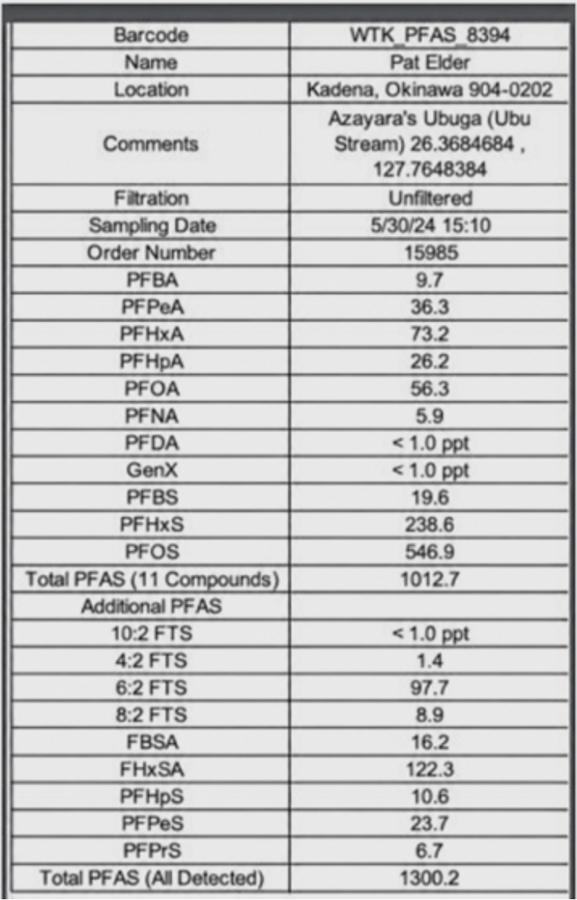
In May of 2024 Rachel Clark and I again joined with Okinawan activists to test waters flowing from U.S. military bases in Okinawa. We followed Ubu stream as close as we could to the point where it drains from Kadena Air Base.
The strongest observation in the Kadena sample is the PFOS + PFHxS pairing: together they are 785.5 ppt, about 60% of all detected PFAS in this sample. 3M’s older electrochemical-fluorination (ECF) – made AFFF is known for PFOS dominance followed by PFHxS with smaller concentrations of PFHpS and PFBS.
The scientific data gathered from the Ubu stream and the Kurashiki landfill acts as an unalterable forensic record. Because federal military specifications strictly barred the U.S. armed forces from purchasing foreign-made firefighting foams, the heavy presence of distinct 3M-manufactured POSF precursors leaves no room for alternative theories. Tokyo and Washington can no longer mask this environmental crisis behind bureaucratic stalling tactics and withheld admissions. The chemical evidence demands what Okinawan communities have rightfully sought for over a decade: immediate, independent base access, exhaustive public sampling, and an open, accountable cleanup operation to protect public health.
The post The 3M Fingerprint: How Science Disproves the Pentagon’s Denial of Okinawa PFAS Pollution appeared first on World BEYOND War.
From World BEYOND War via This RSS Feed.