

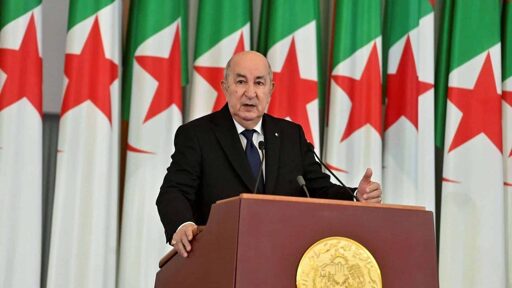

Announcing the severing of diplomatic ties with the United Arab Emirates (UAE) on Thursday, September 10, Algeria summoned the Emirati envoy and gave him 48 hours to leave the country.
“Algeria has exercised a great deal of restraint and a high sense of responsibility,” despite the increasingly “provocative or hostile actions emanating from” the Gulf power, the North African country’s foreign ministry said in a statement.
“Despite these numerous warnings, the United Arab Emirates continued to persist in these actions, which have reached limits where they can no longer be considered acceptable or tolerable within the framework of relations between two sovereign states, nor remain without a response.”
Later that day, its defense ministry announced that the UAE’s military and civilian aircraft are banned from using Algerian airspace from Friday. The only exemption is for commercial civilian planes, which can continue to fly over Algeria until the existing contract expires at the end of the year.
Algeria had already initiated the termination of the air services agreement with the UAE in February, when President Abdelmadjid Tebboune alleged attempted Emirati interference in its elections.
Multiple Algerian media outlets aligned with the state have reported that the UAE has been supporting the Movement for the Self-Determination of Kabylia (MAK), a separatist group Algeria designated as a terrorist organization in 2021.
Algeria and the UAE also find themselves on opposing sides on several fronts of international relations.
Algeria aids Western Sahara’s liberation struggle; UAE backs Moroccan occupation
The support for the national liberation struggle of Western Sahara, occupied by Morocco immediately after it won independence from Spanish colonialism, has been a central plank of Algeria’s foreign policy.
In 2021, Algeria severed diplomatic relations with Morocco, accusing it of supporting the MAK in retaliation for Algerian support to the Polisario Front (PF), which is fighting for Western Sahara’s national liberation. But there is no equivalence between the PF and the MAK.
The MAK, which has long had close links to Israel, largely operates from Europe and is based in France, Algeria’s former colonizer. The PF, on the other hand, is fighting for Western Sahara’s liberation, with its military operating in its liberated territory adjoining Algeria. The UN recognizes the PF as the sole representative of the people of Western Sahara, a country it lists among the last few pending decolonization.
Read more: Western Sahara’s decolonization at a crossroads after 50 years of occupation
Despite funding and arming the Moroccan occupation, the US had not officially recognized Morocco’s claim to sovereignty over Western Sahara until December 2020, when Morocco signed the Abraham Accords to normalize diplomatic relations with Israel.
The first Trump administration, in turn, proclaimed that the US “recognizes Moroccan sovereignty over the entire Western Sahara territory” and went on to open a consulate in Dakhla, a major city in the occupied region.
The UAE was a step ahead, setting a precedent before the American move by opening its consulate on the occupied land in November 2020, a month before Morocco normalized relations with Israel. The UAE had already normalized relations with Israel that September.
In contrast, Algeria refuses to normalize relations with Israel until the Palestinians have secured their statehood. Algerian media often refers to the UAE as an “Israeli vassal”.
“Wherever they set foot, blood flows”
Algeria’s diplomatic break was foreseeable since at least July, when President Tebboune said in a thinly veiled reference to the UAE in a televised interview, “Wherever they set foot, blood flows… We want them to stay away, so that blood does not flow in our country.” He gave the example of Mali, Libya and Sudan.
A month later, in August, the UN confirmed that the USD 50 million transferred to the Al Qaeda-affiliated JNIM in the form of ransom helped fuel its attack across Mali. A Reuters investigation identified the UAE as the source of this payment to JNIM. The group has also attacked its neighbors, Burkina Faso and Niger, both of which have followed in Mali’s footsteps by expelling French troops.
Read more: Mali fights yet another wave of attacks on multiple cities by terror groups
The UAE’s supply of arms and mercenaries to the Libyan warlord General Khalifa Haftar, who has been fighting Libya’s UN-recognized government, is also well-documented in multiple UN reports since 2017.
Tebboune’s reference to “blood” flowing from Emirati interference is best demonstrated in war-torn Sudan, where the UAE is funding and arming the Rapid Support Forces (RSF), whose depopulation campaign in El Fasher had all the “hallmarks of genocide”, according to the UN.
Read more: RSF has burnt and buried tens of thousands of corpses in El Fasher, says Yale report
He added in the July interview that a “diplomatic break” with the UAE “would have happened long ago.” Algeria, he explained, had refrained only to avoid adding to the already existing divisions in the Arabic-speaking world.
When the break finally came on Thursday, the UAE’s foreign ministry said it hoped that it “will be temporary, in a manner that preserves the fraternal ties between the two brotherly peoples.”
In an apparent reference to the absence of explicitly stated reasons in Algeria’s statement, Anwar Gargash, the diplomatic advisor to the UAE’s president, Mohamed bin Zayed, said, “Diplomatic relations are managed through reason, communication, and clarity of interests, not through puzzles and signals that require decoding.”
He went on to preach that “successful diplomacy is built on clarity of positions, sound management of interests and differences.”
Gargash’s statement “is revealing above all for what it carefully conceals. Not a word about the actions of this arsonist, predatory state, which thrives on chaos wherever it sticks its nose in Yemen, Sudan, the DRC, Somaliland, and elsewhere,” retorted former Algerian diplomat, Amar Belani.
Describing the UAE as a “state that has made other nations’ instability its economic model,” Belani concluded his response, saying: “As for the lesson on ‘reason and clarity of interests’, Abu Dhabi would do better to reserve it for its partners in the Abraham Accords, with whom it shares complicity in the face of war crimes, crimes against humanity, and acts of genocide committed against the Palestinian people.”
From BT News via This RSS Feed.