

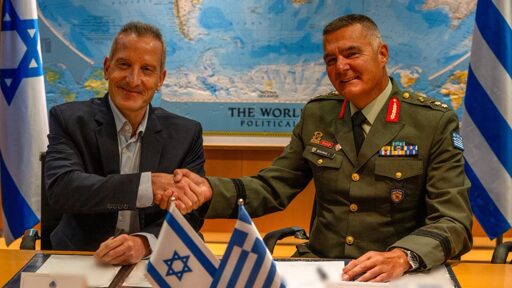

At the end of August, the Greek government signed the “Achilles Shield” agreement – a €3 billion “defense” deal with Israel. Under the terms, Israeli companies including Rafael Advanced Defense Systems and Israel Aerospace Industries (IAI) will develop and build anti-aircraft and anti-ballistic systems for Greece.
“This is the largest defense export deal in the history of Israel-Greece relations, and one of the largest in the history of the State of Israel,” the occupation’s Ministry of Defense stated. “Greece’s choice of Israeli technology as the backbone of its most ambitious air defense buildup program in the past decade reflects the depth of trust built between the two countries.”
“Under the deal, Israel will build Greece a comprehensive, multi-layered air defense array, drawing entirely on Israeli-made systems and on the extensive operational experience Israel’s defense establishment has gained during the war.”
The “war” in the statement being the genocide Israeli forces have been conducting in Gaza since October 7, 2023.
An influx of Israeli investments in Greece
According to journalist Vangelis Ilias, the new deal should be contextualized within broader trends of Greek capital and subsequent governments deepening ties with the occupation power. While the current Mitsotakis administration did not initiate this trend, he says, it deepened it both before and since the genocide in Gaza began. “Over the past 6-7 years, we have witnessed an influx of Israeli investment funds into Greece, both in the real estate sector and through the acquisition of former public – but not exclusively public – companies in various sectors of the economy, one of which is defense.”
Israeli real estate investments in Greece have already had a notable impact on people’s everyday lives, driving up rents and making housing more unaccessible. Endeavors in the defense sector might have been more lowkey, Ilias adds, but they are widespread and expanding under the sight of NATO and European institutions. “In the south of the country, in Kalamata, there is a large Greek Air Force base that also falls under the NATO umbrella as an International Pilot Training Center,” he says, emphasizing the presence of Elbit Systems in the area.
Israeli companies have also purchased local military enterprises, including Intracom Defense, operating in electronic warfare and drone production. “Through this acquisition, the Israeli state-owned company IAI gained access to the European Defense Fund (EDF), an EU mechanism intended exclusively for financing European defense procurement programs – something that was made possible only thanks to the active support of the Greek government,” Ilias adds.
“[Achilles Shield] has been promoted by the domestic media and the elite as an agreement that shields Greece,” he adds. “[Under the claim] that the money being spent, while not going to healthcare and education, or toward supporting the incomes of citizens who are still trying to recover from the years of economic crisis, protects us from those who seek to harm the country, with Turkey always implied in this context,” he explains.
“In this era of crises, military buildup, and preparations for a full-scale war, they are trying to present this not only as something reasonable but also as something necessary, where strategic agreements between states take precedence over the needs of the people and international law, overlooking genocides or the ethnic cleansing of an entire people.”
The deal’s Achilles’ heel: reliance on Israeli arms
While Greek officials described the deal as a breakthrough for Greek sovereignty, critics have warned of dangers on several fronts. To begin with, in the announced distribution of funds, local industry expects only €750 million of the total €3 billion. The rest goes to Israeli arms companies making the genocide in Gaza technically feasible.
And despite the amount of money being spent, parts of the agreement have been presented inconsistently to the public. “We’re talking about a complex system of sophisticated weapons utilizing artificial intelligence, with a central control unit that operates based on computer code, Ilias emphasizes. “There has been extensive debate over whether this code will belong to Israel or be controlled by Greece. So far, the government’s responses to a barrage of questions from the opposition have been neither reassuring nor consistent. This remains to be clarified.”
The expenditure has been heavily criticized by left movements, including the Communist Party of Greece (KKE), in the context of EU armament taking place at the expense of labor rights and social services. “Costing more than €3 billion, this agreement forms part of the broader ‘2030 Agenda’ arms program serving NATO’s needs, for which our people are paying dearly – tens of billions of euros – at the expense of their rights and needs,” the KKE pointed out.
Like most other EU governments, the Mitsotakis administration has announced harmful labor and social reforms just as it committed billions for Israeli arms producers. This new-old austerity agenda has met widespread resistance. Recently, tens of thousands demonstrated in Thessaloniki demanding dignified wages and pensions, efficient public healthcare, and investments in education. “Not one euro for imperialist wars,” they insisted.

The “Achilles Shield” deal also adds to the case made by academics and activists worldwide that Israel is using the Gaza genocide to market its weapons. This is apparent not only from the purchase list, but from official statements as well. The Israeli Ministry of Defense announced similar deals are part of a broader strategy “to expand defense exports as a central tool for strengthening the IDF’s force buildup, influencing Israel’s foreign policy standing worldwide, and bolstering the Israeli defense industry and economy.”
Critics have argued that Greece’s arms deal risks making the country captive to Israel’s defense industry and alienating it from other countries in the region. “In practice, strategic relations with the murderous state of Israel, together with joint military preparations, are adding fuel to the fire of imperialist rivalries in the region, as well as the conflicts between the bourgeois classes of Turkey and Israel, and of Greece and Turkey, in the Aegean and the Eastern Mediterranean, with the peoples being the victims,” the KKE emphasized.
Read more: Amid mass protests in the West, Israel’s military footprint expands in Eastern Europe
“Greece’s ruling class has made a strategic choice to align itself closely with the Western alliance,” Ilias says, referencing events since the Greek Civil War. “It is particularly worth noting that, as a result, the Greek people have borne the brunt of the bloodshed.”
And while the post-Civil War regime attempted to crush “the popular and anti-imperialist movement that existed in the country,” he concludes, they did not succeed.
“This is partially why we still see today such a stark contrast between the ruling class and the organized, collective reactions of significant segments of the Greek people throughout the country against the genocide perpetrated by the Israeli state against the Palestinian people. These reactions are multifaceted, with segments of the working class – beyond just the youth – actively participating.
From BT News via This RSS Feed.
Yeah Achilles, famously known for having no weakness… At least technology tried through genociding a people sells