

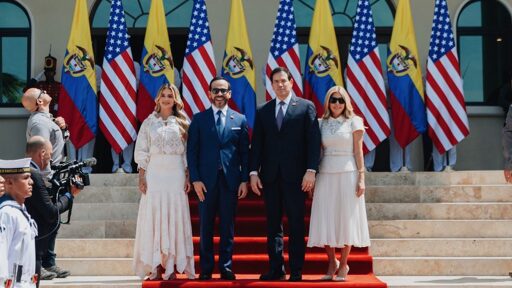

Abelardo de la Espriella has now been in office for one month. The far-right president won the election by a narrow margin over leftist Iván Cepeda (less than 1% of valid votes), despite allegations of irregularities made by then-President Gustavo Petro.
However, De la Espriella dismissed the allegations of irregularities and began his administration by attempting to demonstrate military strength, an overt religious faith (for which he had to issue a public apology), and a clear alignment with Washington’s political doctrine.
The earthquake and the return to a state policy of war
However, just three days after he took office, a powerful earthquake struck the western part of the country, leaving more than 300 dead and nearly 5,000 injured. The government’s actions drew controversy. His supporters applauded the government’s response, while critics accused the administration of exploiting the tragedy to boost his public image and giving certain countries – such as Israel – priority in search-and-rescue efforts, while denying entry to rescue teams from other countries.
Added to this is the rhetoric of a return to all-out war against subversive armed groups and criminal organizations that De la Espriella already put forward during his election campaign. But this has not been merely a matter of rhetoric. Since taking office, the executive branch has ordered a series of attacks against positions held by these groups, some of which were engaged in peace talks aimed at their demobilization.
In fact, De la Espriella canceled the peace negotiations, which had been resumed by the Petro administration as part of his “total peace” policy.
Read more: President De la Espriella cancels peace talks in Colombia
In addition, the government’s death-defying political communication strategy has caused quite a stir. In some videos, the president can be seen walking among the bodies of alleged “bandits and terrorists” (as the government calls them), which, according to the Executive Branch, number 40, in addition to the capture of nine people allegedly linked to illegal organizations.
But the bombings have also drawn significant domestic criticism. In the Guaviare Department, three minors were reported killed following the bombings ordered by the president, which were part of a series of attacks that left a total of about ten people dead. And while De la Espriella said that armed groups are responsible for the deaths of the minors, he has not been able to escape criticism from human rights organizations that view indiscriminate bombing as a dangerous threat to innocent people and the civilian population.
A return to neoliberalism
Ultimately, the contrast between Petro’s and De la Espriella’s administrations seems so evident that many wonder whether it is precisely this political distancing that serves as the compass guiding the new government – or whether Colombia is, in fact, attempting to establish a new form of state.
To understand this transformation, BreakThrough News spoke with Danilo Urrea, philosopher at the Universidad Nacional de Colombia, who sees in this first month a clear shift toward a return to a state policy of war – one that had previously been implemented with negative results: “In Colombia, this was historically known as the era called ‘La Violencia,’ which was one of the worst periods the country has ever experienced in terms of the barbarity it generated.”
“The president presents the killing of people to the country as a success,” he added. “But he also does so with an aesthetic and a semiotics that portray death, murder, and the like as a possibility for the country. And in a context like Colombia’s – where we have the highest death toll on the entire continent, surpassing even the combined death tolls of all the region’s dictatorships – this shows us that it is a step backward in terms of the possibility of building a country based on dialogue and reconciliation.”
Urrea also says the current government is trying to push the idea that the country it has inherited is in a disastrous financial situation, which is why it must promote a radical neoliberal policy: “We’ve identified efforts to promote a supposed economic turnaround for the country through old formulas that have already been tried and proved disastrous for social cohesion, for the territories, and for the relationship between humans and nature – with negative impacts on the communities living in the very places where this return to an extractive economy is once again being proposed.”
Furthermore, he warns that in the short time De la Espriella has been in office, there has been a setback in environmental and labor matters: “He has also come under attack during this first month, as he has begun to dismantle the gains made in terms of wages, recovery, overtime pay, and certain labor protections … which had been restored under President Petro’s administration through reforms and which this administration is now once again rapidly undoing with the stroke of a pen, supposedly to improve economic conditions. That, in very general terms, is what we’re seeing and what’s projected: the deregulation of all social benefits, of all the hard-won gains; the complete dismantling of all reforms; and the surrender of the country – in the areas of health, education, food, and all fundamental rights – to privatization processes primarily for the profit of transnational corporations.”
A new (old) geopolitical doctrine
Following the Petro administration’s attempts to defend the Palestinian people against Israel’s onslaught, as well as its various clashes with Washington’s hemispheric geopolitical agenda, Urrea asserts that Colombia has joined a regional strategy of control orchestrated by Washington: “The rise of the far right, which is well known … Through this administration, Colombia has become yet another outpost of U.S. imperialism’s advance across the region. And obviously, this has far-reaching consequences for the geopolitics of Latin America and the Caribbean in particular.”
WATCH: Colombia’s new president declares ‘colonial allegiance’ to US & Israel
Furthermore, Urrea highlights the historical importance Colombia – a country with access to both the Pacific Ocean and the Caribbean Sea – has held in the United States’ geopolitical strategy to control natural resources: “From a geopolitical standpoint, conditions are being created for Colombia to once again become one of the countries that facilitates U.S. military control – but above all, control over the natural resources and assets that are so coveted in this era of challenges for the United States in terms of its economic capacity, its dispute with China, and everything related to critical minerals.”
What is the opposition doing?
Urrea notes that, for now, the opposition parties have not managed to formulate a clear response to De la Espriella’s project. First, he points to a certain caution regarding a state policy that promotes violence and war: “There is obviously a great deal of fear regarding the actions I mentioned earlier – this language of violence, death, and murder. And obviously, in a country like Colombia, this has repercussions for the ability of those opposed to the current regime to act. Furthermore, because there has been an increase in the targeted killings of social leaders in various parts of the country, especially in areas most affected by geopolitical disputes as well as conflicts over economic and commercial control, illegal economies, and so on.”
However, Urrea notes that a coordinated opposition to the popular sectors could emerge, and the people might offer a peaceful and better-coordinated response: “We should consider an opposition that stems more from the popular sector, and there, I believe, there is also fear about how to react in the face of a violent scenario, a dangerous scenario, and manipulation. But I believe that organizations are now focusing on analyzing what the main peaceful and strategic causes might be to address the current situation. It seems to me that one of these fundamental aspects will undoubtedly be, and is already taking shape in the country through popular organization and mobilization, the defense of the environment, the defense of territories that are already being targeted for the control and exploitation of natural resources by transnational corporations, and the issue of fracking.”
From BT News via This RSS Feed.