

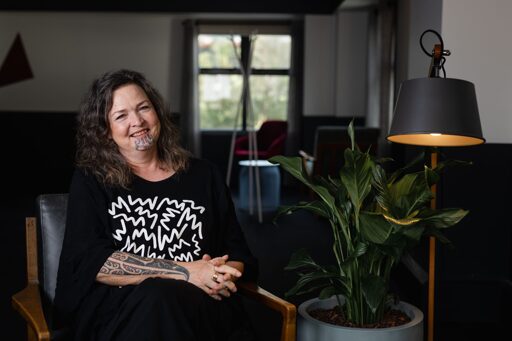

Atakohu Middleton (Photo: Trinity Thompson-Browne, Māori Literature Trust Te Waka Taki Kōrero)
E-Tangata arts and books editor Atakohu Middleton, an adult learner of te reo, has just published Waka Aroha*, a collection of Māori-language short stories. Here, she reflects on her own reo journey.*
Looking back, I now realise that Willow Park Primary in Northcote, Auckland, circa 1975, was a wildly progressive school. It was there that I learned to sing “E Papa Waiari” with tītī tōrea (sticks) made from rolled-up copies of the New Zealand Woman’s Weekly, bound with sticky tape.
I remember singing, with great gusto, the Māori vowel song “A-E-I-O-U” (piiiko piko piko piko, toro, piko!). There were no actual reo lessons, but kids’ waiata were just part of the fabric of the place.
Then, in intermediate and high school, there was nothing. There was no reo at home either. My mum, Faye, had migrated from Queensland, Australia, as a young adult, and my dad, Ron, our Māori parent, saw his whakapapa as a historical curiosity rather than an identity. The last native speaker in our whakapapa, my second great-grandfather Richard Cossill, died in 1931 after a busy life as a sea captain and “native interpreter”.
I didn’t know where, or even if, I belonged in the Māori world.
So when I started at the University of Auckland in the mid-1990s, aged 24 and already qualified as a journalist, te reo was at the top of the list as a gateway to finding the Māori me.
What I remember from those first reo classes was realising that my monolingual, monocultural upbringing was not the only way of seeing the world, and that learning a language as an adult is hard. Competent adults hate feeling like tongue-tied kids, and language trauma arouses very complicated emotions.
But I also learned that this language, though lost to my whānau for so long, could be recovered. So many people were already doing amazing work to make that happen.
But I didn’t recover the tongue of my tūpuna straight away, as it turned out. After two years of reo classes at uni, I could barely hold a conversation, though I did enjoy reading. I graduated with a Bachelor of Arts in English and returned to journalism. Then my reo fell away, as tends to happen when you live in a monolingual world. I got busy working in daily news, dealing with a cancer diagnosis, and going overseas.
At 37, as I was preparing to come back to Aotearoa, I reflected on my life and knew that if I didn’t dedicate serious time to te reo, I would never speak it. Once home, I set myself up as a part-time journalist and communications adviser to make space to embrace my other heritage language.
The journey looked like this. I took all the reo papers at Auckland University of Technology (AUT), a 10-week night class at Unitec, one Te Ataarangi course, a full-time immersion year at Te Wānanga o Aotearoa (Te Aupikitanga in 2013, with Adrienne Peke), followed by a part-time immersion year in 2014, also at Te Wānanga o Aotearoa (Te Pīnakitanga, with Te Kurataiaho Kapea). In 2015, I was back at AUT doing a postgraduate course in te reo with various kaiako.
During all of that, I went to as many kura reo (five-day immersion schools) as I could fit in — at Tokoroa, Ōtaki, Whanganui-a-Tara, Whangārei, and Tāmaki Makaurau. At these kura reo, I learned from experts such as Tīmoti Kāretu, the late Te Wharehuia Milroy and their disciples, among them kaiako Pānia Papa, Heketū Blake, Tātere McLeod, Paraone Gloyne, Hēmi Kelly, and Ngaringi Katipa.
Ideally, a learner marries classroom work with a reo community. My husband and I don’t have kids, so I don’t have little people to pass te reo on to, and I don’t get to speak te reo much in day-to-day life. So those formal pathways were really important.
I can hear your question: Which courses were most effective?
For me, it was immersion education at Te Wānanga o Aotearoa (TWOA), followed by kura reo. In those spaces, I was able to use my reo for day-to-day activities and gain confidence. Most importantly, I was living te reo and the tikanga, the customs and values, that come with it.
From reo learner to reo author
The postgraduate qualification at AUT in 2015 included a reo-Māori creative writing paper taught by poet Hana O’Regan, so I jumped in. It was hard work, being creative in a language I didn’t fully command, but I composed a mōteatea and a rather stilted short story set 500 years in the future, in which a kuia tells her mokopuna why Earth was abandoned for the planet they now live on. I really didn’t know what I was doing, but I enjoyed the exercise. For a word nerd like me, being able to write in te reo as well as English was just delicious.
Then I got sidetracked again — this time into a doctorate in reo-Māori journalism at AUT. My thesis was in English, and, worried that my reo would lose its edge during that time, I wrote more short stories to keep me going.
That first story I’d written for Hana’s class got a rewrite and became the story of a rangatahi writing in the year 2600 about her tupuna, who’d led a migration to another planet. It was still rather dry, but I entered it in the Pikihuia biennial short story competition in 2017. The winners’ stories and other submissions, including mine, were published in Huia Short Stories 12. That was super-encouraging, so I kept writing stories and entering them in Pikihuia.
Another turning point came with a story called “Wairua”, about a Māori policewoman called to investigate mysterious goings-on at a motel. It was first published in Huia Short Stories 14 in 2021.
Two years later, it was reprinted by Auckland University Press in its collection *Hiwa: Contemporary Māori Short Stories. “*Wairua” was one of just four reo stories out of the 17 in the book. The fact that there were only four in te reo, and that mine was a reprint, underlines how few adult short stories in te reo exist.
This shortage has bugged me for a long time. I remember, as an immersion student at TWOA, looking for original stories in te reo and finding hardly anything. Reo writers are necessarily creating original stories for tamariki in immersion education, and Kotahi Rau Pukapuka focuses primarily on producing translations. But where are the original fiction stories for adults in te reo that reflect life in Aotearoa?
At the Hiwa launch, an opportunity to do something about this presented itself in the form of Sam Elworthy, the director of Auckland University Press. After the formalities, I introduced myself.
“Four reo stories in a book like Hiwa is nowhere near enough!” I said. “What are you going to do about the shortage of short stories in te reo Māori? Oh, by the way, I’ve got some others.” Cheeky, I know, but I’d had a wine by then.
A couple of days later, we met for coffee, and I outlined the vision: a collection that would be interesting for fluent speakers, but that would tell adult stories accessible to those at intermediate level. In short, I’d write stories to fill that yawning gap between pukapuka tamariki (children’s books) and translations. It turned out that Sam, who’s Pākehā, was an enthusiastic learner of te reo and also saw the gap.
So started a delightful 18-month period in which I put together 15 short stories totalling 50,000 words. Ehara taku toa i te toa takitahi, e hoa mā — it wasn’t a solo endeavour. Funding from both Creative New Zealand and Te Mātāwai allowed me to do two important things: I cut back paid work so I could spend three days a week on the book, and I paid Dr Darryn Joseph to be my reo and writing mentor.
In his two decades at Massey University until 2023, Darryn ran the motu’s only long-term te reo Māori creative-writing course. He writes perceptive and wryly dark stories about human behaviour and has won the reo fiction section of Pikihuia several times, most recently last year.
Every writer needs a second set of eyes and a sounding board, and Darryn has been my hoa haere, my companion on this journey. He has taught me so much about narrative form and te reo Māori. He has provided exercises to spark my creativity, strengthened my narrative style and flow, and done taste- and sense-checks on the stories.
Once the book was delivered, I was very lucky to have mumu reo (language champions) Hēmi Kelly as editor and Te Ahunui Farnham as proofreader. I learned a lot from both of them, too.
Lessons from the reo journey
So, as I’ve been on this very long and winding reo journey, what have I learned?
Here’s a list of random thoughts, which are probably most relevant to other late learners.
I’m not a language natural. I have to work at it. But I am very determined, so I just keep on going.
It’s worth it. Te reo strengthens my sense of identity, anchors me more firmly to the whenua I call home, and connects me directly to my ancestors. The threads of whakapapa and te reo tie us together across the centuries.
Find a reo buddy. It’s easier to learn when you have someone to share the journey with.
Find reo-speaking spaces or create them. I spent two years (2022 and 2023) working three days a week on the reo news team at Radio Waatea, and that was very good for my reo. You might volunteer to read to kids at kōhanga reo, or create a reo space at a pub. Nothing like a glass or two of beer or wine to make you braver!
Read in te reo. Reading consolidates your learning, and you can do it at your own pace.
Try to overcome negative self-talk or fear of making mistakes, which can either stop you from speaking at all or prevent you from taking leaps of faith while you’re speaking. You do have to put your adult ego aside to learn te reo later in life.
As Pānia Papa often says at kura reo: “Nau mai ngā hapa.” Welcome your mistakes, for that is how you learn.
With spoken te reo, I still often overthink things and second-guess myself. I know I’m not alone in this, so I wrote pieces for E-Tangata on overcoming negative self-talk with Awanui Te Huia and the top traits of successful learners with Matiu Ratima. I’m getting better at applying their advice.
Comparison really is the thief of joy. I often grumble to my husband that I’m jealous of kura kaupapa kids and all the talented adult learners who speak as if they were kura kaupapa kids. Quite logically, he reminds me that I wasn’t a kura kaupapa kid and never will be — I left school before immersion education existed. So why am I beating myself up? Better to rejoice in the gains.
It’s also useful to revisit a workbook from several years ago so you can marvel at your progress. I recently had a look inside my first reo textbook, Te Kākano by John Moorfield, now so well-worn that it’s had spinal surgery with black insulating tape. When I open it, I can see just how far I’ve come.
On the inside cover are scribbled some words I must have been grappling with at the time: tiaki (to look after), mākū (wet), huri (turn) and tīhore (pierce — probably because I was learning Hirini Melbourne’s waiata “Tīhore Mai”).
The book pretty much falls open at the first table of personal pronouns: tātou, mātou, koutou, rātou, and so on. I remember how mind-bending it felt to learn 11 different personal pronouns, let alone insert them into a sentence. Recalling that makes me smile at my younger self.
Now, in conversation, I don’t have to think twice about those pronouns. Yes, I’ve come a long way, and I’m still excited about what’s ahead on my reo journey — ups and downs, errors and all.
Dr Atakohu Middleton (Waikato, Pākehā) is a journalist whose lengthy career has included outlets as diverse as Radio Waatea*, the* Guardian (UK), the New Zealand Listener, the Sunday Star-Times*, and the* New Zealand Herald*. She lives in Tāmaki Makaurau. Her book* Kia Hiwa Rā! Māori journalism in Aotearoa, based on her PhD thesis, was published by Huia in 2024. Atakohu’s first book in te reo Māori, the short-story collection Waka Aroha: He kohinga pakipoto (Auckland University Press), was published on September 10 in time for Te Wiki o te Reo Māori, September 14-20.
Read one of Atakohu’s short stories in te reo Māori here.
The post Atakohu Middleton: From reo learner to reo author appeared first on E-Tangata.
From E-Tangata via This RSS Feed.