

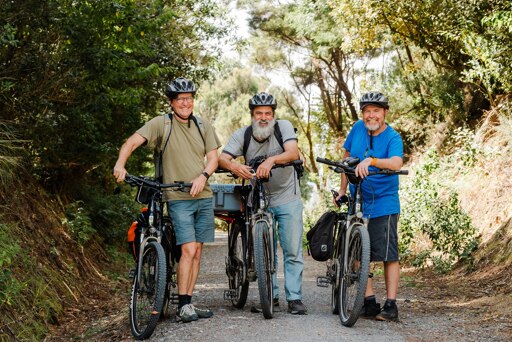

Adam Dudding, James Dansey, and Eugene Bingham on the Ōpua Cycle Track. (Photo: Jess Burges)
In a new five-part bilingual podcast for RNZ, friends Eugene Bingham, Adam Dudding, and James Dansey ride their bikes across Te Tai Tokerau on a travel adventure and a celebration of te reo Māori.
As we tucked into breakfast and gulped coffee on the platform of the Kawakawa Train Station in the Bay of Islands, kaumātua Walton Davis glanced towards us out of the corner of his eye.
Was it a look of suspicion? After all, we seemed a bit out of place: three friends from Tāmaki, surrounded by bike helmets and sound-recording equipment.
Was he judging our dodgy reo Māori? We were trying, sure, but we still considered ourselves learners.
Then Matua Walton’s face broke into a cheeky smile. It turned out he was one of those crack-up uncles, keen to share a joke and gently poke fun. And we were the perfect targets.
He then told us stories that may or may not be true, blending the language he grew up with in Motatau, te reo Māori, with the language he’d been forced to learn at school, te reo Pākehā.
You know those famous humped bridges on the outskirts of Kawakawa township along State Highway 1? Matua Walton was keen to tell us why they were built that way. Nā ngā tuna, he said. Because of the tuna — the eels — round these parts.
He laughed.
“Pono?” we asked. True?
He swivelled towards James Dansey, who has whakapapa connections to Tūwharetoa.
“Āe,” said Matua Walton. “Those three bridges, why they’re like that is because you get all these fullas from down Tūwharetoa way talking about how big their tuna are down there in Taupō. But ours kept getting head damage, so we had to raise the bridges. That’s how big our tuna are up here. He nui ake ngā tuna o Kawakawa!” The eels are bigger in Kawakawa!
We all laughed. It was beautiful — and it was a reminder that this language we all loved didn’t always have to be treated like some precious artefact, tiptoed around in case it broke.
We’d come to Te Tai Tokerau to ride the Far North cycle trail and to record a podcast for RNZ, Reo Journeys: Te Pou Herenga Tai.
Adam Dudding and I had worked together for years before we met James Dansey, a musician and audio editor, at Te Wānanga o Aotearoa, where the three of us were studying Rōnakitanga (Level 5) alongside our extraordinary hoa akomanga (classmates) and our kaiako (teacher), Mārena Mane.
Last year, we made a podcast together called Witi Underwater about Witi Ihimaera Smiler’s time at Te Wānanga Takiura, learning te reo Māori at 80. It was a haerenga (journey) full of emotion as the kaituhi rongonui (the famous writer) reflected on what it took to finally learn the language that he had grown up with as a boy in Waituhi, Te Tai Rāwhiti.
For this podcast, Reo Journeys, we wanted to capture the reo and kōrero of the north, all the while enjoying the beautiful trail stretching from Ōpua on the taitamawāhine (east coast) to the Hokianga on the taitamatāne (west coast).
We knew there would be mamae. Parts of the whenua in the north are soaked with blood and tears, the remnants of colonisation and pakanga (conflict). And we certainly heard plenty of that, like when we sat with the Wīhongi whānau as they told us about the confiscation of their whenua at Ngāpuhi Road on the outskirts of Kaitaia.
We knew there would be reo trauma. As in every part of the country, generations were forced to close their ears to te reo Māori and tune their tongues to English only. We all cried with Matua Babe Kapa as he tearfully recounted his struggles to reclaim te reo Māori as an adult.

Babe Kapa and Eugene Bingham. (Photo Adam Dudding)
So, yes, recording the podcast wasn’t always an easy ride. But with the heaviness came plenty of lightness.
What we didn’t expect to find were so many laughs and so much joy in te reo Māori.
As a learner, it’s easy to become overly cautious about the language, and feel like we must always be slaves to strict sentence structures and forms. We can get bogged down in the seriousness of te reo Māori, in the formality and solemnity of it, the oratory, karanga, and karakia.
Certainly, the business of learning te reo Māori, of being part of its reclamation and revival, is serious.
But what we experienced on our reo journey was the humour, richness, and beauty of everyday kōrero. We were reminded that te reo Māori is a living, breathing language. A language of laughs and love. A language for today.
As Matua Walton told us: “What I love about your fullas’ kōrero is that you met in a reo Māori class. A lot of the ones learning today — they treat it like a subject. They don’t realise that it’s something for every day, every moment. Me kawe tō reo i ngā wā katoa!”
That train station encounter was itself part of the journey. Because, unusually for a cycle trail, this one is partly best travelled by train.
Trace Dalton, kaiwhakahaere of the trail trust, explained how, yes, for most of the approximately 85 kilometres of the trail, a bike is your best option.
However, “if you’re going to ride from Ōpua, you’re going to include a train ride with Bay of Islands Vintage Railway Trust. It’s six kilometres along the river of Taumārere ending on the longest wooden railway bridge in the southern hemisphere.”
And so we pushed our bikes up the ramp onto the carriage, sat back, and enjoyed the view of the Taumārere, the awa that has come to stand for so much.

Adam Dudding, Eugene Bingham and James Dansey on the Kawakawa Train.
You don’t have to spend long in the north to hear the famous whakataukī: “Ka mimiti te puna i Taumārere, ka totō te puna i Hokianga. Ka mimiti te puna i Hokianga, ka totō te puna i Taumārere.”
Literally, it means that if the spring at Taumārere is empty, the pool at Hokianga is full, and vice versa. Figuratively, it’s much deeper than that — it’s a proverb that speaks to the kotahitanga of the north.
During our trip, we recited it often, reflecting on the connections we were witnessing as we pedalled from coast to coast. Sometimes it felt like we were being handed from one hapū to the next, from one community to the next — a giant chain of manaakitanga and aroha stretching along the trail.
Everyone knew everyone. And they wanted to make sure we did too. Each person we spoke to would say: “E mōhio ana koutou ki tōku hoa?” (Do you know my friend?)
Or: “Kua kite koutou ki a rātou?” (Have you seen them?)
Or: “Me kōrero koutou ki a mea.” (You should talk to so and so.)
Mostly, everyone wanted to make sure that we were enjoying the trail, learning its history, soaking up the views, and savouring the kai from the cafes.
And often there was the distinctive mita, kupu, and kīwaha of Te Tai Tokerau.
Āe mārika! Haramai tētahi āhua!
The kōrero we heard was of this place.
From Hinerangi Himiona, who was the pou tikanga for the podcast, we heard the funny sayings that she remembered from her childhood beneath the maunga Te Ahuahu — kupu tohutohu that kept her and her cousins on their toes.
From Te Aomihia Tumai, the pou reo Māori for the podcast, we heard gentle corrections, mahi whakatika, picking us up when we struggled for the right word or way of expressing what needed to be said.
And from Wikitoria Makiha we heard a karanga composed especially for the podcast, a call that encompassed all we were trying to capture: a journey by bike, a journey in te reo Māori, a journey in hope.

Trace Dalton, Josie Kemp Baker, Roddy Pihema (in front), Eugene Bingham, and Pamela Anne Ngone Simon. (Photo: Adam Dudding)
Reo Journeys: Te Pou Herenga Tai was made by Te Pūrongo Productions for RNZ with support from Te Māngai Pāho. It will be released during Te Wiki o te Reo Māori with new episodes daily from Monday, September 14. You can find it at rnz.co.nz/podcasts or on your usual podcast platforms.
Eugene Bingham (Pākehā, Ngāpuhi) is a freelance producer and writer. He has been a journalist and storyteller for 35 years, reporting and producing news and current affairs across newspapers, television, digital and podcasts. Eugene has been learning te reo Māori since 2021, mostly at Te Wānanga o Aotearoa. He lives in Tāmaki Makaurau Auckland with his wife, journalist Suzanne McFadden, and their children and mokopuna.
The post We don’t always need to be so serious about te reo Māori appeared first on E-Tangata.
From E-Tangata via This RSS Feed.