

BRICS New Delhi Declaration 2026 calls for peace, rejects unilateral sanctions, backs Global South representation and advances cooperation in energy, health and finance.
Related: 10 Historic Venezuela Suriname Cooperation Agreements Strengthen Caribbean Integration
BRICS Adopts New Delhi Declaration 2026 for Peace and Multilateralism
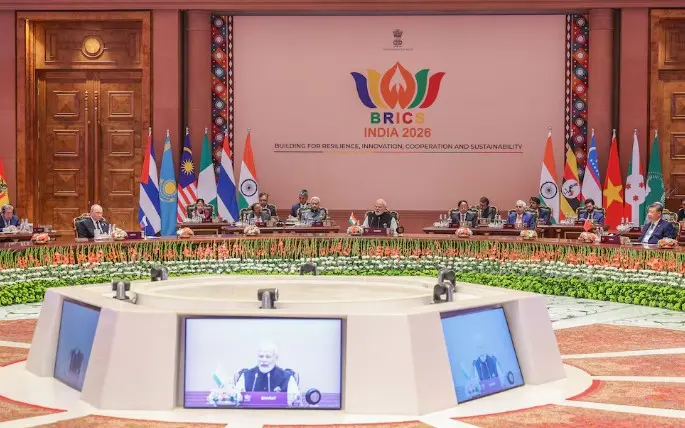
BRICS New Delhi Declaration 2026 was adopted unanimously by the leaders of the expanded bloc on Saturday during the 18th BRICS Summit in India’s capital.
The document expresses deep concern over the escalation of armed conflicts in West Asia and calls for maximum restraint, multilateral dialogue, and the peaceful resolution of international disputes through diplomacy.
The declaration also criticizes the growing use of unilateral tariffs, non-tariff barriers, and coercive economic measures, saying these policies distort global trade and undermine development. Although it does not name specific governments in every section, the language clearly addresses sanctions imposed by the United States against countries such as Russia and Iran.
The BRICS leaders said a more consolidated multipolar international order would create greater opportunities for developing countries to participate in a fairer form of economic globalization.
They also described the Global South as a decisive actor in addressing current geopolitical and economic challenges. The declaration calls for stronger international cooperation and a more representative system of global governance.
“The BRICS New Delhi Declaration 2026 reflects the bloc’s effort to combine political coordination with practical cooperation,” the document states through its positions on peace, trade, energy, health, finance, and development.[pmindia.gov][pmindia.gov][economictimes]
The leaders rejected any attempt to revise the composition of the Group of 20 without consensus among its members. They reaffirmed their support for South Africa’s full participation in the G20 and emphasized the importance of geographical balance and the growing economic weight of developing countries.
The declaration also reiterates the bloc’s commitment to the United Nations Charter, international law, and diplomatic mechanisms for addressing disputes. It calls for greater representation for Africa, Asia, Latin America, and the Caribbean in international decision-making institutions.
BRICS New Delhi Declaration 2026 Rejects Unilateral Pressure
Read the official New Delhi Declaration 2026.
A central element of the BRICS New Delhi Declaration 2026 is its rejection of unilateral coercive measures, including economic and secondary sanctions that are not authorized by the United Nations Security Council.
The document says such measures can have far-reaching consequences for human rights, health, food security, development, and the environment. It argues that sanctions often affect vulnerable populations more severely than political decision-makers.
The bloc called for the elimination of measures it considers inconsistent with international law and the principles of the UN Charter. This position reflects a longstanding concern among BRICS members that unilateral sanctions are increasingly being used as instruments of political pressure.
The declaration also expresses serious concern over the rise of unilateral tariff and non-tariff measures. According to the document, such policies disrupt global commerce, weaken supply chains, and conflict with the principles of the World Trade Organization.
BRICS members called for a more predictable and open international trading system. They also supported continued discussions on practical solutions for cross-border payments, including greater use of national currencies and financial systems less exposed to external pressure.[economictimes.indiatimes][indianexpress]
The economic section of the declaration links trade reform to the wider demand for changes in global governance. The bloc argues that developing countries should have greater influence over the institutions that regulate international finance, commerce, development, and security.
This includes calls for greater representation within international institutions and renewed discussion about reforming the UN Security Council. The BRICS position is that the existing system no longer reflects the distribution of global population, production, and political influence.
The declaration’s emphasis on multilateralism comes as conflicts in West Asia, Ukraine, and other regions continue to generate economic and humanitarian consequences. Leaders urged the protection of civilians and civilian infrastructure and stressed respect for national sovereignty and territorial integrity.
The document also condemns attacks on peaceful nuclear facilities and emphasizes that nuclear safety, security, and safeguards must be respected, including during armed conflicts.[moneycontrol][moneycontrol]
The BRICS New Delhi Declaration 2026 therefore combines a diplomatic appeal for peace with a broader criticism of military intervention and economic coercion. Its language reflects the different positions of the bloc’s members, but the final text demonstrates that they were able to reach consensus on several major global issues.
Cooperation in Energy, Health, Finance, and Technology
For a summary of the declaration’s energy and technology measures, see BRICS backs smart grids, energy storage, and diversified energy cooperation.
Under India’s 2026 chairship, BRICS completed a year of more than 400 meetings and engagements across 30 Indian cities. The program involved ministers, parliamentarians, government agencies, businesses, academics, experts, civil society organizations, and youth representatives.
The declaration highlights four broad priorities: resilience, innovation, cooperation, and sustainability. These priorities cover energy security, public health, agriculture, disaster preparedness, digital technologies, financial inclusion, and climate adaptation.
In the energy sector, BRICS endorsed the Guiding Principles on Smart Grids and Energy Storage. The bloc also welcomed India’s initiative to create a Digital Centre of Excellence for Smart Grids and Energy Storage.
The proposed center would support cooperation on artificial intelligence, data analytics, digital systems, renewable-energy integration, and the cyber resilience of critical infrastructure.
The declaration says these technologies can help improve the planning and management of electricity networks. They may also support a more stable integration of solar, wind, hydroelectric, nuclear, and other energy sources.
The document recognizes that BRICS countries have different national conditions and energy mixes. It therefore supports a diversified approach that includes renewables, hydropower, nuclear energy, hydrogen, fossil fuels, low-carbon technologies, bioenergy, and energy storage.
The bloc also adopted additional measures aimed at strengthening clean-technology manufacturing and supply chains. These include cooperation in photovoltaic industries, critical minerals, sustainable mobility, low-emission hydrogen, and climate finance.[downtoearth.org]
Health cooperation is another important component of the BRICS New Delhi Declaration 2026. Leaders agreed to strengthen coordination among national medicines regulators.
The objective is to improve the availability of safe, effective, and high-quality medical supplies throughout BRICS countries. Greater regulatory coordination could facilitate the approval, production, and distribution of medicines and medical technologies.
The bloc also emphasized cooperation in disease prevention, health systems, traditional medicine, and public-health innovation. These initiatives seek to reduce dependence on concentrated pharmaceutical supply chains and improve access to essential products.
In the financial sphere, BRICS leaders welcomed progress made by the BRICS Think Tank Network for Finance. The network has been working on fintech tools that could support infrastructure financing, financial inclusion, and inclusive economic growth.
The declaration also promotes mechanisms for cross-border payments and expanded financial cooperation. While the document does not establish a single BRICS currency, it supports practical measures that could increase the use of national currencies in trade.
The bloc’s financial agenda reflects concerns about exchange-rate instability, sanctions, and the vulnerability of developing countries to decisions made by major Western financial institutions.
The declaration also reaffirms the members’ commitment to the United Nations 2030 Agenda for Sustainable Development. Leaders called for deeper cooperation with BRICS partner countries through inclusive alliances focused on shared development.
Geopolitical Context: BRICS and the Global South
The BRICS New Delhi Declaration 2026 demonstrates the bloc’s growing importance as a platform for the Global South, but it also reveals the limits of consensus among its members.
BRICS now includes major energy producers, emerging economies, and countries with different political systems and diplomatic priorities. China, Russia, India, Brazil, Iran, South Africa, and the other members do not share identical positions on every conflict or economic question.
Nevertheless, they have found common ground in opposing unilateral sanctions, supporting broader representation in global institutions, strengthening trade cooperation, and defending the principle of national sovereignty.
The declaration is particularly significant for countries facing unilateral restrictions from the United States and its allies. Russia and Iran have used BRICS to promote alternatives to Western financial mechanisms, while other members have sought to protect their own economic ties with both Western and non-Western partners.
For India, the summit was an opportunity to present itself as a bridge between major powers and to promote practical cooperation in technology, energy, health, and trade. New Delhi’s chairship focused on institutional continuity and a large number of sectoral meetings designed to turn BRICS from a political forum into a more functional platform.
For China and Russia, the declaration reinforces opposition to a world order dominated by a single power. For countries in Africa, Asia, Latin America, and the Caribbean, the document provides political support for greater participation in global governance.
However, the declaration’s impact will depend on implementation. Calls for payment alternatives, trade facilitation, energy cooperation, and technology sharing require financing, technical standards, regulatory coordination, and political trust.
The bloc also faces challenges in maintaining unity over security issues. Its members have different relationships with Washington, Europe, and regional powers. They may agree on broad principles while remaining divided on the details of specific conflicts.
Even so, the BRICS New Delhi Declaration 2026 sends a clear message: the bloc wants a more multipolar international system in which developing countries have greater influence over the rules of global trade, finance, security, and development.
The declaration’s emphasis on diplomacy and multilateralism comes as wars and economic disputes continue to disrupt international relations. Whether BRICS can transform that message into concrete institutions and policies will shape its credibility in the years ahead.
From teleSUR English via This RSS Feed.