

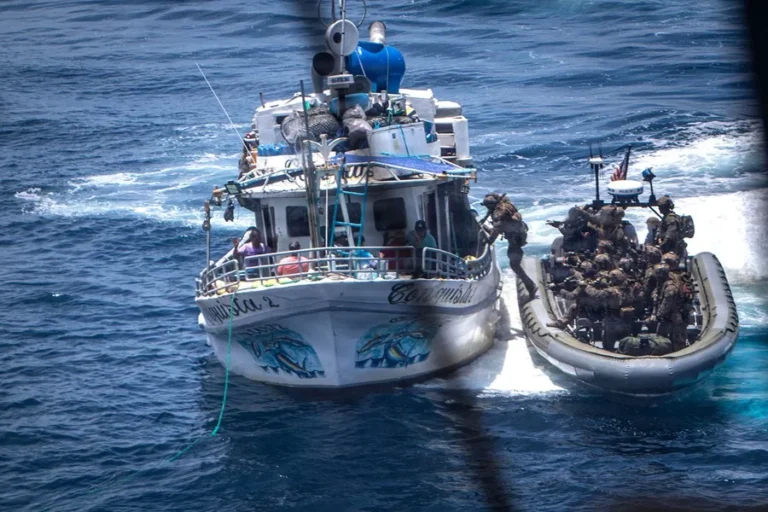
Ecuador fishermen released: 28 crew members freed after prosecutors failed to show evidence of criminal activity linked to U.S. strikes on Pacific fishing boats.
Related: Human Rights Mission Denounces Repression, Militarization and Extractivism in Ecuador
Ecuador Fishermen Released After U.S. Strikes on Pacific Boats
Ecuador fishermen released became the central development in a growing legal and diplomatic controversy after an Ecuadorian judge ordered the immediate release of 28 crew members from two fishing vessels destroyed during U.S. military operations in the Pacific Ocean.
The decision was issued after prosecutors failed to present sufficient evidence to support charges against the fishermen for alleged maritime crimes or criminal association. The ruling involved crew members from the vessels Montecristi and Don Rufo, which were intercepted and destroyed during recent operations attributed to U.S. forces.
The fishermen were taken to San Cristóbal Island in the Galápagos archipelago to appear before Ecuadorian authorities. Their lawyers argued that the transfer and detention process had been irregular and that prosecutors had not demonstrated any connection between the workers and organized drug trafficking.
Defense attorney Steven Alvia, who represents crew members from the Don Rufo, said the Public Prosecutor’s Office was unable to sustain formal accusations because it lacked supporting evidence. The case therefore remains at the preliminary investigation stage rather than advancing to a formal criminal proceeding.
The ruling follows the release of another 28 crew members from the Conquista II and OM2, who were also freed after Ecuadorian courts found no sufficient indications of criminal conduct. In total, 56 fishermen have now been released without charges from the four vessels.
A further 32 workers remain under conditional release measures while authorities continue investigating allegations of criminal association. Their defense teams have rejected the accusations and demanded that prosecutors provide concrete evidence.[efe][expreso][prensa-latina]
The cases have drawn national attention because the boats were destroyed in international waters during operations publicly justified by the United States as part of an anti-drug campaign. U.S. officials alleged that the vessels served as floating refueling stations for speedboats used by criminal organizations.
Ecuador Fishermen Released as Courts Challenge U.S. Allegations
Read the EFE report on the release of the 28 crew members.
The Ecuador fishermen released in the latest ruling belonged to two vessels that had been operating from Ecuador’s coastal province of Manabí. The Montecristi was intercepted and sunk on September 7, while the Don Rufo was attacked the following day, according to reports cited by Ecuadorian media.
The two operations were attributed to the Joint Task Force of the Western Hemisphere, operating with the support of the U.S. Southern Command. Washington claimed the vessels were connected to maritime drug-trafficking routes and were used to supply fuel to smaller boats.
The crews and their families have denied involvement in organized crime. The fishermen say they were carrying out ordinary fishing work and that the operations destroyed their boats, disrupted their livelihoods, and exposed them to serious physical danger.
After the vessels were intercepted, the crew members were transferred to Ecuadorian custody and taken to San Cristóbal for legal proceedings. The court examined whether there were sufficient grounds to validate their detention and initiate formal charges.
The judge concluded that the prosecution had not provided enough evidence to establish a criminal connection. The decision ordered the fishermen’s immediate release, although the preliminary investigation was not formally closed.
The ruling does not determine whether the U.S. military operations themselves were lawful. It does, however, establish that Ecuadorian prosecutors were unable to demonstrate in court that the fishermen had committed the alleged offenses.
Lawyers have also questioned why the crew members were transferred to the Galápagos rather than processed closer to their communities on Ecuador’s mainland. The defense has described the procedure as irregular and has demanded explanations from both Ecuadorian and U.S. authorities.
The latest decision adds to a pattern of judicial scrutiny. On September 11, an Ecuadorian court also ordered the release of 28 fishermen linked to the Conquista II and OM2 after determining that their detention could not be supported by sufficient indications of a crime.[efe][prensa-latina][cuencahighlife]
The legal decisions have increased pressure on the government of President Daniel Noboa, which has supported closer security cooperation with Washington as part of its campaign against organized crime.
Ecuadorian authorities have acknowledged intelligence cooperation with U.S. agencies in relation to some maritime operations, while distancing themselves from responsibility for the decision to use force against the boats. The government has defended the broader security partnership but has faced demands for greater transparency.
The controversy has also raised questions about the treatment of Ecuadorian fishermen during foreign military operations. Relatives say families were left for days without clear information about the whereabouts or condition of their loved ones.
In a separate case, Ecuador’s Navy recovered 10 crew members who went missing after U.S. forces intercepted and sank the Don Rufo. The fishermen were found after a two-day search and transported aboard the naval vessel BAE Atahualpa for processing by the competent authorities.[upi]
At least six Ecuadorian fishing vessels have been destroyed since late August, according to reports based on statements by U.S. Southern Command and Ecuadorian authorities. The operations have reportedly affected fishermen from coastal communities whose livelihoods depend on small-scale and industrial fishing.
The United States has defended the operations as necessary to disrupt maritime drug-trafficking networks. Secretary of State Marco Rubio said during a visit to Ecuador that U.S. authorities would continue destroying vessels when they considered the threat serious enough and the action had undergone legal review.
“Our goal is not to go after fishermen; our goal is to go after drug traffickers,” Rubio said. He added that operations were assessed individually and were intended to target drug-trafficking vessels and illegal fishing rather than ordinary fishing activity.[mid-day][aljazeera]
The statement has not resolved concerns raised by fishermen’s organizations and human rights advocates. Critics argue that the destruction of vessels before public evidence is presented places civilian workers at risk and makes it difficult for families to recover their boats, equipment, and income.
Human rights groups have called for independent investigations into the operations, including the circumstances of the interceptions, the use of force, the transfer of survivors, and the evidence used to classify the boats as criminal assets.
Geopolitical Context: U.S.-Ecuador Security Cooperation in the Pacific
The Ecuador fishermen released case has become part of a broader debate over the expansion of U.S. military and intelligence operations in Latin America.
Washington and Quito have strengthened security cooperation as Ecuador confronts rising violence linked to drug-trafficking organizations. The Noboa administration has sought assistance from the United States in intelligence, maritime surveillance, equipment, training, and counter-narcotics operations.
U.S. officials describe the Pacific campaign as an effort to prevent criminal groups from moving cocaine and other drugs along maritime routes toward Central America, Mexico, and the United States. The operations have taken place as Washington seeks to establish a more aggressive regional strategy against organized crime.
The campaign has also sparked concern over the limits of extraterritorial military action. The destruction of fishing boats in international waters raises questions about jurisdiction, the rules governing the use of force, and the protection of civilian life under international law.
The issue is especially sensitive because the boats were associated with Ecuadorian coastal communities, and the fishermen were processed by Ecuadorian courts only after being intercepted by foreign forces. The legal system’s decision to release many of them has highlighted the gap between military allegations and courtroom evidence.
The case may also affect Ecuador’s sovereignty. While the government has accepted extensive U.S. cooperation, critics argue that foreign forces should not be allowed to determine who is treated as a criminal suspect or to destroy Ecuadorian vessels without transparent judicial oversight.
For Washington, the controversy risks weakening the credibility of its anti-drug campaign if authorities cannot publicly demonstrate that the targeted boats were involved in trafficking. For Ecuador, the release of the fishermen places pressure on the government to explain how joint intelligence operations are conducted and what safeguards exist for civilian workers.
The dispute also has implications for the wider Pacific region. Ecuador’s waters are connected to important fishing zones, maritime trade routes, and the approaches to the Galápagos Islands. Any increase in military operations could affect fishing communities, commercial shipping, environmental protection, and relations with neighboring countries.
Human rights organizations have urged both governments to clarify the legal basis for the attacks and to guarantee compensation when civilian property is destroyed without proof of criminal conduct. Families of the fishermen have also demanded the return of equipment and support for workers who lost their boats.
The release of 28 crew members does not end the controversy. The preliminary investigations remain open, and another 32 fishermen are still subject to judicial measures. Meanwhile, questions continue over the evidence used to justify the strikes, the role of Ecuadorian authorities, and the accountability of foreign military forces operating in the region.
For the fishermen and their families, the court’s decision represents an important victory, but it does not repair the material damage caused by the destruction of their vessels. Their release leaves unresolved the larger question at the heart of the case: how can an anti-drug operation be justified when prosecutors cannot present sufficient evidence against the workers who were detained?
From teleSUR English via This RSS Feed.