

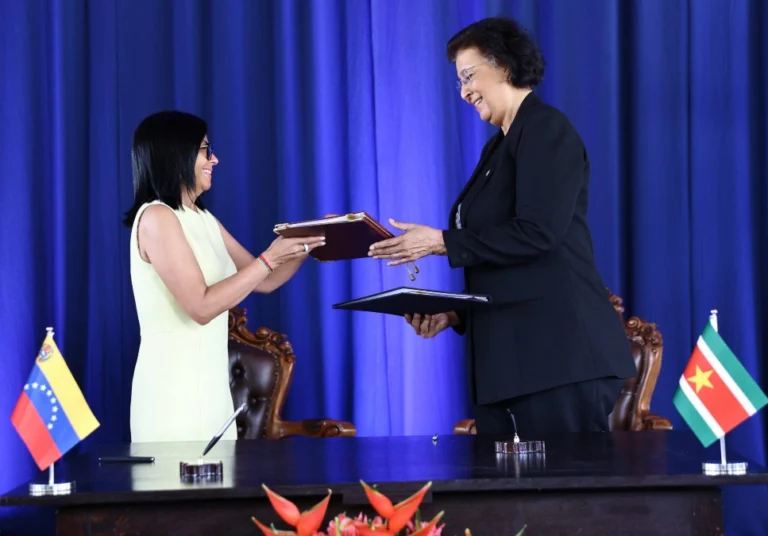
Venezuela Suriname cooperation agreements expand energy, agriculture, fisheries, trade, transport and education ties while advancing sovereign Caribbean integration.
Related: BRICS Summit Opens In New Delhi
Venezuela and Suriname Sign Agreements to Benefit Both Peoples
Venezuela Suriname cooperation agreements were signed on Friday in Paramaribo as part of a high-level meeting aimed at strengthening regional integration, economic complementarity, and the sovereign development of the Caribbean.
Venezuelan Acting President Delcy Rodríguez met with Surinamese President Jennifer Geerlings-Simons at the Presidential Palace in Paramaribo. The talks focused on building a broader framework for cooperation in energy, agriculture, fisheries, transportation, trade, tourism, education, and food security.
The delegations reviewed and signed legal instruments based on the principles of self-determination, mutual benefit, and non-interference by foreign powers. The agreements are intended to generate practical and immediate results for both countries, while strengthening ties between two neighboring South American and Caribbean nations.
According to President Simons, the meeting produced two agreements, four letters of intent, three cooperation frameworks, and one joint declaration. The documents cover agriculture, livestock, fishing, investment, connectivity, tourism, security, education, and hydrocarbons.[telesurenglish][telesurenglish][telesurtv]
The meeting took place as Venezuela and Suriname commemorate 50 years of diplomatic relations, formally established in November 1975. Both governments described the visit as the beginning of a new stage in bilateral relations, with an emphasis on transforming political dialogue into concrete projects.
Venezuela Suriname Cooperation Agreements Expand Energy and Food Sovereignty
Read teleSUR English’s report on the Venezuela-Suriname cooperation agreements.
One of the main areas of the Venezuela Suriname cooperation agreements is the energy sector. The two countries formalized arrangements for cooperation in oil, gas, hydrocarbon exploration, production, technical training, and technological research.
Venezuela will contribute experience in oil and gas exploration and production, while Suriname will participate through its academic and industrial institutions. The cooperation framework includes the Anton de Kom University of Suriname, which is expected to take part in technology transfer and the exchange of knowledge linked to the petroleum industry and related services.
A separate roadmap establishes priorities for developing bilateral cooperation in hydrocarbons. The agreement could create opportunities for joint training, research, technical assistance, and the strengthening of professional capabilities in both countries.
For Suriname, energy cooperation with Venezuela offers access to the experience of a country with decades of involvement in the oil sector. For Venezuela, closer relations with Paramaribo open space for cooperation in a neighboring country that is developing its own offshore hydrocarbon industry.
The agreements also address food production and agricultural supplies. Venezuela will review its agro-export capacity to determine how it can help supply Suriname’s poultry sector. The two sides will also evaluate the possibility of providing urea at affordable prices to meet Suriname’s demand for agricultural inputs.
The agricultural agenda includes trade in products such as avocados, cassava, beef, buffalo meat, poultry products, and eggs, as well as cooperation in animal genetics, regenerative agriculture, sanitary standards, and productive alliances.[orinocotribune][bnamericas]
These measures are designed to strengthen food sovereignty and regional supply chains. By relying more heavily on nearby suppliers, both countries seek to reduce transportation costs and limit their exposure to disruptions in distant international markets.
The fisheries and aquaculture sector was another important component of the agreements. Caracas and Paramaribo signed a memorandum on the responsible development, management, and regulation of fishing and aquaculture activities.
The arrangement could allow Venezuelan fishermen to participate in an Atlantic fishing corridor established by Suriname. According to information published after the meeting, approximately 200 Venezuelan fishermen from the states of Nueva Esparta and Sucre may be able to obtain licenses to operate in that corridor.
The two governments presented the fisheries agreement as a way to promote sustainable resource management, expand employment, and improve the contribution of fishing communities to the economies of both countries. The arrangement also creates a framework for addressing regulatory, environmental, and technical matters in the shared maritime environment.
Connectivity, Education, and Peace Diplomacy
For additional details on the signed instruments, see the Venezuelan government’s official account of the visit and agreements.
The Venezuela Suriname cooperation agreements also seek to improve air and maritime connectivity. Both governments agreed to optimize transportation routes for passengers and cargo, not only between their territories but also across the wider Caribbean Basin.
A new air services agreement includes provisions linked to fifth-freedom rights, allowing airlines to carry passengers and cargo between the two countries and onward to third-country destinations. The measure could help restore or expand commercial flights while creating new connections between South America, the Caribbean, and other international markets.
The governments also identified tourism as a priority. The tourism memorandum calls for closer cooperation among tour operators and travel agencies, business meetings, and the creation of multidestination tourism packages.
The initiative could encourage travelers to combine destinations in Venezuela and Suriname, while promoting cultural, ecological, and historical tourism. Both countries possess significant natural attractions, including rainforests, rivers, coastal areas, and culturally diverse communities.
Venezuelan Tourism Minister Daniella Cabello participated in the negotiations on the tourism component. The objective is to move beyond isolated national tourism markets and develop a more connected Caribbean travel system.
Education and professional training form another pillar of the partnership. The agreements provide for undergraduate and postgraduate education, short courses, and technical training in hydrocarbons, health, technology, agrifood production, aeronautics, and diplomacy.
The Venezuelan Institute for Technical Education and Productive Training, known as INCES, will participate in technical and professional training programs. Venezuela also offered places for Surinamese students in medical, agricultural, technological, and hydrocarbon-related programs.
The University of Hydrocarbons of Venezuela and Anton de Kom University are expected to cooperate in applied research, personnel training, and technological innovation. A separate academic cooperation program for 2026–2029 will involve the Bolivarian University for the Diplomacy of Peace.
President Simons welcomed the broad scope of the agreements, saying that the commitments covered agriculture, livestock, fishing, skills development, trade, investment, connectivity, tourism, and security.
She also expressed appreciation for Venezuela’s support in supplying productive inputs and other materials, emphasizing the advantages of cooperation based on geographic proximity and shared regional interests.
Rodríguez, for her part, said the purpose of the visit was to strengthen the bilateral agenda and consolidate agreements that could advance regional integration.
“I am very pleased to be alongside a woman president of our South America and the Caribbean,” Rodríguez said. She also thanked Suriname for the humanitarian assistance it provided to Venezuela after the double earthquake that struck on June 24.
“The Venezuelan people will always carry it in their collective memory and in their hearts,” she said.
The two presidents also agreed to reactivate the sixth political consultations mechanism and convene the 10th meeting of the Venezuela-Suriname Joint Commission. These mechanisms are intended to maintain regular dialogue and monitor the implementation of the newly signed instruments.
Geopolitical Context: Caribbean Sovereignty and South-South Cooperation
The Venezuela Suriname cooperation agreements emerge within a broader effort by South American and Caribbean governments to strengthen South-South cooperation and reduce dependence on external powers.
The agreements are especially significant because Venezuela and Suriname are located in a region where energy resources, maritime routes, fisheries, and offshore development have become increasingly important. Cooperation between Caracas and Paramaribo could contribute to greater coordination in the Caribbean Basin while supporting trade, transportation, and food security.
The partnership also reflects the political language of sovereign integration promoted by Venezuela. Rodríguez emphasized self-determination and non-interference, presenting the agreements as an alternative to relationships based on political pressure or unequal economic conditions.
Suriname, meanwhile, has sought to diversify its economic partnerships while developing its offshore oil industry and expanding agricultural and logistical capacity. Cooperation with Venezuela may offer technical assistance, regional trade opportunities, and access to nearby sources of fuel, fertilizer, food, and professional training.
The agreements could also influence the wider Caribbean energy landscape. Venezuela remains one of the world’s major holders of oil reserves, while Suriname has emerging offshore prospects. Technical cooperation between the two countries could create opportunities for joint training and knowledge exchange, even as both governments face financial, infrastructural, and geopolitical constraints.
The emphasis on maritime and air connectivity is equally important. Better transport links could help transform the Caribbean Basin into a more integrated commercial space, connecting ports, airports, producers, students, tourists, and service providers.
The signing ceremony included a tribute to Liberator Simón Bolívar, reinforcing the historical symbolism of the meeting. The homage invoked the idea of Patria Grande, or a united Latin America and Caribbean, as well as the region’s shared anti-colonial memory.
Both governments portrayed the agreements as part of a multipolar development model based on peace, mutual benefit, and respect for national sovereignty. Whether that vision produces lasting results will depend on the speed of implementation, available financing, and the ability of institutions to convert the signed documents into functioning projects.
For now, the visit marks a notable expansion of Venezuela-Suriname relations. After five decades of diplomatic ties, Caracas and Paramaribo are seeking to build a more practical partnership—one that links energy, food, transportation, education, tourism, and regional diplomacy.
From teleSUR English via This RSS Feed.