

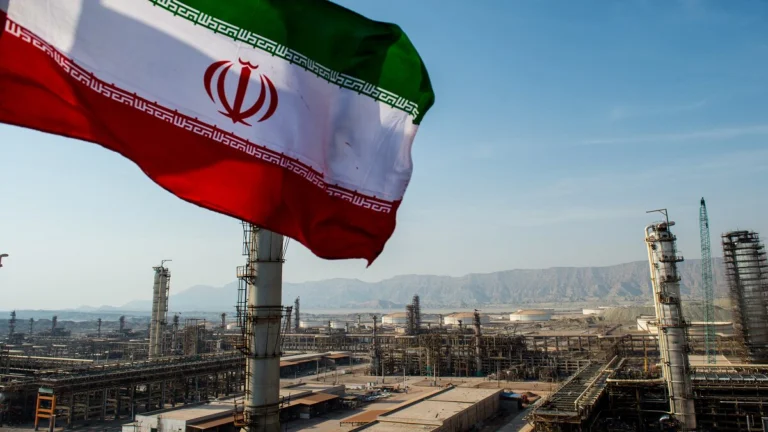
Iran BRICS energy partnership expands as Pezeshkian offers energy, food and transport links, while Tehran and China oppose U.S. pressure and promote trade integration.
Related: Iran, Gulf States to Hold Key Summit on Hormuz Maritime Transit
Iran Positions Itself as Strategic Energy Partner to BRICS
Iran BRICS energy partnership was a central theme at the 18th BRICS Summit in New Delhi, where Iranian President Masoud Pezeshkian presented his country as a potential strategic link for the bloc’s energy, food, and transport supply chains.
Speaking at the BRICS Business Forum on Friday, Pezeshkian said that food security and energy security are two fundamental pillars of economic security. He argued that Iran’s large energy reserves and strategic geographic location place it in a position to support the bloc’s efforts to build more resilient supply networks.
“The Islamic Republic of Iran, with its enormous energy reserves and privileged geographic location, is ready to play the role of a strategic partner in the energy, food, and transport supply chains of BRICS,” the Iranian president said.
The two-day summit, hosted by India on September 12 and 13, brings together the leaders of the expanded BRICS group amid conflicts, economic uncertainty, pressure on global supply chains, and continuing debate over the future of the international financial system. The agenda includes energy security, food security, trade, investment, technology, health, disaster resilience, and reform of global institutions.[modernghana][theindianawaaz][newindianexpress]
Pezeshkian called on BRICS members to move from fragmented cooperation toward gradual integration of their commercial infrastructure. He said this process should include the digitalization and integration of customs procedures, trade facilitation, the reduction of regulatory and administrative barriers, the creation of cross-border markets, and mechanisms to encourage joint private-sector investment.
The Iranian president also backed greater use of national currencies in trade among BRICS members, a proposal aimed at reducing exposure to exchange-rate shocks and limiting dependence on the U.S. dollar and Western financial institutions. He said the bloc should establish mechanisms for managing currency risks and enabling reciprocal settlements between member countries.[islamtimes][cnbctv18]
Iran BRICS Energy Partnership and Trade Integration
Read the BRICS Summit 2026 agenda and key priorities.
Pezeshkian’s proposal places energy cooperation at the center of Iran’s BRICS strategy. Iran holds some of the world’s largest oil and natural gas reserves, while its territory connects Central Asia, the Persian Gulf, the Indian Ocean, and the wider Middle East.
That geography could make Iran a valuable link between BRICS economies seeking alternative energy routes and more diversified transport corridors. Tehran has also sought to expand the role of Chabahar Port, located on Iran’s southeastern coast, as a gateway linking India with Afghanistan, Central Asia, and markets beyond the Persian Gulf.
The port has particular importance for India, which has invested in its development and views it as a way to reach Central Asian markets without relying entirely on routes through Pakistan. During Pezeshkian’s visit, Iranian officials indicated that trade, connectivity, and Chabahar would be among the main areas discussed with Indian authorities.[mid-day][moneycontrol]
The proposed Iran BRICS energy partnership extends beyond the sale of crude oil and natural gas. Tehran is also seeking cooperation in refining, petrochemicals, electricity generation, renewable energy, transportation, and industrial technology.
For Iran, participation in BRICS creates opportunities to attract investment and develop new commercial channels despite U.S. sanctions. For other members, Iranian energy resources could contribute to supply diversification, particularly at a time when conflict and sanctions have increased uncertainty in global energy markets.
However, transforming the proposal into concrete projects will depend on financing, insurance, infrastructure, payment mechanisms, and the willingness of BRICS companies to accept sanctions-related risks. The bloc includes countries with different economic systems and foreign-policy priorities, meaning that political support for Iran does not automatically translate into large-scale commercial investment.
The summit’s emphasis on critical supply chains also reflects a broader effort by BRICS members to reduce vulnerability to disruptions caused by war, maritime insecurity, sanctions, extreme weather, and geopolitical rivalry. India’s agenda for the meeting focuses on strengthening collective resilience in energy, food, health, disaster response, and strategic technology.[newindianexpress][newindianexpress]
Iranian Foreign Ministry spokesperson Esmaeil Baghaei reinforced Tehran’s position by describing Iran and China as two leading countries of the Global South. In a statement carried by Iranian media, Baghaei said that relations between Tehran and Beijing had followed an “ascending trajectory” and that the two countries shared similar views on major international issues.
“As two leading countries of the Global South and members of the Shanghai Cooperation Organization and BRICS, we consider excessive interventionism by the United States to be an obstacle to the progress of the Global South,” Baghaei said.
He added that Iran and China were determined to expand their relationship on both bilateral and multilateral levels. According to Baghaei, the two governments believe their strategic partnership strengthens ties between the two nations and should continue to develop.
The statement followed comments made by Baghaei on September 7, after the Shanghai Cooperation Organisation meeting in Bishkek. At that time, he described relations with Beijing as friendly, lasting, and based on continuous contacts at different levels.
China has also repeatedly rejected unilateral sanctions imposed by Washington, arguing that measures lacking authorization from the United Nations Security Council do not have a basis in international law. Beijing has maintained that maximum pressure is not a solution and that dialogue is the only correct path for resolving disputes.[hurriyetdailynews][dw]
For background on Iran’s relationship with China, see the Iran–China strategic cooperation overview.
The convergence between Iran and China is particularly important as Tehran faces what Iranian officials describe as severe economic and military pressure from the United States and Israel. Pezeshkian said in New Delhi that pressure on Iran had reached a “critical and dangerous stage”, referring to sanctions and what he described as military aggression.
Chinese President Xi Jinping also attended the New Delhi summit, creating an opportunity for discussions involving Iran, China, India, and other major BRICS members. The presence of Russian President Vladimir Putin and leaders from South Africa, Brazil, Egypt, Indonesia, the United Arab Emirates, and other participating states further underscored the forum’s growing political and economic weight.[hurriyetdailynews][outlookindia]
The Iran BRICS energy partnership therefore forms part of a wider diplomatic effort to make the bloc more effective as an economic platform. Tehran wants BRICS to produce practical results rather than remain a forum for political declarations.
Pezeshkian’s call for integrated customs systems, cross-border markets, joint investment, and local-currency settlements reflects that objective. These measures could make trade more efficient and reduce the effects of sanctions, although their implementation will require agreements among countries with different regulations, currencies, banking systems, and political interests.
Geopolitical Context: Iran, BRICS, and a Changing Global Order
The Iran BRICS energy partnership has implications beyond energy markets because it reflects the growing importance of the Global South in international diplomacy and economic governance. Iran’s full participation in BRICS gives Tehran a larger platform from which to challenge unilateral sanctions and promote alternatives to Western-dominated financial institutions.
For China, Iran is important because of its energy resources, geographic position, and role in regional transport corridors. For India, Iran offers access to Central Asia through Chabahar and represents a significant partner in energy and connectivity. For Russia, closer coordination with Tehran can support efforts to reduce Western influence across Eurasia.
At the same time, India and China maintain their own strategic competition, while several BRICS members continue to preserve strong economic or security ties with the United States and Europe. These differences could limit the bloc’s ability to adopt a unified position on sanctions, payment systems, or conflicts in the Middle East.
The debate over the Strait of Hormuz adds another layer of importance. Any disruption in the waterway could affect global oil and gas shipments, insurance costs, food prices, and commercial navigation. Iran’s location near the strait makes it central to discussions about maritime security, while India has emphasized the need to protect commercial shipping and the safety of seafarers.[dw][organiser]
The summit also takes place amid efforts by BRICS members to increase trade in national currencies and reduce their dependence on the dollar. Iran has strongly supported these initiatives because sanctions restrict its access to conventional banking and payment systems.
Still, establishing a fully functional alternative financial architecture will be difficult. The dollar remains deeply embedded in international trade, and many BRICS economies continue to depend on Western markets, technology, shipping services, and financial institutions. The gradual creation of payment channels, currency-swap arrangements, and regional banking mechanisms may be more realistic than an immediate replacement of the dollar.
Iran’s energy ambitions also face practical obstacles. Sanctions have limited access to foreign technology and investment, while aging infrastructure has constrained production and refining capacity. Any major expansion of Iran’s role in BRICS energy networks would require substantial capital, technical cooperation, and long-term guarantees.
Nevertheless, Tehran’s message in New Delhi was clear: Iran wants to be treated not only as a sanctioned state but as a strategic economic actor with energy reserves, transport corridors, industrial capacity, and political influence across Eurasia.
The outcome will depend on whether BRICS members can convert political solidarity into concrete agreements. If they succeed, Iran could become a significant supplier and transit hub within a more integrated network linking Asia, the Middle East, Africa, and Latin America. If they fail, the Iran BRICS energy partnership may remain primarily a diplomatic slogan rather than a fully operational economic project.
¿Cómo ha influido el 11-S en las políticas de EE.UU. hacia Irán?
La expansión de la islamofobia tras los atentados ha tenido profundas consecuencias políticas y sociales.
¡Descubre más en nuestro enlace! https://t.co/K8B1f5B44s#11Sep #PolíticaGlobal #Islamofobia #teleSUR
— teleSUR TV (@teleSURtv) September 11, 2026
From teleSUR English via This RSS Feed.