

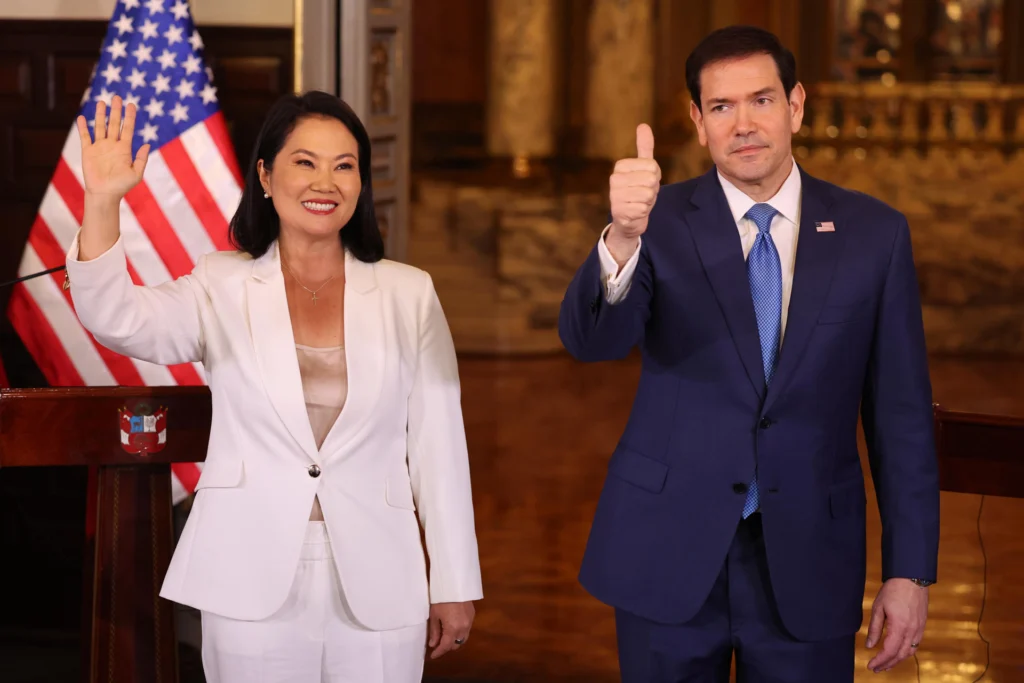
Peruvian President Keiko Fujimori confirmed on Thursday that her country will join the Shield of the Americas, the coalition promoted by Donald Trump, following a meeting at the Government Palace with U.S. Secretary of State Marco Rubio.
In a joint statement with U.S. Secretary of State, Fujimori affirmed that the main topic addressed during the meeting was “how to confront transnational organized crime and citizen insecurity,” announcing that Peru would join the Shield of Americas initiative, which already includes 15 countries with right-leaning governments aligned with Trump. “For Peru it is of vital importance to know that the United States now has a political outlook in Latin America,” the Peruvian President told the press.
This move underscores Peru’s commitment to regional security and its alignment with U.S. strategic interests.
RELATED: Ecuador Strengthens Security and Economic Cooperation With U.S.
Fujimori was careful to stress that the decision does not compromise national sovereignty, adding that “Peru’s sovereignty remains intact” with its accession to the Shield of the Americas, and that participation will allow the country to “obtain information faster and act with greater firmness.”
In this sense, the Peruvian President emphasized that “from Peru we will act with all the powers that the law and the Constitution grant us.”
PRESIDENT of PERU: I am happy to inform our nation that Peru will become part of the Shield of the Americas, a multilateral coalition that includes more than 15 countries and which is led by the United States. pic.twitter.com/ZYNLDqGiSB
— Department of State (@StateDept) September 10, 2026
For his part, Rubio welcomed the decision and praised Fujimori directly: “We are glad you were elected President, you promised to confront this, and we are going to help you as much as possible.”
The U.S. Secretary of State argued that criminal groups function as transnational terrorist networks with economic ties that “are trying to take over the hemisphere.”
Rubio framed U.S. involvement in the region not as a favor but as a matter of self-interest. “By getting involved in the region, the United States is not doing a favor. It is essential for our own security,” he stressed, noting that organized crime groups often have “more money and equipment” than the armed forces of several countries in the region, posing a direct threat to national sovereignty.
Rubio also was careful to frame the cooperation as consensual rather than imposed, acknowledging that Washington has “the capacity to act unilaterally, but we want to have partners.” “We cannot enter sovereign nations,” he added, stressing that the goal is not unilateral action but a coordinated effort against groups he described as terrorist organizations that “extort the people, commit all kinds of crimes” and must be defeated collectively.
With Peru’s formal accession, the Shield of the Americas now counts 16 member nations across the region, reinforcing what Rubio has repeatedly described during his tour as a broader realignment of Latin American governments toward closer security cooperation with Washington.
The announcement in Lima closes out a trip that, across all three stops, combined security pledges, financial commitments and high-profile diplomatic gestures aimed at consolidating U.S. influence with right-leaning governments across the region.
La presidenta sostuvo una reunión en Palacio de Gobierno con el secretario de Estado de los Estados Unidos, Marco Rubio.
El encuentro reafirma los sólidos lazos de amistad y cooperación entre el Perú y los Estados Unidos, y permitirá fortalecer el diálogo bilateral en temas de… pic.twitter.com/8n8oHlrhsC— Presidencia del Perú
(@presidenciaperu) September 10, 2026
Text reads: “The president held a meeting at the Government Palace with U.S. Secretary of State Marco Rubio. The meeting reaffirms the strong ties of friendship and cooperation between Peru and the United States, and will allow to strengthen the bilateral dialogue on issues of security, investment, development and generation of new opportunities for our citizens.”
Space Catalyst Initiative Launched
The United States government officially presented the Space Catalyst Partnership (SCP) in Lima, a program designed to deepen civil and commercial space cooperation with countries that have signed the Artemis Accords. The initiative, launched by the U.S. Department of State, includes a 6.5 million dollars project to provide high-speed satellite internet to rural schools and businesses in southern Peru.
This significant international initiative builds on technological cooperation ties previously established between the two nations. Just days earlier, in late August, Peru’s Foreign Ministry and the U.S. Embassy formalized the creation of the Bilateral Space Council, a body designed to coordinate efforts among the public, private and academic sectors to advance science, education and the aerospace industry within Peru.
El @SecRubio lanzó oficialmente el Space Catalyst Partnership. Como parte de esta iniciativa, Perú será un socio prioritario en exploración del espacio, en el ámbito civil y comercial a través de la diplomacia, la colaboración con la industria y la asistencia. pic.twitter.com/f89kDyEnEq
— Embajada EEUU Perú (@USEMBASSYPERU) September 10, 2026
The partnership extends beyond connectivity to include commercial and civil cooperation. Peru is now a key partner in space exploration, promoting scientific diplomacy and industrial collaboration in areas such as agriculture, energy, and pharmaceuticals.
Latin American Major Ally
Furthermore, the United States has formally notified Peru of its intention to designate the country as a Major Non-NATO Ally. This status will provide Peru with preferential benefits in military equipment, joint training, and logistical support, enhancing its defense capabilities and strengthening the bilateral security partnership.
The strategic alliance also includes agreements on emerging technologies and infrastructure. A memorandum on artificial intelligence was signed, committing Peru to adopt U.S. digital technologies, such as data centers, 5G networks, and cloud computing. This agreement prioritizes commercial partners within the hemisphere for national security reasons.
In the energy sector, the two nations have agreed to collaborate on the development of civilian nuclear energy for peaceful purposes. Additionally, in response to the climatic threat posed by El Niño, Peru will receive preparation funds and the deployment of the USNS Comfort hospital ship to its coasts by early 2027. This humanitarian effort highlights the comprehensive nature of the U.S.-Peru partnership, addressing both technological advancements and immediate humanitarian needs.
The meeting between Rubio and Fujimori at the Government Palace, located in Lima’s historic center, marked the final stop on the U.S. Secretary of State’s whirlwind tour of South America, which also included visits to Ecuador and Colombia in the preceding days. After a meeting with President Keiko Fujimori, Rubio left for the United States, leaving agreements on military cooperation and regional security.
From teleSUR English via This RSS Feed.
World fascism is inevitable at this point. By the time your grandkids are grown, it may burn itself out.
