

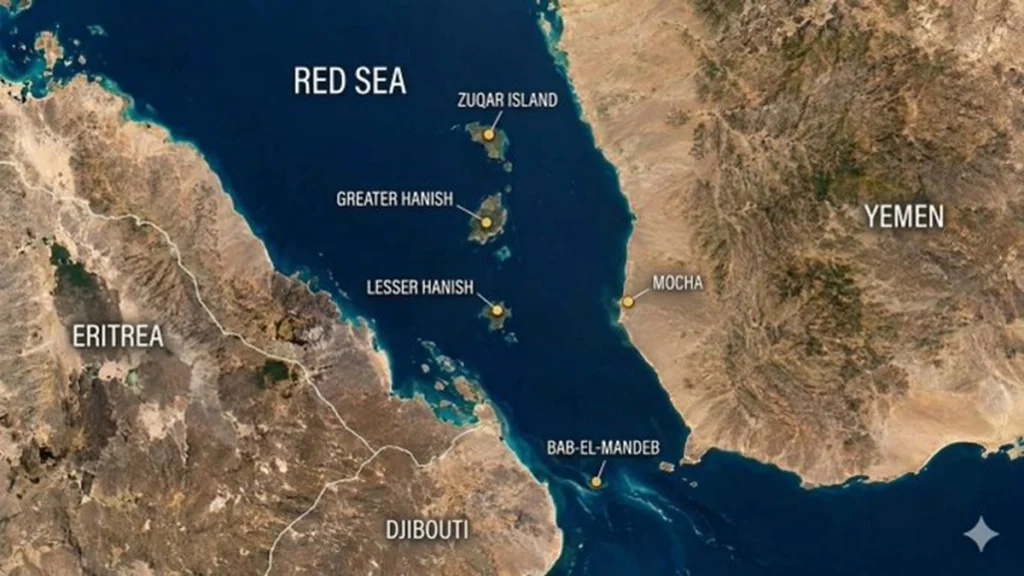
Rebel forces expand control near Bab al-Mandeb strait after taking Al Hudeida province.
On Thursday, the Shiite movement Ansar Allah (Houthis) seized the islands of Zuqar, Greater Hanish and Lesser Hanish in the Hanish archipelago.
RELATED:
Yemen Fighting Spreads as Saudi-Houthi Tensions Rise
The Yemeni rebels also took control of Mocha port a few hours after completing the takeover of the entire province of Al Hudeida.
These military feats consolidate the Houthi presence near the Bab al-Mandeb strait, where the Red Sea narrows before emptying into the Gulf of Aden, which constitutes a fundamental route for international commercial maritime transport.
In the case of Zuqar island, the military operation began with missile attacks launched from positions on the mainland in the surroundings of Al Jauja, some 33 kilometers away, followed by an amphibious operation by which Houthi fighters landed on the island.
HOUTHI DEFENSE MINISTER: ‘WE ARE ENTERING A NEW STAGE’ OF ‘NATIONAL LIBERATION’
Mohammed Nasser Al-Atafi said that the Houthis will ‘cleanse’ areas previously occupied by ‘aggression and colonialism’ pic.twitter.com/9NwDgA1Ygv
— RT (@RT_com) September 10, 2026
Zuqar, with an area of some 130 square kilometers, is located in the south of the Red Sea, between Yemen and Eritrea, approximately 90 kilometers southwest of Al Hudeida.
Its location gives it a dominant position near one of the world’s most important maritime corridors and it was initially taken by the Houthis at the end of 2014, after the group seized Sana and expanded its control through northern and western Yemen.
“The battle for Yemen’s Red Sea coast has implications far beyond the country. Bab al-Mandeb links the Red Sea to the Gulf of Aden and Indian Ocean and carries roughly 10% of global seaborne trade,” outlet RT stated.
“Its importance to energy markets has surged since the U.S.-Israeli war on Iran erupted on February 28 and the Strait of Hormuz came under a de facto blockade, forcing Saudi Arabia, one of the world’s largest oil exporters, to rely more heavily on Red Sea exports.”
“Saudi Aramco has increasingly diverted crude through its cross-country pipeline to the Red Sea port of Yanbu. Loadings have averaged more than 4 million barrels per day since June, more than four times last year’s level. Saudi crude shipments through Bab al-Mandeb between March and mid-July were eight times higher than in the same period of 2025, making disruption to the strait a growing threat to the kingdom’s oil exports,” RT added.
Mohammed Ali al-Houthi, the head of the Houthis, personally drives through newly captured Al-Jarrahi.
He’s mocking the Saudis, since he is driving an armored vehicle of the Saudi-backed government forces.
Meanwhile, the Saudi-backed forces retreat and the Houthis captured… https://t.co/mA17hvZiYF pic.twitter.com/coUVeSyBIZ
— Lord Bebo (@MyLordBebo) September 10, 2026
In 2015, forces of the Saudi-led coalition recaptured Zuqar, after which this island became an operations and support base for naval forces allied with the Yemeni government recognized by the United States, Saudi Arabia, the United Arab Emirates, and their Western allies.
Greater Hanish is the second-largest island of the Hanish archipelago, with an area of some 65 square kilometers, and reaches an altitude of approximately 407 meters. This island is practically uninhabited, except for military personnel and fishermen, and lacks surface fresh water.
The Hanish archipelago is made up of some ten volcanic islands, among which are included Zuqar, Greater Hanish and Lesser Hanish.
The islands have also been the subject of a territorial dispute between Yemen and Eritrea. Eritrean forces seized Greater Hanish in December 1995 after clashes with Yemeni troops.
The Permanent Court of Arbitration ruled in 1998 that most of the Hanish archipelago, including Zuqar, Greater Hanish and Lesser Hanish, belonged to Yemen, while it awarded Eritrea several smaller islands located closer to that country.
teleSUR/ JF
Sources: RT – EFE
From teleSUR English via This RSS Feed.