

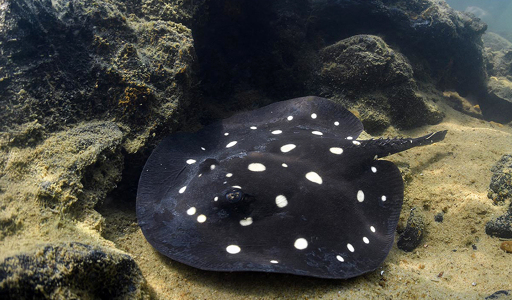
The Vashishti River, originating in the biodiversity-rich Western Ghats and flowing into the Arabian Sea along India’s western coast, has long supported traditional fishing communities. But in 2023, local fishers encountered something entirely unexpected. As they hauled a gill net into a boat, a gray body, still making faint movements, emerged tangled in the mesh, and then another surfaced beside it. By the time the net was lifted aboard, three bull sharks (Carcharhinus leucas) were tangled inside. The video of the incident quickly spread across social media, drawing renewed scientific attention to the presence of sharks in inland and estuarine waters. “This is the first documented report of sharks from the Vashishti River, although historically sharks and rays have been recorded from several major Indian river systems,” Priyankar Chakraborty, an independent marine and wildlife researcher in India, told Mongabay. Across India, dozens of species of sharks and rays (collectively known as elasmobranchs) have been reported as inhabiting estuaries and rivers, but while species such as the bull shark are relatively well documented, many others are known from only a handful of records, leaving major gaps in understanding, Chakraborty said. Globally, around 60 species of sharks and rays spend at least part of their lives in inland waters. Yet compared with their marine counterparts, these species have received remarkably little scientific attention, even though many are among the most threatened vertebrates on Earth, Michael Grant, a marine biologist at James Cook University in Australia and member of the IUCN Species Survival…This article was originally published on Mongabay
From Conservation news via This RSS Feed.