

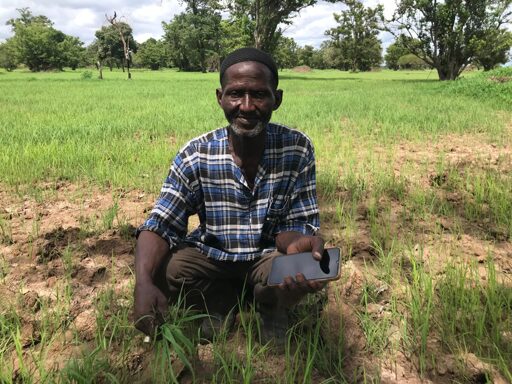
Every year, the villagers of Kiang Jifarong contribute labor and money to build earthen dikes using clay and mud in an effort to keep seawater out of their farms. Rice fields once stretched unbroken for 5 kilometers, about 3 miles, along the Bintang Bolong estuary here in western Gambia. For generations, families cultivated rice on these fertile lowlands, relying on seasonal floods and freshwater to sustain one of the country’s oldest farming traditions. There are now worrying gaps in this productive landscape. For 10 years now, many of the villagers have retreated inland, away from the coastline, as saltwater transforms once-productive rice fields into barren land. Farmers say saltwater stress is easy to recognize: rice leaves turn yellow, while harvested grains become light and hollow because the plants fail to develop properly. “The grains become almost empty,” says Tombong Barrow from the Kiang Jifarong village development committee, a statutory body responsible for identifying local development needs at the village level and coordinating responses to them. “The salt makes them useless.” Aerial view of the Bintang Bolong estuary at Kiang Sankandi, the Gambia. Image courtesy of Ansumana Darboe. Jonni Kinteh and Mama Njie, both veteran rice farmers, say they abandoned their fields eight years ago after repeated crop failures linked to salinity. “We have farmed these fields since childhood alongside our mothers,” Kinteh says. “Now we can no longer use them.” “Our parents farmed much closer to the river,” Barrow says. “Now those fields have been completely taken over by salt.…This article was originally published on Mongabay
From Conservation news via This RSS Feed.