

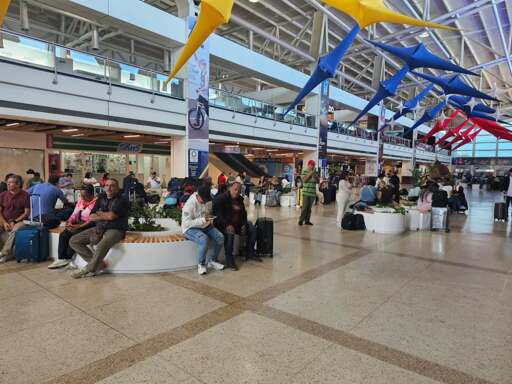
Caracas (OrinocoTribune.com)—Venezuela has now restored over 50% of the pre-earthquake operational capacity of the Simón Bolívar International Airport in Maiquetía, La Guaira state, only 35 days after beginning construction of temporary passenger terminals.
During an interview with journalist Esther Quiaro broadcast by Unión Radio this Tuesday, September 8, Venezuelan Transport Minister Francisco Garcés explained that this rapid recovery was achieved through the coordinated work of Venezuelan institutions, national specialists, and international technical teams.
The figure represents an advance from the 45% capacity reported during the first days after commercial passenger operations initially resumed on September 1. The June 24 double earthquakes in the country severely damaged the runways, passenger terminals, offices, equipment, and service infrastructure at Venezuela’s principal international airport.
The minister highlighted the fact that this restored activity is being complemented by operations at airports in Valencia, Barcelona, Porlamar, and Maracaibo, which have helped preserve domestic and international connectivity while reconstruction continues in La Guaira.
Extensive damage beyond the airport’s main structures
Garcés also reported additional details about the condition of the airport after the disaster, explaining that while the main buildings suffered mostly moderate or minor structural damage and can therefore be repaired, the non-structural destruction was extensive.
According to the minister, most interior walls collapsed, equipment was put out of service, and electrical, computer, administrative, and other essential systems were severely affected. Consequently, the buildings could remain structurally sound while being completely unusable for passenger operations.
One of the airport’s runways was repaired rapidly, and the second smaller one remained available after the earthquake. This allowed Venezuela to continue receiving international humanitarian-support and cargo flights throughout the emergency, although regular passenger services could not be provided until the temporary terminals were inaugurated.
Garcés said additional capacity will be incorporated progressively, but the complete rehabilitation of the airport will continue into 2027. The earthquake has also revived discussion about Venezuela’s need for a new, modern, high-capacity international airport. Some analysts have suggested the Libertador Air Base in Palo Negro, Aragua state, to be among the possible locations that could be evaluated to complement or eventually replace Maiquetía’s ageing infrastructure.
First inaugurated in 1945, Maiquetía became Venezuela’s principal international gateway, while its current international terminal dates largely from the modernization carried out during the 1970s.
Even before the earthquake, the facility showed significant deterioration after decades of intensive use, uneven maintenance, and accumulated faults since the beginning of the illegal blockade led by the US empire that obstructed Venezuela’s access to international financing, imported technology, specialized equipment, and replacement parts. Although successive renovation projects kept the airport functioning, the June disaster exposed the vulnerability of infrastructure already requiring substantial modernization.
La Guaira port
Garcés also addressed the recovery of the port of La Guaira, another critical component of the principal transportation and logistics hub serving the Venezuelan capital.
The minister clarified that all the port’s cargo cranes have been recovered and reactivated. However, some sections of the port remain restricted because the earthquake displaced concrete slabs and altered the level of operational surfaces, preventing their full use while engineering surveys and repairs continue.
A significant share of cargo operations was therefore redirected to Puerto Cabello, Carabobo state, allowing Venezuela to maintain the flow of imported and exported goods and protect nationwide commercial activity. Garcés said the redistribution required Puerto Cabello to intensify its operations, while work advances toward the complete recovery of the La Guaira port.
The rapid restoration of these strategic facilities, despite the destruction caused by the strongest earthquakes to strike Venezuela in its history and the continuing effects of Washington’s colonial coercive measures, has relied heavily on Venezuelan public institutions, engineers, construction workers, and technical specialists.
Temporary homes advance in Ciudad Caribia
Venezuelan news outlet Diario Vea reported that the construction of temporary single-family homes in Ciudad Caribia is progressing rapidly despite the high temperatures recorded in Venezuela in recent weeks.
According to the report, the Ciudad Caribia project is expected to accommodate approximately 3,000 families affected by the June 24 disaster, which caused its greatest devastation in La Guaira, only a few kilometers from the socialist urban development.
Workers shared photographs on Tuesday showing progress across several terraces. Ciudad Caribia was conceived and built under the leadership of late President Hugo Chávez between the mountains west of Caracas and the Caribbean coast of La Guaira.
Construction of the first terrace, designed to house 100 families, began on July 8. The temporary units in this section have one bedroom and one bathroom. Work on the second terrace began in early August near the Ciudad Caribia Hospital, inaugurated by President Nicolás Maduro in July 2024. These homes have two bedrooms, a bathroom with a shower, and an additional area that can be used as a kitchen or living room.
Workers told Diario Vea that additional building materials are expected to arrive next week to accelerate construction. Experienced builders are also training younger workers in the assembly and reinforcement of the prefabricated homes.
Several workers have relatives who were displaced by the earthquakes, while others lost loved ones in the disaster. They emphasized their commitment to delivering secure and dignified temporary homes for families who have spent weeks living in emergency shelters.
Special for Orinoco Tribune by staff
OT/JRE/AU
From Orinoco Tribune via This RSS Feed.