

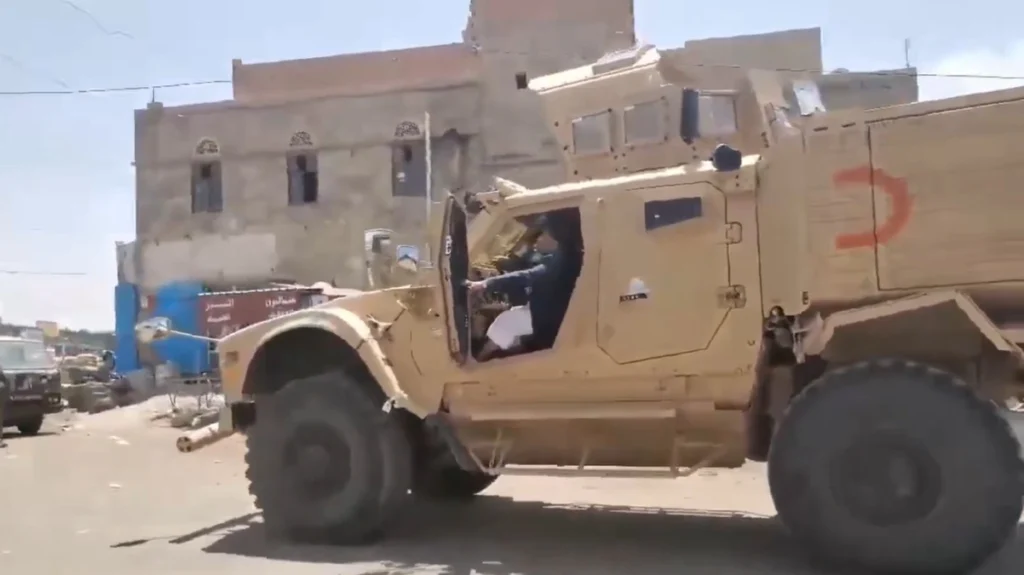
Expanding clashes are threatening the fragile calm that has prevailed since the 2022 UN-mediated truce.
After more than four years of fragile calm along Yemen’s major front lines, fierce fighting between government forces and the Houthis has spread across the country’s western and northern regions, while the Houthis have resumed large-scale attacks inside Saudi Arabia.
RELATED:
Yemen’s Houthi Rebels Attack Saudi-Linked Oil Tanker
Analysts say the latest escalation is putting mounting strain on the informal Saudi-Houthi understandings forged in the wake of the UN-brokered truce in 2022, and should the latest exchange of attacks and retaliatory strikes evolve into a sustained cycle, the risk of a broader escalation would increase substantially.
CURRENT SITUATION
The latest escalation first gathered momentum in western Yemen, where intense fighting erupted in southwestern Taiz province and neighboring Red Sea province of Hodeidah. Houthi forces sought to cut key roads linking Taiz with the government-held Red Sea port of Mocha and advance toward territory near Bab al-Mandab.
“The battle for Bab al-Mandab is not simply about gaining territory inside Yemen. Whoever can threaten this waterway acquires leverage that extends well beyond Yemen’s borders,” Aden-based political analyst Muqbil Naji said.
The fighting did not remain confined to western Yemen. Government forces subsequently launched a major offensive in Al-Jawf, a northern province bordering Saudi Arabia and located east of the Houthi-held capital Sanaa. Fighting has also intensified on other fronts.
The widening battlefield has changed the military dynamics. The Houthis initially pressed their offensive in western Yemen toward areas near Bab al-Mandab, but additional fronts subsequently opened elsewhere, forcing them to redistribute forces.
“Opening multiple fronts by Yemen’s government will weaken the Houthis,” said Abdul-Salam Mohamad, chairman of the Abaad Studies and Research Center.
As military pressure expanded inside Yemen, the Houthis widened the confrontation beyond the country’s borders. On Tuesday, the group fired dozens of ballistic missiles and drones at military and energy facilities across southern Saudi Arabia. Saudi authorities said attacks on civilian and economic sites in Abha, Khamis Mushait, Jazan and Najran wounded 73 people and caused fires at several energy facilities.
“The attacks on Saudi Arabia should not be viewed separately from what is happening on the ground in Yemen,” Naji said, adding that by increasing the costs for Riyadh, the Houthis could be seeking to create a new equation in which Saudi Arabia has greater incentive to restrain military pressure from Yemeni government forces.
On Monday, UN Special Envoy for Yemen Hans Grundberg described the renewed escalation as “extremely alarming,” warning that increasingly intense clashes threatened to expand the conflict and further complicate prospects for a political settlement.
OIL-TRADE — MAJOR DEVELOPMENTS IN YEMEN
The war in Yemen flared up and the Houthis seized much territory from the Saudi-backed government.
The coastal areas they seized are of key importance and essentially allow control over the Suez Canal.
Iran blocks traffic through… pic.twitter.com/FMWHqcQPIF
— Lord Bebo (@MyLordBebo) September 10, 2026

BEHIND THE ESCALATION
Yemen has been mired in conflict since late 2014, when the Houthis seized Sanaa and much of northern Yemen, forcing the internationally recognized government out of the capital. A Saudi-led coalition intervened in the conflict in 2015 in support of the Yemeni government.
The UN-mediated truce that began in April 2022 formally expired six months later, but relative calm largely persisted for years afterward. The period of direct Saudi-Houthi confrontation gradually gave way to an undeclared arrangement under which cross-border attacks and Saudi air operations sharply declined even though no comprehensive peace agreement was reached.
That informal arrangement now lies at the center of the current crisis. Salah Ali Salah, a researcher at the Sanaa Center for Strategic Studies, described what remains of that relationship as a “gray area.”
Salah said years of conflict management without resolving the war’s fundamental political, security and economic disputes helped produce today’s vulnerability. Temporary de-escalation can give the parties time to “catch their breath and reposition their military and political strategies,” he said.
According to Salah, recent attacks do not necessarily mean the undeclared understandings have collapsed, but they are becoming more fragile and less capable of containing escalation.
“Both Riyadh and the Houthis understood the enormous costs of returning to sustained direct warfare,” he said, adding that the greater danger lies in “repeated exchanges becoming a sustained cycle of retaliation.”
If that happens, Salah said, both sides could begin reassessing the informal “rules of engagement” that have helped contain direct confrontation in recent years, increasing the risk that “a calibrated escalation becomes harder to control.”
For now, however, Naji believes Saudi Arabia has not yet decided to return to the open-ended military intervention seen during earlier stages of Yemen’s war. “Saudi Arabia still appears to be calibrating its response,” he said. “The objective at this stage seems to be deterrence and gradual pressure rather than immediately entering a decisive war.”
The Houthis are advancing in western Yemen and moving closer to Mocha and Zubab — cities near the strategic Bab el-Mandeb Strait
According to Reuters, their goal is to establish control over the entire Red Sea coastline.
If the Houthis seize control of the area around the… pic.twitter.com/RWrUDwCLBm
— NEXTA (@nexta_tv) September 10, 2026
WHERE DOES ESCALATION LEAD?
The Yemeni analysts agree that a return to the calm of recent years is becoming more difficult, but they differ on what may come next.
Mohamad outlined three possible scenarios. His most likely scenario is continued fighting followed by another temporary truce after significant changes on the battlefield. “The war might halt, or a temporary truce might be reached,” he said.
In his assessment, however, such as pause would come after changes in the military balance rather than through an immediate restoration of the pre-escalation status quo.
A second possibility is a much wider war. Continued Houthi attacks inside Saudi Arabia could alter Riyadh’s calculations, Mohamad said, potentially leading to stronger Saudi backing for a broad government offensive.
His third scenario — an early Houthi move toward de-escalation and a restoration of the previous status quo — is less likely because the military and economic conditions underlying the current confrontation have already changed. “The situation is poised to explode,” Mohamad said.
Salah described “a full-scale Saudi-Houthi confrontation as the most dangerous potential outcome, though not the most likely for now.” That calculation could change, he said, “if cross-border attacks persist, ground operations widen or a high-impact strike inflicts enough casualties to force either side to fundamentally reassess its response.”
The risk, Salah said, is that a confrontation could develop beyond the calculations that initially produced it. A confrontation can begin with controlled attacks designed to signal resolve, he said, but retaliation and counter-retaliation could create a chain reaction that becomes increasingly difficult to stop.
According to Salah, the more likely scenario is “a prolonged period of limited, intermittent escalation.” Under this scenario, the parties would continue using military pressure to gain territory and strengthen their bargaining position while keeping some channels of communication open and seeking to avoid an all-out war.
teleSUR/ JF
Source: Xinhua
From teleSUR English via This RSS Feed.