

Bullets:
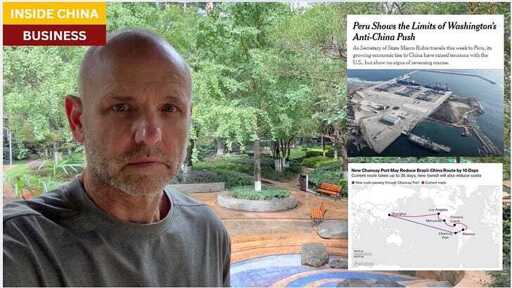
The Port of Chancay, in Peru, has transformed global logistics, shortened trade routes between Asia and Latin America, and opened vast new markets for South American farmers and merchants.
It was part of China’s massive Belt and Road Initiative investments across South America.
The port cost about $1.3 billion to build, over nine years, mostly paid for by Chinese firms.
For the same money, the Peruvian government ordered 12 F-16 fighter jets, which may be delivered before 2031.
Inside China / Business is a reader-supported publication. To receive new posts and support my work, consider becoming a free or paid subscriber.
Report:
Good morning.
A decade ago, China announced plans for a major Belt-and-Road Initiative project in Peru, a Pacific port that would open up vast new trade opportunities between South America and Asia. Then the phones started ringing. The US State Department called the Peruvian ambassador, to ask why Peru was partnering with China for such an important project, in such an important location.
Mr. Castilla replied that Peru is open to doing business with anyone, but nobody on Wall Street would take their meetings. China did, and agreed to invest $1.3 billion to build out the first phase of the port at Chancay.
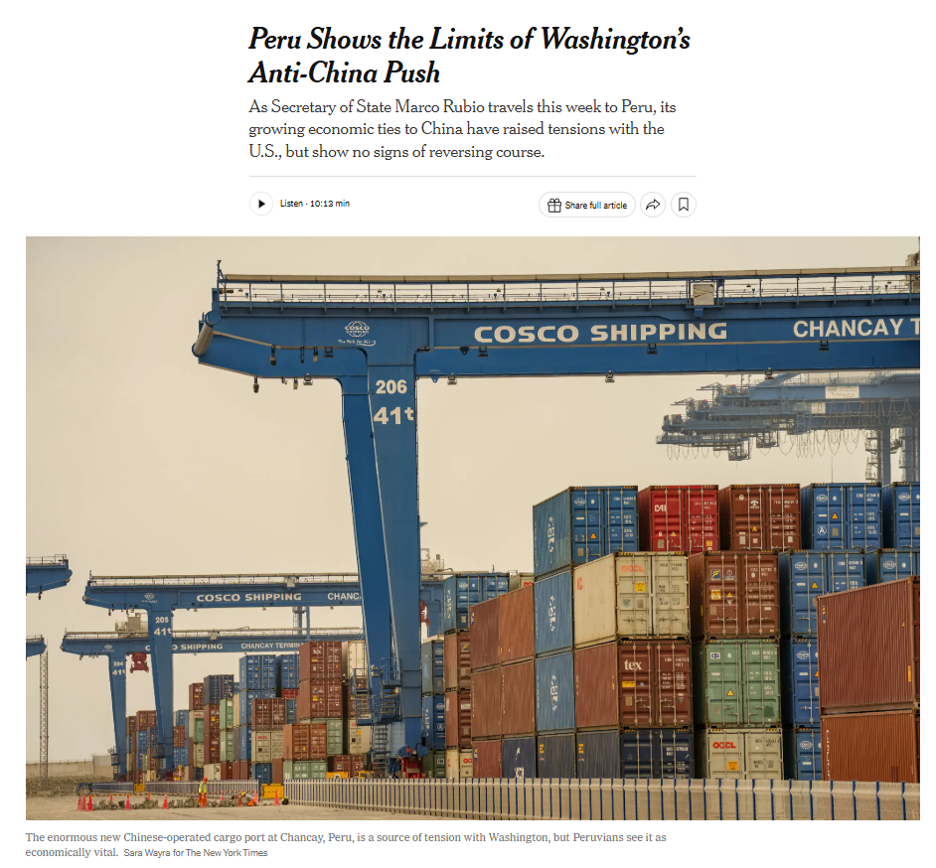
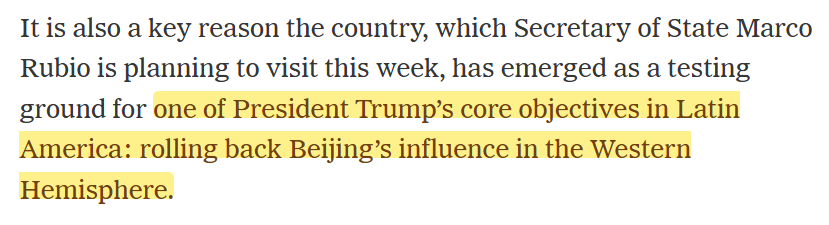
Marco Rubio is Secretary of State these days, and now that the port is finished and ships are being loaded and sailing back and forth, he’s flying down to Peru. The objective of the current administration is to “roll back” Chinese influence in the Western Hemisphere.

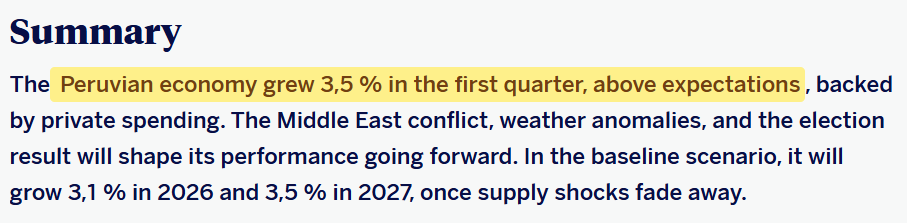
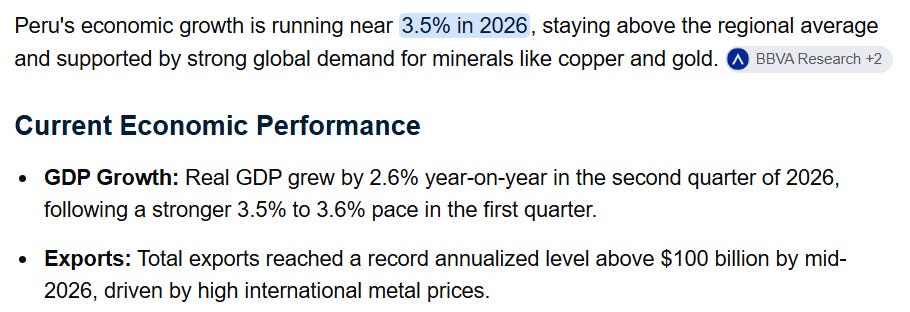
Today China is Peru’s biggest trade partner, and has key investments in mining, energy, and infrastructure. That in turn helped make Peru’s economy one of the strongest in the region, growing faster than expected for three years running. Peru has a new President, who describes Peru as a bridge between Latin America—the whole continent–and Asia, the continent. Peru will be deeply integrated with supply chains and consumers here.
That’s a function of where Peru is. Shipping times between ports in China and elsewhere in Asia are cut by about half, because of that new port at Chancay, which also is the world’s most modern and efficient. Autonomous cranes and trucks, and fully automated and remote-controlled loading and unloading operations. A tunnel a mile long runs underneath the city.
When the global economy froze up after the subprime crisis and the construction industry in North America shut down, Chinese firms stepped up to buy raw materials from Peru, and today takes a third of Peru’s total exports. China was “the perfect partner” during those years. “They bought everything.”
Chinese investors think longer-term than private Western firms; China is more patient, and now that the port is open, and trade is expanding, the Chancay area is booming. The local hospitality industry, universities, and healthcare companies are buying up land and renting buildings. Washington officials are unhappy, and floated ideas to put high tariffs on anything coming out of ports in South America built with Chinese money.
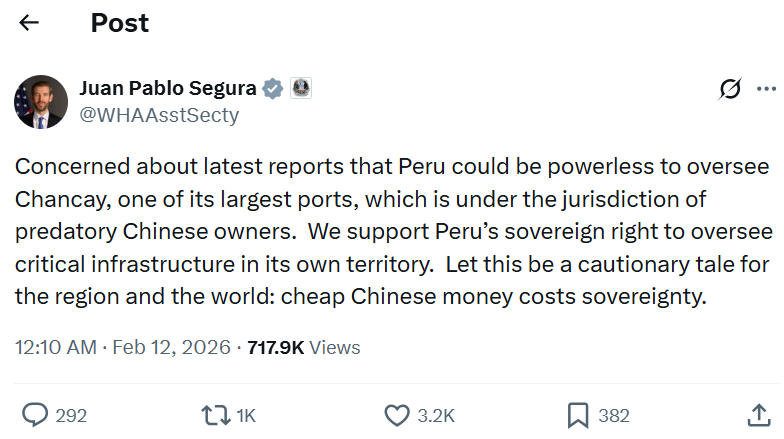
But it seems like Peru is pleased with the way everything is going so far. Peruvians are proud of the port, and the new standing the country enjoys. And they point out the differences between their relationship with Beijing, compared to Washington. China pays for important infrastructure, and makes long-term investments into jobs-producing industries.
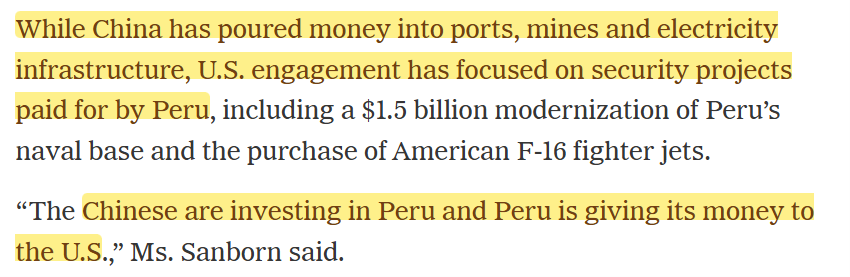
US engagement is focused on defense and security projects, which Peru pays for. Case in point is a $1.5 billion upgrade of Peru’s naval facilities and down payments on some American F-16’s.
China’s Belt-and-Road Port is much more popular, politically, than that decision to buy 24 fighter jets from Lockheed Martin. Last April the outgoing president punted, and deferred the final decision to the next president. He said that it would be irresponsible for a transitional government to bind the incoming administration. A pair of cabinet ministers resigned, because of the pause, then a $462 million down payment did go out—that was the “first installment”—then the purchase halted again.
The United States is pushing the government in Peru to buy the planes and thereby “shore up influence in Peru”.
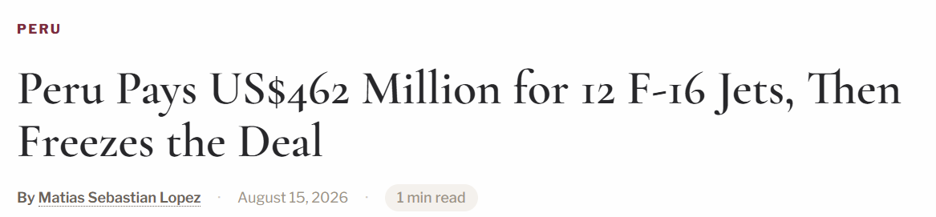
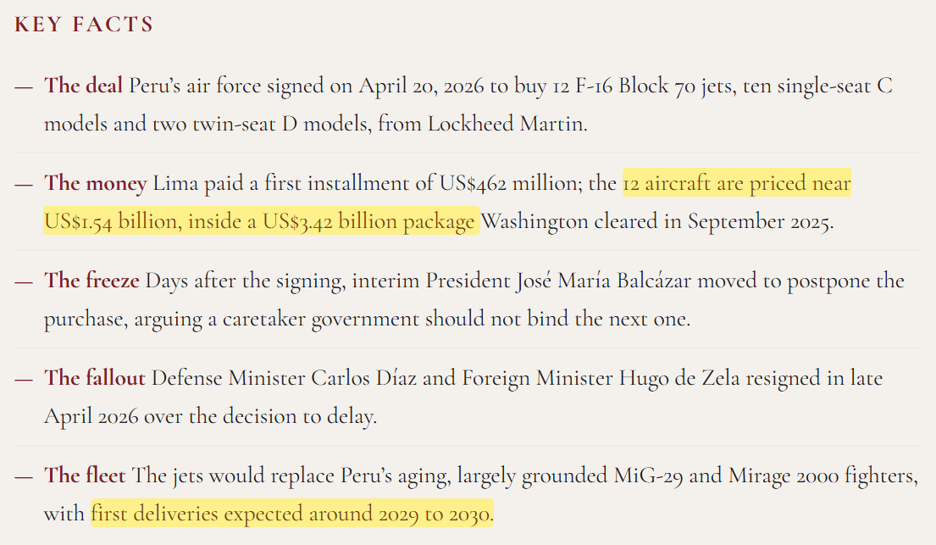
So here’s the math. Peru’s Air Force agreed to buy 12 F-16 Block 70 aircraft from Lockheed Martin. Base price: $1.54 billion. Then come the weapons and training packages, for a total sticker price of $2 billion, with first deliveries expected in 2029 or 2030.
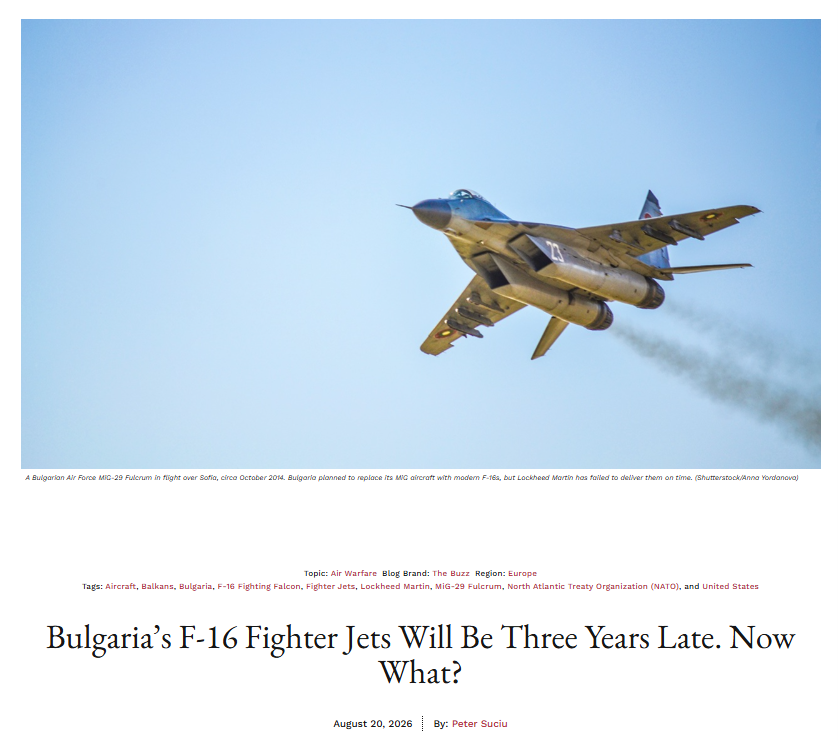
That’s probably optimistic, considering the news just out of Bulgaria: they ordered eight Block 70 F-16’s in 2022. Four years ago, Bulgaria ordered eight aircraft, for delivery next year—2027. Lockheed told them there’s a delay, with a new date is Q2 of 2030, at the earliest. “Bulgarian officials are understandably unhappy”, and let’s assume that Peruvian officials are understandably skeptical that their planes will show up in 2030, which were ordered this year.
We don’t want to be at all subtle on this point, about how far the same money will go, depending on who is building what. The Chancay port was built on a budget of $1.3 billion, and completed on time. The port transforms logistics and supply chains between the hemispheres. Today the trade bypasses ports in the United States and Mexico.
Chancay is the first deepwater port on the Pacific Coast of South America that can take Ultra-Large Container Vessels with over 20,000 twenty-foot shipping containers.
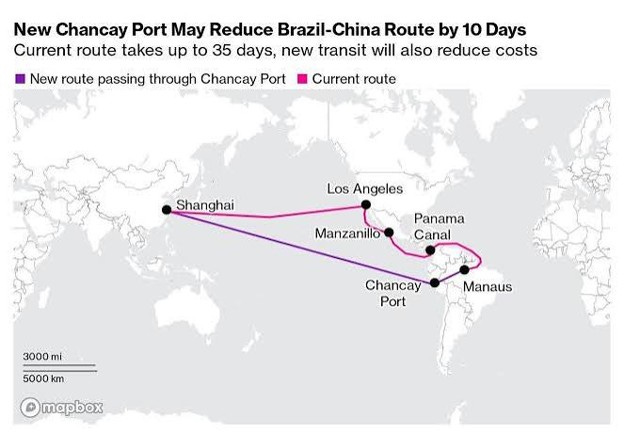
Before Chancay, those ships had to dock further up the coast, and South American businesses paid higher freight costs and suffered longer transit times, and were dependent on relationships with Mexico and the United States to move freight. That’s gone now. Full capacity at Chancay is over 3 million containers a year, and new trading routes are being set up. Port productivity is far higher than at North American ports.
Peru’s economy is already booming, driven largely by increased trade with China. And Chancay is a major transshipment hub for other Latin American countries who save money and time, and who are opening markets in Asia, by shipping through Peru.
Peru got all of that for a cost of under $1.5 billion, most of which was from China. For that same money, Peru signed a contract to buy 12 planes from Lockheed Martin, which won’t show up until next decade.
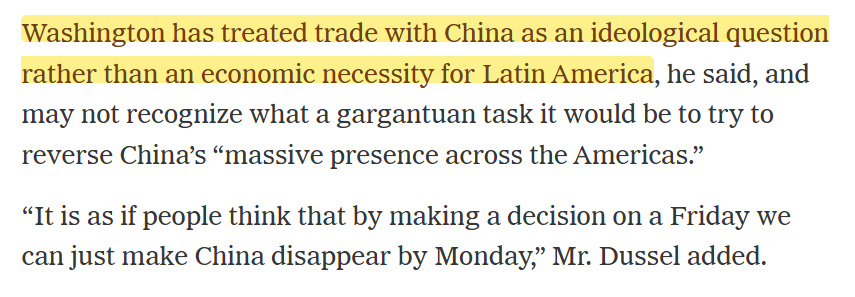
That’s just one project. But continent-wide, Chinese companies have put in over $130 billion, across more than 300 projects. “Washington has treated trade with China as an ideological question.” But for Latin America, it’s existential.
Be Good.
Resources and links:
Peru Shows the Limits of Washington’s Anti-China Push
https://www.nytimes.com/2026/09/07/world/americas/peru-trump-china-economy.html
Peru Economic Outlook – June 2026
https://www.bbvaresearch.com/en/publicaciones/peru-economic-outlook-june-2026/
Peru’s interim president defers $3.5 billion fighter jet purchase to the next government
https://apnews.com/article/peru-fighter-jets-purchase-balcazar-presidential-election-6fa5fcfbaea1e53283cd87ab21a8000a
Peru makes first payment in F 16 deal after ministers quit in clash with president
https://www.reuters.com/business/aerospace-defense/peru-defense-minister-resigns-amid-postponement-f-16-aircraft-purchase-2026-04-22/
Peru Pays US$462 Million for 12 F-16 Jets, Then Freezes the Deal
https://www.riotimesonline.com/peru-pays-us462-million-for-12-f-16-jets-then-freezes-the-deal/
Bulgaria’s F-16 Fighter Jets Will Be Three Years Late. Now What?
https://nationalinterest.org/blog/buzz/bulgarias-f-16-fighter-jets-will-be-three-years-late-now-what-ps-082026
China’s new gateway into South America: the Port of Chancay
https://asiatimes.com/2025/11/chinas-new-gateway-into-south-america-the-port-of-chancay/
Inside China / Business is a reader-supported publication. To receive new posts and support my work, consider becoming a free or paid subscriber.
From Inside China / Business via This RSS Feed.