


B****y A. AL-MUHAJIR (in Leipzig and Halle, Germany)
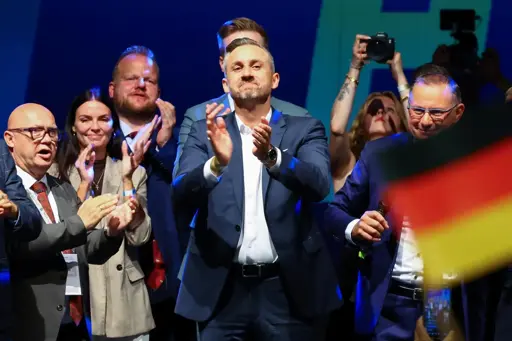
Sept, 6, 2026, “A Dark Day” — On Sept. 6, the far-right Alternative für Deutschland (Alternative for Germany or AfD) trounced its opponents in the state election in Sachsen-Anhalt (Saxony-Anhalt) state. For the first time in German postwar history, a party of the far right has won a state election. Everyone here from the far left to the liberal center sees this as one of the darkest moments of German postwar history.
The election results, in summary
At the time of writing, with the polls recently closed, the AfD had secured almost 44 percent of the vote, a shocking result given the highly divided multiparty system in Germany. The Christian Democrats (CDU), one of the two dominant parties in Germany from the postwar era to the present, polled at just over 17 percent, almost 20 percent below its result from the last election.
The SPD (Social Democrats), die Linke (the Left) and Grünen (Greens) each polled at around 9 percent, a disappointing result for die Linke but a surprisingly good one for the other two. The fact that the leader of the SPD, the other dominant party both in postwar West Germany and in post-1989 East Germany, expressed enthusiasm at his party’s showing says everything about that party’s shambolic state in the East. As a rank-and-file member of the Sachsen-Anhalt SPD told me a few days before the election, the party has totally lost touch with its working-class base here.
The role of kingmaker now falls to the Bündnis Sahra Wagenknecht (BSW). A right-wing breakaway from the Linke, BSW has tried in the past few years to navigate a “red-brown” line by appealing to a highly romanticized image of “workers,” whom they imagine as predominantly ethnic German, anti-immigrant, and mired in Arbeitertümelei, a word that connotes stereotypes of workers as grizzled men toiling in factories who care only about wages and see issues of oppression as a “sideshow.”
Polling at around 5 percent, which is the minimum that a party must achieve to enter state parliament (Landtag), BSW leaders have said they are willing to work with the AfD on areas of agreement such as the cost of energy, which played a large role in the election. [Subsequent to this writing, the BSW was judged to have cleared the 5 percent threshold.] If the BSW does form a coalition with AfD, then the AfD will have the majority it needs to form a government. Alternatively and not out of the question is the scenario in which the AfD successfully recruits disaffected CDU members of parliament.
The AfD: Who are they and what is their program?
Formed in 2013 as a right neoliberal party, the AfD has over the past decade become an electoral and extraparliamentary force all over Germany but especially in the former GDR. This it did by transforming itself in the mold of Le Pen in France and the Lega and Meloni in Italy by appealing to anti-immigrant and racist sentiments, misogyny, and transphobia and anti-Queer bigotry.
The AfD has taken advantage of widespread racism and anti-immigrant sentiment in Germany to misdirect economic and political frustrations with a declining German capitalism toward the predictable far-right scapegoats: Muslims and Roma people, immigrants, along with women and the Queer community. AfD supporters have also been involved in increasing attacks on Pride parades—called Christopher Street Day or CSD parades—and other Queer spaces, and AfD leaders and parliamentarians constantly mouth Nazi-adjacent rhetoric and some even have been members of neo-Nazi organizations.
A main obsession of the AfD is immigration, which it wants to stop entirely. Its slogan, in its draft program and in the election, is “deportations from minute one!” Its first target will be immigrants without residency permits, all of whom it wants to deport. The program envisions more detention centers, a crackdown on asylum seekers, and defunding of “integration” programs. Its education policy is openly segregationist, envisioning separate schools for German citizens and for the children of parents without permanent residency.
It is also obsessed with what it calls “globalist” influences in art and culture, attacking “anti-German” art, the Bauhaus, which located in the Sachsen-Anhalt city of Dessau, rainbow flags and other symbols of diversity. Since the arts and culture (libraries, symphonies etc.) are largely funded by tax payers in Germany, a party with this kind of cultural politics poses a real threat to some of Europe’s and the world’s cultural treasures.
Much of the AfD program for Sachsen-Anhalt is rhetorical. For example, immigration enforcement and foreign policy—the AfD takes a position critical of Germany’s anti-Russia posture—are under the control of the federal government. However, in areas such as the media—AfD wants to defund tax-payer funded state media, for example—as well as the aforementioned arts funding, a state government can push through.
Sachsen-Anhalt
Sachsen-Anhalt, located in the former East Germany, is the poorest German state. More rural and older than most other parts of Germany, it has witnessed the emigration to other states of the young, particularly young women, over recent years.The Wende or “reunification” (literally, the “turning”) in 1989 was experienced by the majority of the people of the former GDR as an enormous dislocation. The complexity of this experience cannot be fairly discussed here. What is relevant to note here is that the economic consequences have been devastating for workers in the former GDR. Joblessness, underemployment, under-investment from the state, along with stereotypes of Easterners as everything from backward to Stalinist to authoritarian to far-right, have festered since then.
This author has been to the East countless times since the early 2000s and has never seen the East-West divide as toxic as it has been during this election season, a feeling confirmed by local people here. During the election campaign, one often saw social media comments, presumably by West Germans, such as “rebuild the wall” and “keep the blue-browns (i.e., AfD/fascist voters) in the East.”
In recent years, voting participation in Sachsen-Anhalt has been lower than the German average, as voters grew increasingly frustrated, even hopeless, with the economic stagnation and decline in services that have hit the state particularly hard. In this election, the AfD’s success can be largely attributed to the way it positioned itself as a challenge to the status quo overseen by the Altparteien, the “old parties.” In this election, voter turnout was 77.8%, a record high for Landtag elections here. In terms of both new voters and previous non-voters who turned out for this election, again the AfD was the clear winner.
They were also helped by the fact that the German chancellor, Merz, is at record-breaking lows in popularity. His highly unpopular reform package, which will increase the retirement age and make it harder to access sick leave, is seen as symptomatic of a German establishment that stands for more and more cuts to social services, more military spending, etc. Meanwhile, Merz and the CDU, along with at times even the SPD, have increasingly borrowed from the AfD’s anti-immigrant and racist rhetoric, blurring the differences between them. It should also be added that the AfD along with die Linke are the only parties that are critical of the German ruling class’s demonization of Russia and of its war mongering. Thus, albeit mendaciously, the AfD presents itself as an “antiwar” party.
One of the main slogans during the campaign has been “Politikwechsel” which expresses the desire for a wholesale change from the status quo. Boiled down to essentials, along the promise to crack down on immigrants, reassert “traditional family” values and “German” identity, the AfD has sloganeered around social welfare themes more clearly than the other parties. They have talked about reducing energy costs, redistribution (of a kind)—Geld für Deutsche, “money for Germans”—and increasing funding for rural communities, for education and health care: for “Germans,” naturally. The other parties, including the Linke, generally avoided such issues, focusing instead on “defending democracy” and other vague slogans. This couldn’t be clearer from exit polls, which showed that a whopping 65 percent of voters who described their financial situation as “bad” voted for the AfD.
The role of die Linke
Die Linke’s politics are similar to those of the DSA in the United States. They excel at projecting a youthful image online, their social media game is top-notch, and they claim, not without some justification, to be on the side of the marginalized people—workers, immigrants, Queer people and women. Of the main parties, it is striking that only members of the Linke articulate a clear critique of Germany’s support for Israel. Younger Linke members, in particular, are visible on social media wearing kafiyyas, joining and often co-organizing solidarity demonstrations, etc. This is not to minimize the party leadership’s fealty to the German state’s and elite’s “Hyper-Zionism,” however.
All of this is to say that the Linke is a contradictory formation. Its 9 percent vote is its lowest ever result in Sachsen-Anhalt, where it used to regularly get around 20 percent and even achieved almost 25 percent in 2011. What has been striking is how, at least in the former East Germany, it shies away from anything resembling a fighting, class struggle politics. It appeals to the defense of democracy and to, at most, defending rather than expanding social welfare programs. The posture of its leadership is entirely defensive and demobilizing.
These leaders seem more interested in responsible statecraft than in motivating their base to take to the streets, to militate in unions, etc. There is currently a real and open debate here about whether the AfD is a fascist party. It is astonishing therefore to hear Linke party leaders, in their post-election analysis, say nothing about their extraparliamentary strategy, nothing about the role of the unions or the working class in the struggle against the far right, nothing about strikes or street mobilizations. They’re busy counting parliamentary seats and engaging in coalition algebra while their base is looking for leadership to defend against the existential threat posed by the AfD.
Looking ahead
Two weeks after the time of writing, state elections will take place in Berlin and Mecklenburg-Vorpommern, also in the former East. Die Linke is expected to do very well in the former, the SPD and AfD in the latter (the Linke is also polling at around 11 percent in M-V). One or more of these is expected to get a boost from the Sachsen-Anhalt election.
One silver lining, arguably, from the Sachsen-Anhalt election was the youth vote. While among under 30s, the AfD still scored around 44 percent of the vote, the vote for the Linke was around 17 percent, two times higher than the party’s overall vote; among those under 18, polled by a federal program for youth voter engagement, the Linke is the clear leader at 31 percent to the AfD’s 22 percent.
The German youth are also leading dynamic antifascist and solidarity movements all over the country, including in the East. A street movement of thousands mobilized in the eastern city of Erfurt in early July to blockade the AfD party conference. This was a sign of hope, according to a leading left-wing daily. At the small town of Sangerhausen, Sachsen-Anhalt, hundreds of mainly youth protesters led by Palestine solidarity groups mobilized in late August to protest the establishment of an arms plant by the Israeli firm Elbit. Out of this, organizers built discussion circles with local residents, many of whom are older and working class. Over 15,000 protested in Magdeburg, capital of Sachsen-Anhalt, against the AfD ahead of the election.
Activists I’ve spoken to here have looked, maybe surprisingly, to the U.S., among other places, for lessons not only in “how bad it can get”—though there’s a lot of that, understandably—but also to learn from positive examples. For example, from the militancy of the Minneapolis movement against ICE, which is seen as a model of community organizing from below against the far right. The Palestine solidarity movements in both the U.S. and Britain have also been mentioned as giving the movements here more confidence to challenge Germany’shyper-Zionism. And activists have also been impressed with Mamdani’s skill at social media and his ability to speak clearly to mass audiences.
Comrades in various socialist groups here in Leipzig are currently organizing for mass mobilizations in late September against austerity and are clearly connecting these to the rise of the far right and to immigrant workers’ struggles. They are in a fighting mood. They have been for a while. The movements here are internationalist, youth-led, and are not going to give up. As the old German antifascist saying has it, Kein Fussbreit dem Faschismus! Not an inch to the fascists!
Photo: Ulrich Siegmund, leader of the AfD in Saxony-Anhalt. (Fabrizio Bensch / Reuters)
The post Far-right breakthrough in Germany: A report from Saxony-Anhalt first appeared on Workers’ Voice/La Voz de los Trabajadores.
From Workers’ Voice/La Voz de los Trabajadores via This RSS Feed.