

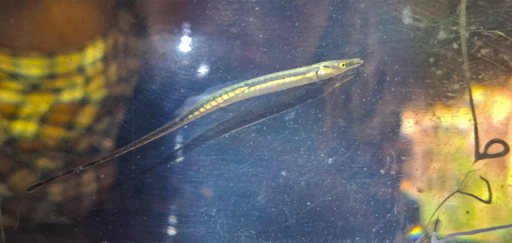
Founder’s Briefs: An occasional series where Mongabay founder Rhett Ayers Butler shares analysis, perspectives and story summaries. On the final day of a two-week expedition, where researchers were searching for a “lost” species along Papua New Guinea’s Sepik River, Helen Asu arrived with two small, greenish-brown fish. She had caught them while fishing for prawns with an umben, a traditional hand net, near Imbando village in East Sepik province. They were spinach pipefish (Microphis spinachioides), a species known only from the Sepik and not recorded by scientists since 1985, reports Mongabay’s Spoorthy Raman. “It was honestly an incredible moment,” said Jerrica Agebigo, a researcher at the Papua New Guinea University of Technology and the New Guinea Binatang Research Centre, who led the expedition. “When Helen showed the fish to us, I immediately realized that we had found something very special.” The spinach pipefish is a freshwater relative of seahorses and seadragons. It grows to about 15 centimeters (6 inches) and uses its elongated snout to catch small prey. Its coloring helps conceal it among water lilies and other plants along the banks of the Sepik, Papua New Guinea’s longest river. Almost everything else about it remains uncertain. The specimen used to describe the species was held at Hamburg’s natural history museum, but was destroyed during the second world war. When the fish was last assessed for the IUCN Red List in 2016, it was classified as data deficient. It later became one of the 10 most sought-after species on the…This article was originally published on Mongabay
From Conservation news via This RSS Feed.