

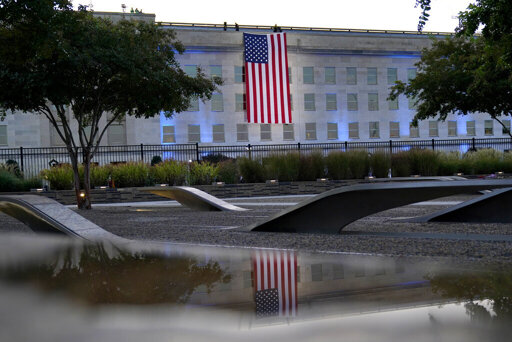

This year marks the 25th anniversary since the attacks on Sept. 11, 2001, in New York City and Washington, D.C. If you are feeling triggered, the Centers for Disease Control and Prevention operates a Disaster Distress Helpline at 800-985-5590.
Editor’s Note: Renae Ditmer, a citizen of the Sault Tribe of Chippewa Indians, is a regular contributor to ICT.
Renae Ditmer
Special to ICT
Time goes so fast. It’s almost a cliché except that, like most, it has a foothold in reality. I, along with 25,000 others, was in the Pentagon on Sept. 11, 2001, and every year it gets further and further in my rearview mirror. But there are elements of that day and the days that followed that are etched on both my memory and my heart. Here’s a look at how I recall the events that unfolded.
Dear Friends,
Like all of us there that day, the attack on 9/11 was an event none of us could have anticipated.
That is except, perhaps, for Kenneth Williams, an expert in Middle Eastern terrorism who had penned the Phoenix Electronic Communication memo out of the FBI field office in Phoenix prior to 9/11.
He had uncovered a pattern of Middle Eastern pilots being trained to minimal flight standards at civilian and professional flight schools and simulators across the United States. He suspected Osama bin Laden was funding the training, yet everyone in the ivory towers of the FBI’s office in Washington, D.C. ignored it. It was an internal memo that got buried with all of the thousands of others written every week. Unimportant until it wasn’t.

Renae Ditmer, Ph.D., a citizen of the Sault Tribe of Chippewa Indians, is a regular contributor to ICT. She has a doctorate in government from Georgetown University and a master’s in strategic studies and international economics from the Johns Hopkins Paul H. Nitze School of Advanced International Studies. Credit: Courtesy of Renae Ditmer
I was working in the Pentagon in the Offices of the Secretary of Defense for Dov Zakheim, Under-Secretary (Comptroller) and Chief Financial Officer of the Department of Defense. As a Ph.D. summer economic intern, I was holed up in a Sensitive Compartmented Information Facility, known as a SCIF, in the Pentagon basement between the 8th and 9th sectors. We had half-windows because the rings of the Pentagon are so close together that it would be impossible for anyone to get any kind of look into our policy shop.
One of my colleagues in the next room monitored the morning news as part of his morning routine. We had become quick friends. He was a quiet, thoughtful man, not prone to excitement. So when he yelled my name that morning, I jumped up and ran to his desk. Pointing to the TV screen, he was speechless as the clip of American Airlines Flight 11 hitting the World Trade Center at 8:46 a.m. EDT played in an endless loop.
I stood behind him trying to process what was happening. The talking heads were reporting that a small plane had hit the tower, but anyone that knows anything about how skyscrapers are constructed was more than skeptical. When United Airlines Flight 175 hit the South Tower at 9:03 a.m. EDT, we knew Washington, D.C. had to be next. Three targets stood out: the White House, the Capitol, and the Pentagon. But with no official orders given as to what to do, we continued working in an atmosphere we had nearly sucked the air out of already. Something wasn’t right. We were being kept in the dark intentionally. Nevertheless, on with business we went.
I had never imagined myself thrust so unwillingly into history. Most of the life stories that I’d written for myself had involved grandeur of a different kind: becoming a national political leader, writing a book that people would marvel at 200 years from now, discovering something scientifically novel. That was not to be. Instead, I was one of the 25,000 people in the Pentagon when American Airlines Flight 77 hit the building at 9:37 a.m. EDT on Sept. 11, 2001. That has become my 15 minutes of fame thus far.
One thing that everyone in Washington, D.C. there that tragic day is that it was one of the most beautiful days they could remember. The crisp, blue end-of-summer sky was sparsely streaked with a few wispy white clouds that could not dim the brightness of the morning sun. Stunning. Memorable. The kind of memory that now provokes anxiety attacks every time we see another just like it.
New York was no different, though the smoke pouring from the Trade Towers quickly obscured the dazzling weather as it would eventually in D.C… But even before that, my day had started out with its own dark moment, the reason I had stopped for tea. The government job offer I had gotten from the office I was interning in a week before had been withdrawn, largely due to a report I had written on how much revenue surplus the U.S. really had. My conclusion had not been what they had anticipated, and certainly not a number that would allow President George W. Bush to expand the Department of Defense as he had planned. Ironically, but not surprisingly, I was the first casualty of my own report, so someone obviously took what had been a “throw-away assignment” for the summer intern — me — seriously. That was my only consolation.
So, even after watching the World Trade Center Towers go down, with no order to stand down, I headed to the Pentagon library in Sector 5 to pull myself together and to do some editing on another project I was working. Feeling a bit beaten up emotionally, I decided to stop for a cup of tea en route. This was not characteristic. I was raising three kids on a very meager income and spent precious little on even little luxuries like lunch. That cup of tea made me feel even guiltier with no job in hand. But there I sat, churning over in my mind what was happening in New York, concerned that we might be next. and trying to focus on my work.
Then came the alarms. And the frantic pleas of the very distraught young cafeteria cashier to evacuate. I can still hear the terror in her voice. Per protocol, because I worked in a SCIF (pronounced “skiff”) and my computer had a Top Secret drive in it, I was required to shut my system down and remove the drive to physically carry to our rendezvous point where it would be collected by my leadership and secured.
I wasn’t far from my office, but I had to fight the crowd hurriedly exiting the building to get there. About halfway there I ran into my bosses, weighted down with every computer drive in the office, who asked where I was going. I told them I was going to shut my computer down and grab the hard drive. They told me to turn around and get out of the building, but even then I did not know why. Part of the confusion and the disconnect with reality in seeing my bosses with the drives came from the four fire drills we had had the previous two weeks. We had missed our July and August fire drills, so they decided to do a two-er the first week of September. On top of that, we had had what in retrospect seem to have been false flags, and thought this was just one more — until we got outside.
The sight was surreal. The definition of chaos. Smoke pouring out of the back side of the building, pandemonium in the parking lots and on the Pentagon grounds. The nearly 25,000 people that had evacuated the building in less than two minutes filled every square inch of the northwest side of the building down to the Potomac River, and all of us were trying to find our rendezvous points while trying to dial home.
CNN and FoxNews helicopters were overhead in a flash. There two hours faster than armed close air support two hours away. Everyone was trying to call out to find out what was going on. The privileged few who had parking spots near the building and who had raced to their cars turned on their radios finally filling us all in: A California-bound plane out of Washington Dulles had hit the building’s southwest corner. Fully loaded with fuel for its cross country flight to Los Angeles, the impact into the 3rd and 4th sectors converted it into a massive missile.
Like many others with some emergency or first aid training, I tried to head to the area that had been hit to see if I could help. We were turned back. We would have been useless in the turmoil and acrid, tarry smoke, and the first responders didn’t need any more casualties to deal with than they already had. But rational thinking had long since left the building.
So we waited. And tried frantically to call our families. The national news reported later that we had jammed the cell grid, but I am not alone in suspecting that someone ordered the grid shut down. I say this because my sister, Judy, managed to get through to me twice from Michigan within a five minute or so span, but long enough to know that I was OK and for her to let me know that she had gotten hold of my folks and my kids. At least they knew I was alive.
After checking in at our rendezvous point, I headed toward the river. As warnings of “incoming” began, I thought that I at least had a fighting chance if I could make it to the water because I could swim. It sounded logical at the time. It sounds a bit arrogant and crazy now.
But finally, after two hours of warnings of “incoming,” we all started to walk home. Nice day or not, the lack of water and bathrooms made that a necessity. Like many who worked there, I commuted in by rail, and cars weren’t being allowed to leave the compound. It was 25 miles or so away, but I thought I would make it home before the boys, who were in high school at the time, could put our family emergency plan into action and somehow make their way to Michigan where my parents lived. It might sound absurd that we had a plan, but we had been under direct threat in France during the first Gulf War (a whole other chapter), and I wanted my kids to know what to do in case I didn’t come home some evening.
I was lucky, though. I didn’t get very far in my heels before someone decided to let cars leave the parking lots. I ultimately I hitched a couple of rides — one with a car full of military contractors that got me to the West Falls Church Metro, and a second in a creamy white tricked out Cadillac SUV owned by a local drug dealer who had come to pick his girlfriend up at the Metro station and was headed to Manassas.
I made it to the house by 5 p.m., only to find my kids and their friends in a near panic waiting for me there along with nearly 50 emails and so many delayed voice mails that I lost count. An outpouring of love and concern for me and my family. Many of my colleagues didn’t make it home until the next day. But we were fortunate. The count of the dead that day has always varied between 184 and 187 for reasons I am loathe to explain here.
I credit my son, Andrew, for not only doing what he did best — skipping school — and catching a glimpse of the Pentagon on fire, then remembering what I taught him to do in the event I didn’t make it home one day. I credit my son, Robert, for unquestioningly listening to him and crashing the doors at school to get home before they locked down the entire place. I credit my daughter, Megan, in her third year at the University of Chicago, for reassuring the boys that they would work it out whatever happened to me.
I don’t know who said first that he was “always surprised at the quality of his friends,” but I know now what he meant.
Americans were all friends that day and for two years to come, as the anthrax letters two weeks later then the D.C. Sniper a year later terrorized the region again with random killings. We all relied on the fundamental good will of the American people to take care of each other under duress, and we weren’t disappointed. I still pray for that young drug dealer as often as I think of him. I still have his girlfriend’s business card.
In retrospect, it was curious that none of us in my office felt the plane hit the building except our chief comptroller, Bryan Jack, who was on Flight 77. He was the only one amongst us to perish that day from our division, but the impact radiated beyond that.
I repost his obituary every 9/11 on FaceBook. He was a man who deserves to be remembered. And we all knew others that perished. Some of my colleagues attended funerals for months. We all recall returning to work within a day or so of the attack, and walking past the Ground Zero Cafe — the center of the Pentagon — being used as a morgue. I haven’t eaten there since.
The fire was not yet out and wouldn’t be for days; the dense soot and smoke from the diesel fuel from the plane lingered for weeks. We all recall being asked to provide respite for the first responders who spent weeks trying to recover bodies and evidence from the site. I wonder if they ever slept. I know that we didn’t after letting them talk. To this day, I see valiant men in tears because they couldn’t do more. I still see the tears of relief in the face of my colleague who tried to come looking for me when he found me in the parking lot. I’ve never had anyone except my children sob over my existence. But here, this beloved man, had tried to come and find me in the library, only to be turned back, but found me at our rendezvous point. I will never forget his face when he saw me. He grabbed me, sobbing, falling on his knees, and thanking God that I was alive.
It’s interesting in a crisis what your priorities come down to. I just wanted to see my kids grow up, and now they are. That day gave me a new lease on life and a perspective that only a close brush with infinity can bring.
I will never forget the outpouring of love for me and for my children that day. My kids, now in their 40s, have never recovered. Every 9/11 refreshes the near loss. For me, every bright blue, perfect fall day reminds me of how fragile our lives are. Our fate truly rests in God’s hands. I have sought to honor my survival with an exuberance for life that I had not known until then.
Those sound like perfunctory accolades, but they are not. My children constantly remind me that I was spared. While I’m still realizing the purpose, and while these past few years have been the most difficult in my life in so many ways, I do so with new-found energy and passion, and pray that my colleagues do the same. I live life to the fullest now. I wake up every day asking God to help me not to miss what He has for me that day.
I make time for people because at the end of the day I want someone to miss me. I keep up with friends — some only via Facebook — but people I love and from whom I am separated by geography only.
All that said, let me repeat that it’s difficult to believe that 25 years have passed since we experienced the worst foreign attack on American soil. That beautiful fall day is forever inscribed in the minds of those of us who stood on the Pentagon lawn awaiting direction or assistance because it stood in such sharp contrast with the billowing smoke and the terror that permeated the scene.
Though we clearly recall that day, it is grievous that we have since forgotten the great rediscovery of who “we” are as Americans. On that day, and for at least two years after, we put aside our differences, and bound ourselves together against a common enemy, and stood together, flags flying from every imaginable place, to send a message to the world that our strength is in the “united” part of the United States. We eschewed labels. We weren’t “native-born or immigrant,” “gay or straight,” “black or white,” or encumbered by all of the things that it has taken more than 200 years and a mountain of law to erase.
You were either for us or against us, but the “us” was the important part. It was an awakening that far surpassed anything that many of us had experienced in our lifetimes.
Thus it is a tragedy that today we allow the petty and inconsequential to put a wedge in who we are. It is my hope and prayer that it will not take another national tragedy of this scale to bring us back to that place. In this postmodern age, we must be more deliberate than ever to identify and hold fast the common ground on which we all stand: our love of family, the devotion with which we practice our faith, and our hard-fought freedom. Let us not forget who we are. I was an incidental part of a history that no one anticipated, but which ploughed my own path ahead.
Pray for the families and loved ones of the lost. Pray for those of us who survived that we will never forget we were spared. Pray for peace.
And let us never forget.
May God bless you, and may God bless the United States of America.
With thanksgiving,
Renae
The post ‘Never Forget’: The view from inside the Pentagon on 9/11 appeared first on ICT.
From ICT via This RSS Feed.