

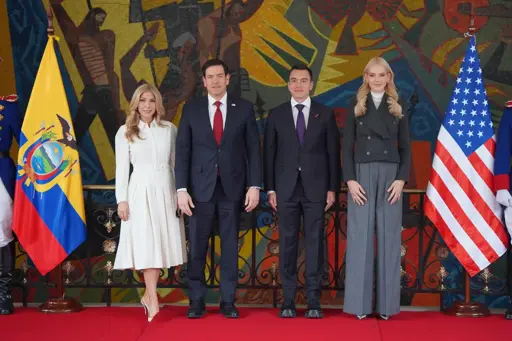
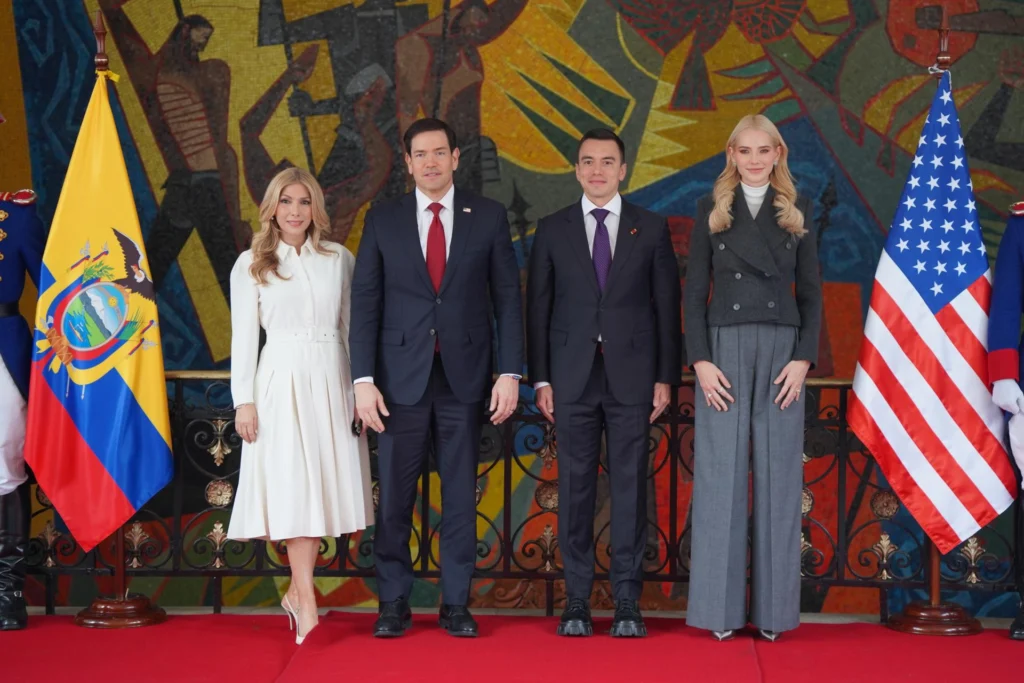
U.S. Secretary of State Marco Rubio met with Ecuadorian President Daniel Noboa in Quito on Wednesday, the second stop of his Latin America tour, announcing new security resources for Ecuador and formally designating the criminal gang Los Tiguerones as an alleged foreign terrorist organization.
U.S. Secretary of State Marco Rubio visited Ecuador this Wednesday, engaging in a series of high-level meetings and public events that underscored the deepening ties between the two nations. The visit, which included a conference at the presidential palace in Quito, highlighted the collaborative efforts in security and economic development.
Rubio’s visit to Quito was his second as Secretary of State, following a previous trip in September 2025 and an earlier visit during his tenure as a senator. His itinerary also included a stop in Peru, reflecting the broader regional engagement of the U.S. in Latin America.
RELATED: New Era in U.S.-Colombia Relations: Marco Rubio and De la Espriella Sign Strategic Deals
Marco Rubio arrived at the Carondelet Palace on Wednesday for a round of talks with Noboa, describing Ecuador as Washington’s principal regional ally in confronting the threat posed by drug trafficking and transnational criminal organizations. “We have no better ally in the region in terms of confronting what is the transnational criminal threat,” Rubio affirmed, arguing that groups operating across multiple countries can no longer be treated as ordinary local gangs, but rather as structures with terrorist-level capacity.
Los Tiguerones Declared as Terrorists
Regarding Los Tiguerones -a group that emerged in Ecuador with early ties to Los Choneros and has since grown into one of the country’s leading criminal organizations- Rubio was blunt: “We are not talking about a normal mafia, we are not talking about criminals. We are talking about terrorists.” The designation adds to earlier U.S. actions against Los Choneros and Los Lobos, both of which Washington has linked to Mexican cartels.
Beyond the terrorist designation itself, Rubio revealed that Washington also plans to sanction seven former Ecuadorian officials accused of colluding with criminal networks. “We also have to go after the corrupt officials who collaborate and conspire with these terrorist groups… for accepting bribes and betraying their most essential duties on behalf of these criminal groups,” though he did not name those set to be designated.
Rubio also announced that the Trump administration will ask Congress for an additional 45 million dollars to support Ecuador’s efforts to dismantle criminal organizations, alongside a separate 10 million dollars program targeting illegal mining, which he said is being used to finance alleged terrorist groups.
“We are doing a lot of things together,” Rubio said, highlighting joint operations between the two countries’ security forces.
#Ecuador | President Daniel Noboa met Marco Rubio in Quito as the U.S. pledged expanded security cooperation, including a request for $45M in additional funding, a $10M anti-illegal-mining initiative and new vessels for Ecuador.
Washington also designated Los Tiguerones a… pic.twitter.com/kXcUXti8bQ
— teleSUR English (@telesurenglish) September 10, 2026
New Equipment, New Deals
Beyond security, Marco Rubio underscored the potential for expanded economic and commercial ties. The U.S. Secretary of State highlighted Ecuador’s growing economy and the “enormous economic opportunities” that exist for both countries. Rubio’s message was clear: while security remains a cornerstone, the relationship between the U.S. and Ecuador is poised to grow in multiple dimensions.
On the financial front, Rubio confirmed that the Trump administration will request an additional 45 million dollars from Congress to continue dismantling alleged criminal organizations operating in Ecuador and across the region, alongside $13.5 million in further support and $6 million earmarked specifically for the acquisition of drones.
A separate $10 million program targeting illegal mining -an activity Rubio said is being used to finance terrorist organizations- was also announced. “We are doing a lot of things together,” Rubio said, highlighting joint operations between the two countries’ security forces.
As part of the security package, Rubio confirmed the transfer of a 110-foot U.S. Coast Guard vessel to Ecuador, with five additional interceptor boats set for delivery in the coming months -bringing the total number of such vessels transferred to Ecuador over the past year to 12.
The security agenda arrives at a moment of intense cooperation between the two governments. In recent weeks, the United States has carried out operations against Ecuadorian vessels in the Pacific that Washington links to trafficking networks tied to the so-called Los Choneros, with six vessels reported sunk in those operations as of Wednesday.
Boat Strikes to Continue
U.S. Secretary of State Marco Rubio announced that Washington will continue striking vessels it accuses of drug trafficking, a day after UN experts denounced at least 223 extrajudicial killings carried out by U.S. forces in international waters over the past year.
Speaking after meeting with President Daniel Noboa’s government, Rubio designated the gang group “Los Tiguerones” as an alleged terrorist organization, adding it to a list that already includes the so-called “Los Choneros” and “Los Lobos,” while Washington keeps 15 Ecuadorian entities and individuals under sanctions and has identified fishing-sector companies for future restrictions.
Just a day earlier, on Tuesday, UN experts had demanded an immediate end to the use of lethal force in international waters, reporting that since September 2, 2025, U.S. armed forces have struck 68 vessels in the Caribbean and Pacific, killing at least 223 people in operations that left no survivors or resulted in the total disappearance of crews.
The experts categorically rejected Washington’s invocation of self-defense under Article 51 of the UN Charter, arguing that drug-trafficking groups do not constitute parties to an armed conflict. “Calling it a war does not make it a war,” the rapporteurs stated, stressing that international law prohibits summary executions both on land and on the high seas.
The UN working group noted that lethal force is permitted only as a last resort against an imminent threat to life, and pointed out that the U.S. administration itself has acknowledged having the capacity to intercept the vessels but chose to destroy them instead. The group called for independent investigations to prosecute the civilian and military commanders responsible, demanded compensation for victims’ families, and urged countries in the region to refrain from sharing operational intelligence with U.S. forces.
Adding to the tension, the US Southern Command (SOUTHCOM) reported Wednesday that its forces carried out a “lethal kinetic strike” against a speedboat allegedly traveling a known trafficking route in the Caribbean, killing three people it described as “narco-terrorists” without presenting evidence. SOUTHCOM said intelligence had confirmed the vessel’s involvement in drug trafficking, and that the operation was carried out by the Joint Task Force Southern Spear under the command’s direction, though no details were released about the strike’s exact location or the identities of those killed -a pattern of limited disclosure that has fueled the UN’s calls for independent scrutiny of the broader campaign.
President Noboa awarded Rubio with Ecuador’s National Order of Merit in its highest degree, the Gran Cruz, a civilian honor previously granted this year to former U.S. Homeland Security Secretary Kristi Noem.
Deeply honored to receive Ecuador’s National Order of Merit, in the grade of Grand Cross, from @danielnoboaok in Quito today.
A meaningful recognition of the strong and growing partnership between the United States and Ecuador. pic.twitter.com/W2Y0fiNmMo
— Secretary Marco Rubio (@SecRubio) September 9, 2026
Taken together, the funding commitments, equipment transfers, terrorist designation and trade discussions position Wednesday’s meeting as one of the more substantive stops on Rubio’s broader Latin America tour, which continues on to Peru.
Rubio’s Ecuador stop followed a Tuesday visit to Colombia, where he met President Abelardo De la Espriella and pledged to help usher in a “golden era” in bilateral ties after tensions under former president Gustavo Petro. Rubio’s tour concludes Thursday in Peru, where he is scheduled to meet far-right President Keiko Fujimori.
From teleSUR English via This RSS Feed.