

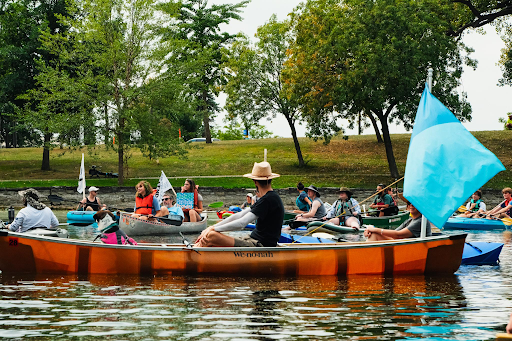
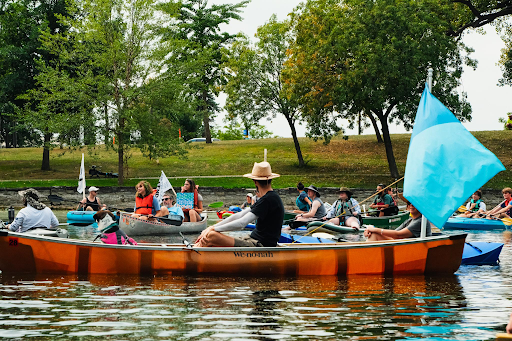
Minneapolis, MN – On Saturday, September 5, over 50 people converged on Minneapolis’s urban lakes to pressure Minnesota’s presumptive governor Amy Klobuchar to take a stand against sulfide mining. While the majority of those assembled took to canoes and kayaks, another contingent marched alongside the flotilla on the lakeshore.
Chants of “Hey hey! Ho ho! Sulfide mining has got to go!” and “Water is life!” could be heard across the water as the protesters navigated the chain of lakes in vessels bearing flags with slogans such as “Defend MN waters” and “No sulfide mining.”
Several weeks before, Minnesota’s current governor, Tim Walz issued executive order 26-10, prohibiting non-ferrous mining in the Rainy River watershed, which feeds into the Minnesota’s Boundary Waters Canoe Area Wilderness Area, and, ultimately, into Hudson Bay. This measure was welcomed by many, after the April repeal of a federal mining ban in the area. Those assembled Saturday, however, felt the executive order did not do enough to protect the wetlands, which are dear to the hearts of many Minnesotans.
The protesters expressed concern that Walz’s order would not be followed up by action from the incoming legislature, nor from Amy Klobuchar, who is widely expected to win her gubernatorial bid this fall. Furthermore, the executive order leaves open the possibility of sulfide mining in Minnesota’s other 79 watersheds, such as the Lake Superior and Mississippi River basins. Of additional concern was Klobuchar’s position on sulfide mining, which remains unclear as she has yet to take a stance on the environmentally destructive practice.
Despite Klobuchar’s recent insistence that further studies need to be done to confirm whether sulfide mining can be done safely, to date not one sulfide mining operation has taken place without polluting the land with toxic runoff. With sulfide mining, the remains left by the extraction process turn into toxic liquids such as sulfuric acid when exposed to air and water, even in relatively arid landscapes. When left exposed in a wetland, the damage is likely to be thorough and immediate, threatening natural habitats and drinking water for human populations.
Speaking for the Climate Justice Committee, Ben Sullivan-McKone stated, “In a city named after water, in a state named after water, we take having fresh water for granted. The watersheds in Minnesota are upstream of everywhere from the Mississippi River to Hudson Bay. If Minnesota’s watersheds are polluted, it will have effects across the country.”
Sullivan-McKone continued, “If we don’t fight to protect our fresh water, we very well may have to face a future where that is not a possibility anymore.”
Minneapolis’ urban lake system is a popular recreation destination for canoe enthusiasts who value the of Boundary Waters. Conversations were had between protesters and the general public, many of whom had previously assumed Walz’s executive order had offered the embattled wetlands a greater measure of protection.
The highly visible protest was organized by the Climate Justice Committee and joined by other local groups such as Save the Boundary Waters, Friends of the Boundary Waters Canoe Area Wilderness, and Minnesota 50501. Despite the gravity of the situation, the mood on the water was jubilant, and many of the attendees expressed a desire to see similar actions in the future, as “our waters are constantly under attack,” as one attendee put it.
#MinneapolisMN #MN #Environment #BoundaryWaters #ClimateJusticeCommittee #SulfideMining
From Fight Back! News via This RSS Feed.