

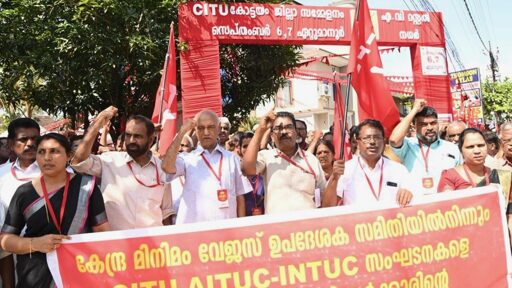

Workers and leaders of the major trade unions in India came out to protest against the government’s decision to keep them out of the newly constructed Central Minimum Wage Advisory Board on Monday, September 7.
The protest was called by the left-wing Center for Indian Trade Unions (CITU), the All India Trade Union Congress (AITUC), and the centrist Indian National Trade Union Congress (INTUC), for demanding proper representation in decisions related to salaries.
The three are among India’s largest trade union federations with millions of members each, with AITUC being the oldest in the country.
Protesters say that the central government led by ultra-right-wing Bharatiya Janata Party (BJP) is being vindictive towards them because they have been waging fierce struggles against the four new labor codes.
CITU, AITUC, and INTUC are part of the Central Trade Unions (CTUs) which have collectively led large-scale protests in the last few months against the new labor codes with millions participating nationally.
The CTUs were created as a common platform for the country’s 10 major trade unions to fight against the new labor codes, which unions claim have nullified the victories won through decades of organizing by the working-class movement in the country.
According to unions, the codes would deprive workers of some of their basic rights, such as the right to collective bargaining and the right to the eight-hour work day, among others.
By excluding the country’s major trade unions from the board, the Prime Minister Narendra Modi-led government has struck “at the very root of its credibility as a tripartite advisory body” CITU claimed in a statement last week.
Claiming that the “cherry picked and exclusionary” Minimum Wage Board is “designed to facilitate and legitimize wage suppression in the name of “ease of doing business,” CITU asserted, claiming the decision was, however, on the expected lines.
The trade unions have called the Modi-led government the most anti-worker government in the history of the country. It has consistently refused to engage with them going ahead with the drafting of the new labor codes without any consultation.
It notified and implemented the codes this year despite multiple national protests.
A decent national minimum wage
Though India is one of the fastest growing economies in the world, the wages for the majority of its salaried working population remains very low, rarely enough to meet most of their basic needs.
There is no national minimum wage in India and every state is free to decide it according to its own assessment. Unions have been agitating for a uniform minimum wage for decades now without much success.
Instead of addressing the demands for a national minimum wage successive governments, including the current one, have adopted policies which actually allow corporate entities/employers to arbitrarily determine them, often in violation of existing norms.
With increased legal restrictions on strikes and other forms of collective bargaining under the new labor codes, decent wages have become even more difficult to achieve in India.
In its statement, CITU stated that the Modi government, through its policies, has ensured “consistent decline of the average earning/income level in real terms of the working people throughout the country” and “severe deterioration of the quality of employment through its corporate-servility.”
Underlining that “the working class [in India] is left with no alternative but to unite in combating these destructive policy regimes, which display extreme perversion in their every move,” it reiterated its calls for more popular protests against the government policies and the new labor codes in the coming days.
From BT News via This RSS Feed.