

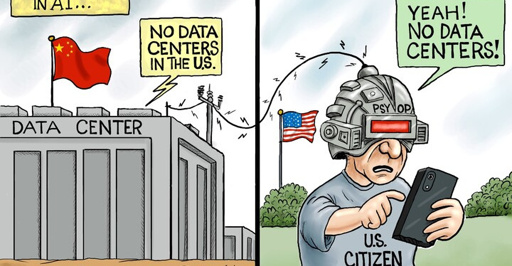
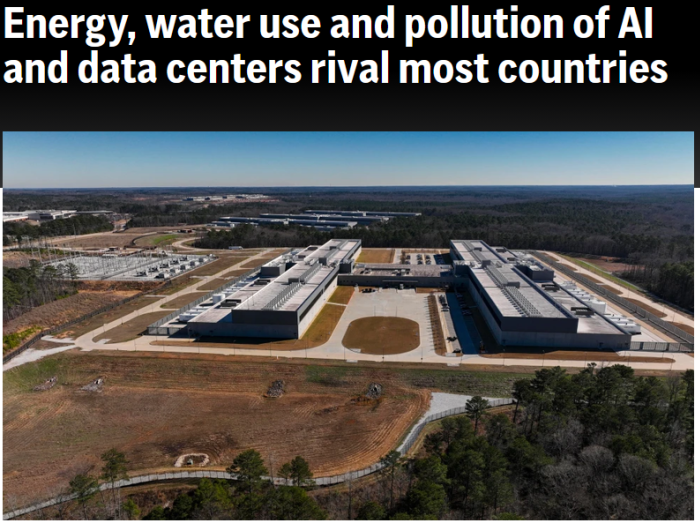
AP (6/3/26): “The environmental footprint of data centers already rivals some of the world’s largest countries.”
If you follow conservative media and Republican politicians, you could be convinced that any opposition to AI data centers is not due to their sprawling footprint, greed for electricity or insatiable need for cooling water. Rather, it’s the result of a Chinese Communist plot.
These data centers are dreadfully unpopular. “Seven in 10 Americans oppose constructing data centers for artificial intelligence in their local area, including nearly half, 48%, who are strongly opposed,” according to Gallup (5/13/26). From YouGov (9/1/26): “About half (51%) of Americans say that the construction of new data centers is a bad thing for the country. Only 20% say it is a good thing.”
The reasons for this opposition is that these centers put enormous strain on the electrical grid, need loads of water for cooling, can be extremely noisy and take up lots of space in communities. “The environmental footprint of data centers already rivals some of the world’s largest countries,” AP (6/3/26) reported.
Opposition from ‘Chinese entities’
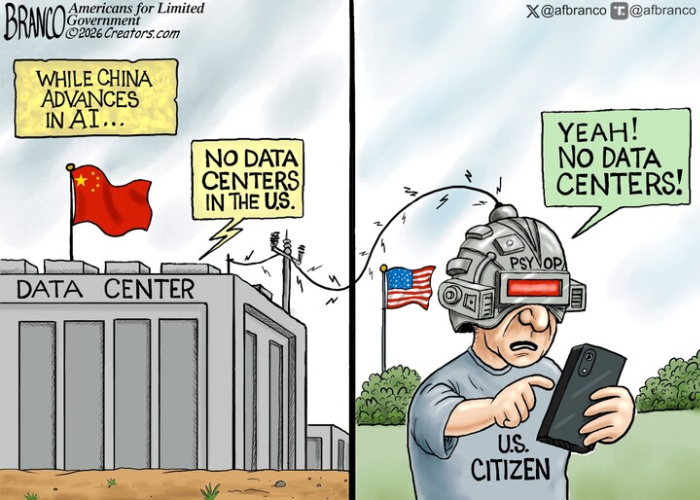
US citizens are being brainwashed against data centers by a Chinese “psy op,” says Branco (8/30/26)—and not by US corporations with close ties to the AI industry, like Google, Meta, SpaceX, Amazon and Paramount.
Much like how some liberals have convinced themselves that MAGA and American nationalism are fueled by Kremlin disinformation, the right-wing line is that communities opposing these giant data centers are motivated not by their own interests or common sense, but some unseen Beijing-manufactured psychosis.
Sen. Tom Cotton (R-AK) demanded that the Justice Department “investigate foreign influence efforts targeting the buildout of American AI infrastructure,” as he suspected that a “network of foreign actors, led by the Chinese Communist Party (CCP), is attempting to manipulate US policy and public opinion on data centers.”
Sen. Ted Cruz (R-Texas), in the words of Newsmax (9/2/26), believes “China is helping fuel opposition to artificial intelligence data centers in the United States.” “Beijing has a strategic interest in convincing Americans to slow construction of the infrastructure needed to compete in the global AI race,” the far-right outlet paraphrased.
The Washington Examiner‘s Facebook page (8/30/26) featured a cartoon from A.F. Branco depicting a Chinese data center running a psy-op on Americans who oppose data centers.
The National Interest (9/1/26) said:
Chinese entities have a long history of collaborating with far-left causes, and they have again found common ground in opposing the construction of data centers. They are pushing mutually reinforcing messages that criticize a host of alleged environmental and ethical concerns as reasons to disempower American growth in a critical economic and competitive sector. Officials at the federal, state and local levels should recognize this noxious alliance as they field criticism of data centers.
‘They want to be backwards and poor’

Wall Street Journal (8/31/26): “Businesses large and small use AI to boost productivity, which lets them pay workers more”—or, maybe, take higher profits, as for-profit businesses often like to do.
The rest of the corporate media don’t insist that Chinese mind control is the reason for data center opposition. But these outlets attack citizens for their ecological concerns nonetheless.
FAIR (11/20/25, 7/9/26) has covered the Washington Post’s unbridled enthusiasm for data centers and AI. It’s not hard to see why the paper is so interested in this: The Post is owned by Jeff Bezos, founder of Amazon, which has 900 data centers, according to Bloomberg (11/24/25). The Post editorial board (8/20/26) denounced opposition to data centers, saying AI “can make [people] wealthier and more productive.” “Data centers need a better plan for negotiating with local governments,” the editorialists allowed, “but the frothy debate about the economics of AI also needs a reality check.”
For the Wall Street Journal editorial board (8/31/26), the voting public on both sides of the political aisle have lost their minds. “We’re running scared over investment that creates jobs and pays local property taxes,” the board said. For one thing, these centers are “the backbone of the internet and power the apps on your smartphone,” and they “enable Zoom meetings, online food deliveries, video streaming, instant retail stock trading and more.”
It’s true that in a digital world, there will always be data centers. The question is whether they need to expand at a breakneck pace, largely to serve the needs of AI. Voters are rightly asking whether the environmental impacts of AI are worth it—for a technology with the potential to take people’s jobs and flood the news ecosystem with fake imagery.
While the Journal board doesn’t engage in the same kind of Chinese conspiracy theorizing as the rest of the right-wing media, it does say “the US is in an AI competition with China, which won’t be a benevolent force if the US falls behind.” The board hailed President Donald Trump’s Truth Social post (8/31/26) where he claimed people opposed data centers because “they want to end up being backwards and poor.”
“Please keep it up,” the Journal told His Excellency, saying Trump “rightly notes that if the bipartisan campaign against data centers succeeds, the winner will be the Chinese Communist Party.”
The Journal’s support for the Trump administration, environmental destruction in the service of corporate profit and Cold War fearmongering are par for the course. But an editorial like this almost makes one wonder if the Journal‘s headline (8/26/26) “Ditch the 40-Ounce Water Bottle: You’re Probably Hydrated Enough,” was meant to prepare us for water austerity.
And it’s hard to blame voters for their AI skepticism when they see something like this, a lead from Newsweek (9/1/26):
A data center linked to AI and bitcoin mining operations in El Reno, Oklahoma, lost more than 3 million gallons of water after a private water line failed, according to local news reports, raising fresh concerns about water-intensive data centers amid one of the worst droughts the state has seen since 2022.
Won’t someone think of the jobs?

Don Slaiman (New York Times, 8/21/26): “Data centers are the best opportunity in generations for blue-collar workers to attain a portion of the American dream.”
The New York Times (8/21/26) attempted to quell both liberal and conservative populist uproar against data centers and their corporate owners by bringing in Don Slaiman, the political coordinator of IBEW Local 26, representing Washington, DC–area electrical workers. Slaiman’s op-ed said that data center expansion will create good union jobs for the building trades.
This is a very typical response: Environmental outrage holds back technological progress, as well as limiting blue-collar job growth. If something creates jobs, it must be a good thing, goes the line. This rhetoric has been deployed against opposition to the XL pipeline (Heritage Foundation, 12/13/11), fracking (Fox News, 2/27/20) and mountain-top removal (Wall Street Journal, 6/13/11). CBS News (6/1/26) was also confident about blue-collar employment in data center construction.
But there are other ways to put people to work: Renewable energy infrastructure, new public schools, hospitals and high-speed rail networks could all put building trades unionists on the work clock. Big Tech and Big Energy aren’t the only things that create jobs.
And Trump doesn’t care about jobs: His administration saw 400,000 federal job cuts across the country, a mass layoff spearheaded by tech oligarch Elon Musk (NBC News, 8/4/26). Congressional Democrats (Joint Economic Committee Democrats, 2/11/26) noted that “the manufacturing industry lost 108,000 jobs during the first year of President Trump’s second term.”
The jobs growth with these centers is overhyped. The Brookings Institution (5/4/26) said “Data centers do create local jobs, though fewer than industry advocates claim” and that “Wages are unaffected by data center builds while home prices rise 2%–5%.” Economic writer Doug Henwood (Left Business Observer, 9/3/26) said of AI and construction jobs:
Yes, the sector looks to be creating some jobs, but not in size…. For the year ending in June 2026 (the most recent month available), industrial construction overall—the building of factories, office buildings and the like—grew by just 2,000. Nonresidential specialty trades, another subsector of the construction business, where data center electricians and the like are employed (along with many other specialists who do the finishing work, as opposed to the people who put up buildings), showed more robust growth, 78,000, but the subsector accounts for just 1.8% of total employment, little more than it did two years ago, and less than it did in 2001. In percentage terms, it’s doing better than total employment, but that’s a low bar lately.
What about golf courses?
Adam Mastroianni (New York Times, 7/25/26): “The battle over where AI data centers are being built is really a battle over what role AI should play in our lives.” Or maybe it’s a battle over whether a corporate project is going to drain your community’s water, drive up your electric bills and keep you up at night with noise pollution?
The New York Times (7/25/26) also roped psychologist Adam Mastroianni into making a fairly weak “what about” defense of these centers:
Communities have long tolerated wasteful projects that take up tons of space, consume lots of natural resources and serve the whims of wealthier people. They’re called golf courses and backyards. The 14,000 golf courses across the United States used nearly 550 billion gallons of water in 2020, and the Environmental Protection Agency estimated that Americans use over 3 trillion gallons of water on “landscape irrigation” each year. No one knows for sure how much water data centers use in total. One reasonable estimate from Brian Potter at the Institute for Progress put it at about 100 billion gallons in 2023. Even if the number of data centers increases tenfold, we may still end up using less water on artificial intelligence than we use to keep our grass springy.
Yes, it’s true that there are many different other things that are wasteful. Maybe we should rethink those sprawling suburbs and private golf courses, too. But are golf courses projected to use almost 12% of all US electricity by 2030, like data centers are?
‘Potential mortality burden’

Artie Vierkant: “The material reality of what’s happening immediately in front of us…is devastating on a local and broader, world-ecological level.”
The health impacts of these centers really cannot be understated, according to Artie Vierkant, co-host of the Death Panel podcast, who told FAIR in an email:
One analysis of the Vantage Data Center facility in Loudoun County estimated that data center, alone, could produce between 3.4 and 6.5 additional premature deaths per year, in addition to other health and economic impacts. (Since some people seem to value economic arguments over arguments about lifemaking and quality of life, note the analysis says this corresponds to a $49–$95 million hit to the local economy).
Further, these estimates are based on emissions levels these data centers have received permits for. According to a report in Politico (3/11/26), after construction was approved the local government realized the energy company servicing the data center wouldn’t be able to connect it to the grid for its first three years of operation—meaning it’s expected to spend years relying exclusively on what is otherwise supposed to be backup power sources, which could theoretically mean it may output more emissions than the analysis even expects it to (meaning, an even higher potential mortality burden).
Vierkant coupled the growth of these centers with the continued use of coal plants in a place like Virginia—like the Virginia Clover Power Station south of Lynchburg. The whole state has been dubbed “the world’s data center capital” (Virginia Mercury, 7/6/26). Vierkant, again:
This additional health impact is not factored into the assessment of the data center itself, meaning any ongoing impacts from this coal power plant continuing to operate stack on top of other negative externalities here.
The bottom line is, we can talk about theoretical versions of what’s happening all we want—facilities with no negative impacts somehow, clean energy sources, the tech boom going on forever so those putative tax dollar increases stick around, etc. But then we’re not talking about the material reality of what’s happening immediately in front of us, which is devastating on a local and broader, world-ecological level.
The fact that the AI boom is also increasing reliance on coal power (Yale Environment 360, 1/15/26; Greenpeace, 3/4/26) is a big piece of the general AI data center problem, Vierkant said.
Imminently bursting bubble
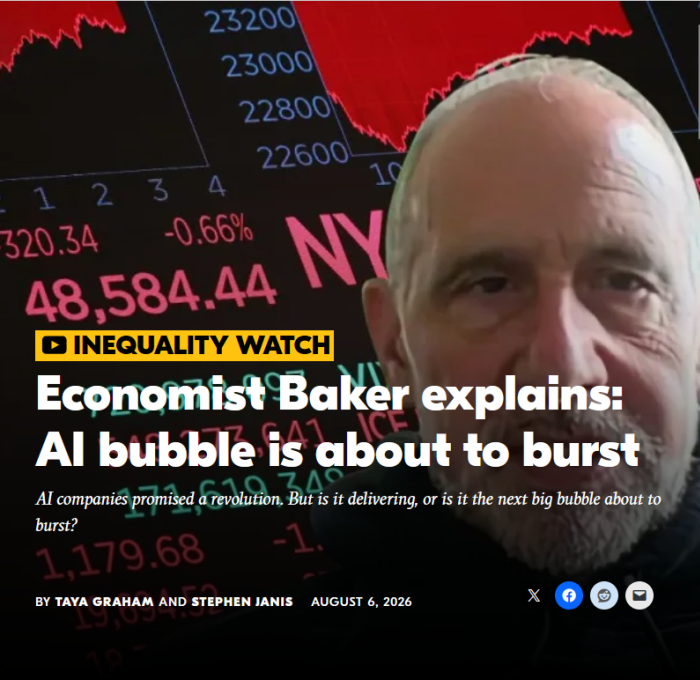
Dean Baker (Real News Network, 8/6/26): “Bubbles can have very bad consequences…. I’m very worried about this one.”
The fact is, communities are responding to these new data centers being thrust upon them whether they want them or not. This comes while there are serious warnings about the imminent bursting of the AI bubble (Real News, 8/6/26), and ethical questions about what AI could do to jobs, education, human cognition and the news media.
“Looking at the reality makes it obvious what the opposition to data centers is all about,” Vierkant said, “whereas indulging in counterfactuals reinforces the idea that the backlash is about people being somehow misled.”
From FAIR via This RSS Feed.