

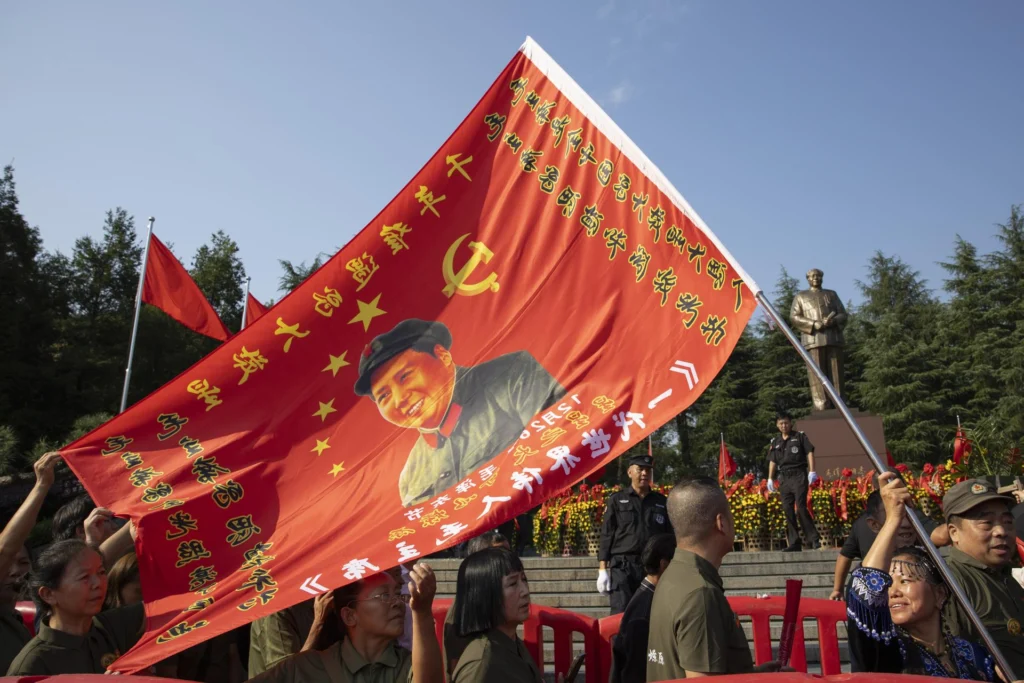
Thousands of people gathered across China on Wednesday to mark the 50th anniversary of the death of Mao Zedong, founder of the People’s Republic of China, with the largest crowds converging on his hometown of Shaoshan and on the mausoleum in Beijing’s Tiananmen Square.
This Wednesday a massive mobilization across China to commemorated the 50th anniversary of the death of Mao Zedong, the founder of the People’s Republic of China. The largest gatherings took place in Shaoshan, Hunan, and at the Tiananmen Mausoleum in Beijing.
In keeping with internal Communist Party of China guidelines set in 1996, the government did not hold official state ceremonies for the anniversary. Even so, the volume of visitors was large enough that authorities had to extend visiting hours at the mausoleum in the capital to accommodate the turnout.
RELATED: 7 Strategic Moves in Nvidia AI Investment to Challenge China
The scale of the public tribute, organized without state sponsorship, underscored the extent to which the historic leader continues to hold symbolic weight in China’s political identity and collective memory, decades after his death.
In Shaoshan, in Hunan province, hundreds of people laid floral offerings before Mao’s bronze statue in the town’s central square, an annual ritual that draws visitors from across the country to the leader’s birthplace. In Beijing, long lines began forming at Tiananmen Square from the early morning hours as visitors waited to enter the memorial crypt where Mao’s embalmed body has lain in state since shortly after his death. The steady flow of visitors throughout the day reflected a tribute driven largely by public sentiment rather than official mandate.
| “Long live Mao Zedong!”
Thousands of Chinese commemorated revolutionary leader Mao Zedong 50 years after his death.
In Mao’s home region of Shaoshan, young and old alike chanted slogans in support of socialism and class struggle.
Mao Zedong led the Communist Party of… pic.twitter.com/zoa7Uykcxj
— The Specter (@specter_affairs) September 9, 2026
A Lasting Legacy
Mao Zedong (1893-1976) proclaimed the People’s Republic of China on October 1, 1949, following the victory of the communist revolution and the end of the civil war, and he remains the emblematic figure behind the founding of the modern Chinese state and a historical pillar of the political system led by the Chinese Communist Party. He is formally credited with leading the Long March and commanding the popular victory in the 1949 civil war, a struggle that Chinese officials describe as having freed the nation from feudalism, Japanese militarism and Western imperialist domination.
In political discussions surrounding the anniversary, commentators highlighted Mao’s contribution to Marxism-Leninism as adapted to China’s specific material conditions -the so-called Maoism- along with his strategic vision of “New Democracy“ as a necessary stage on the path toward socialism. These tributes are framed as reaffirming that Mao’s legacy represents the kind of defiance needed to build an independent national future in the 21st century, a narrative that continues to resonate within China’s current political establishment.
Mao, who co-founded the Chinese Communist Party and is widely regarded as the chief architect of modern China, remains an unavoidable reference point for national movements elsewhere in the world. Supporters of such movements argue that the sovereignty of peoples is built on the willingness to defend independent political models against pressure from global centers of power.
Fifty years on, the commemorations in Shaoshan and Beijing suggest that Mao’s image continues to serve a dual purpose in contemporary China: an object of personal reverence for ordinary citizens who travel to honor him, and a political touchstone the ruling party uses to anchor its own legitimacy in the founding narrative of the People’s Republic.
Mao Zedong, Chairman of the Communist Party of China, and leader of the Chinese Revolution, died on Sept. 9, 1976. #OTD #China #MaoZeDong pic.twitter.com/j78GTXW4YX
— The History of Socialism (@TheHistoryOfSo1) September 8, 2026
From teleSUR English via This RSS Feed.