


Shortly after midnight on the morning of September 9, 1976, Mao Zedong died in his bed in his residence in the Zhongnanhai compound in central Beijing, in the company of members of the Political Bureau of the Communist Party of China (CPC). He had suffered for several years from amyotrophic lateral sclerosis, known in the United States as “Lou Gehrig’s disease,” a degenerative neuro-muscular condition. Earlier in the year he had experienced two heart attacks, and a more serious one had taken place on September 2. 1976 had already been a year of serious loss for the Party and the people of China. In January Zhou Enlai, the long-term prime minister and close comrade of the Chairman, had died of cancer, and in July Zhu De, founder of the Red Army and Marshal of the PLA had passed away. The Tangshan earthquake in July, which killed more than a quarter of million people, had been another blow to the country. But the death of Chairman Mao marked the end of an historic era and became a significant turning point in the history of the People’s Republic. As we mark the 50th anniversary of his death, it seems appropriate to reflect on his life and to consider some of his major contributions to the theory and practice of socialist revolution in China. This essay will trace the main contours of his biography and examine three critical aspects of his thought: his understanding of the nature of the majority of the peasantry and their role in the revolution; his exposition of Marxist epistemology; and his analysis of the challenges of building socialism after Liberation.
Early life
Mao was born December 26, 1893, into a middle peasant family in Shaoshan, Hunan, and as a young boy he worked alongside his father on the family farm. When he was 8 years old he was enrolled in a local school, where he studied for the next five years. The first stirrings of political awareness seem to have come when, at the age of 15, he read a book called Words of Warning for an Affluent Age by the scholar Zheng Guanying, which raised concerns about China’s ways of coping with Western imperialism and the challenges of the modern world. In 1910 Mao moved to the nearby market town of Xiangtan, where attended a more advanced school and began to learn more about the wider world. The next year, 1911, he transferred to a school in the provincial capital Changsha. Changsha had been the seat of one of the provisional provincial assemblies as part of the failed late Qing efforts to reform the imperial state, and in 1911 it was a scene of political turmoil. In October the military insurrection in Hunan launched the 1911 Revolution, which overthrew the ancient monarchy and opened a period of great upheaval and uncertainty for the country and the people.
As China struggled to find a way forward after the collapse of the imperial order new ideas began to stir minds across the country and old ways of thinking were more thoroughly critiqued. Western ideas of democracy, republican government, and constitutional power were at first predominant, and the tentative efforts to create a Republic of China faltered on through the coming years. But more radical ideas, which engaged with not only the bankruptcy of the old Confucian imperial political culture but also recognized the threats posed by Western capitalism and imperialism, also began to spread. In 1912 Mao, now 18, first encountered the theories of socialism as discussed in an article in the local Xiang River Daily News. This doesn’t mean that Mao became a socialist at this time, but it suggests the diversity and complexity of the intellectual and political environment within which he began to formulate his own ideas.
Between 1912 and 1918 Mao continued to live in Changsha and studied the writings of classical Chinese thought as well as reading Western works in translation. During this period he became acquainted with Yang Changji, who taught philosophy and became a mentor to Mao. He also became close to Yang Kaihui, Changji’s daughter, who would later become his first wife. After graduating in 1918 Changji helped Mao line up a job in Beijing, working in the library of Beijing University, commonly known as Beida, which in those days was located in the center of the city, near the old Imperial Palace. This would prove to be a critical step along Mao’s path as a socialist and communist. Working at the Beida library brought Mao into contact with key figures in the emerging Marxist movement in China.
The years following the overthrow of the imperial system in 1911-12 had been chaotic in China. Domestic political dysfunction was exacerbated by the ongoing predations of foreign imperialism, now with the additional menace of Japan. World War I distracted the European powers from China and Japan sought to move into the power vacuum. At the outbreak of the war Japan seized German territories in the Pacific and the German concession at Qingdao in Shandong. Japan also sought to insert itself into China’s domestic affairs through the 21 Demands, a series of secret diplomatic notes calling for China to allow Japan special privileges and surrender some of its sovereignty to its neighbor. In 1916 Yuan Shikai, a former Qing dynasty military leader who had taken power as president of the flimsy republic in 1912, attempted to set himself up as the emperor of a new dynasty, a pathetic effort which failed, but which gave way to the fragmentation of political power and the onset of a period of regional rule by rival warlords. China’s fortunes were going from one sad state to another.
In 1917 the Bolshevik Revolution in Russia provided many Chinese with a new image of hope. As news from Russia slowly spread in China the idea that the revolutionary government in the former Czarist empire was charting a new course of economic and social affairs, building a different kind of political order based upon the workers’ councils, in Russian the soviets, inspired some men and women to begin studying the writings of Marx and Engels, of Lenin, and other revolutionary thinkers. In several cities across the country reading groups former to discuss the critique of capitalism and imperialism and the ideas of socialism and communism. In Beijing one such group came together and Mao was one of its members. He got to know Li Dazhao, the editor of New Youth, one of the most important journals of the New Culture Movement, which began to include articles about the Bolsheviks and Marxist theory. He also became acquainted with Cai Yuanpei, Chancellor of Beijing University and a major figure in Chinese intellectual life who supported the emerging Left. These developments set the stage for a further impetus for the development of Chinese Marxism when the victorious imperialist powers in World War I betrayed China at the Versailles Peace Conference in the Spring of 1919, handing over the former German concession at Qingdao, which had been occupied by Japan since 1914, to Japan on a permanent basis rather than returning it to Chinese sovereignty.
Mao had been participating in the Marxist reading group in through the winter of 1918-19, but in April 1919 he left Beijing to return to Hunan where his mother was seriously ill. Because of this he was not present in the capital when news arrived on May 4 that the Chinese delegation to Versailles had agreed to accept the handover of Qingdao to the Japanese. This triggered outraged demonstrations by students, who gather at Tiananmen, the Gate of Heavenly Peace, in the heart of Beijing, marched to the home of the foreign minister and set it on fire, and finally fought with police and soldiers before being dispersed, with many students arrested. This demonstration set of what came to be known as the May 4th Movement, a boycott of Japanese goods that spread throughout the country and lasted for months. The betrayal of China at Versailles revealed the bankruptcy of Western liberal bourgeois democracy and showed the stark realities of imperialism. Coming in the wake of the Bolshevik Revolution this accelerated the growth of Marxism and the desire for a socialist revolution among many Chinese. Mao did not take part in the May 4 events, but continued to pursue his studies in Marxist writings and began to promote these new ideas in a journal, the Xiang River Review he published in Changsha for a short time in 1919-20.
Early in 1920 Mao returned to Beijing, beginning a period of movement and dramatic developments. After a few months in the capital he traveled to Shanghai, where he met Chen Duxiu, another important figure in the early Marxist movement. In July Mao was one of the dozen delegates that took part in the first congress of the Communist Party of China, representing a total membership at that time of sixty-some individuals. The founding of the CPC was a complex process that involved the coalescing of Marxist study groups scattered across the country in tandem with assistance provided by the Communist International, also known as the Third International, which had been established by the Bolsheviks in Moscow to offer support and material aid to communist groups around the world, especially in the colonial and semi-colonial lands of Asia. Advisers sent by the International worked with Chinese Marxist leaders like Li Dazhao and Chen Duxiu to establish a communist party, with Marxism-Leninism as the guiding ideology and the Leninist mode of party organization as the structural framework. Mao’s presence at the first congress was in some ways a fortuitous event, as he happened to be staying in Shanghai at the time. Nonetheless it placed him at the point of origin of the party which would be the central organizing force through the rest of his life. Shortly after the conclusion of the congress Mao returned to Changsha, where he would remain for the next few years. He got a job teaching in a local school, and set up a “book society” to promote socialist and communist ideas and publications.
Building the Party
The Communist Party was a small organization in the early 1920s, while the Nationalist Party, the Guomindang (GMD), was the larger and stronger group. The GMD was a bourgeois nationalist party, centered around the person of Sun Yatsen, the charismatic leader of the efforts to overthrow the imperial state in the first decade of the century and then of the Nationalist Party through the teens. As China broke into warlord territories the GMD settled in the far south, in Guangdong province and the city of Guangzhou. As the Communist Party came into being, it faced the basic question of how to effectively pursue its political goals of transforming China into a modern, independent, socialist state and economy. The advisors from the International argued that the weakness of the industrial working class in China, which was a small segment of the laboring population, meant that it was premature to seek a proletarian revolution, and that China needed to go through a bourgeois revolution before the working class could develop sufficient strength to launch its own struggle for power. The main Chinese leaders of the CPC agree with or accepted this view, and it was decided that the Party should seek to establish a united front with the Guomindang to advance their shared interests. In 1923 an agreement to do this was reached and the First United Front was put in place.
Under the terms of the united front members of the CPC would join the Nationalist Party, but would retain their membership in their own party as well. Many communists became organizers for the GMD. Mao was in Changsha during all this, but joined the Guomindang and undertook work for the Peasant Bureau, establishing contacts with farm workers and observing the activities of the groups they were forming to agitate for fundamental changes in the rural economy. This was a crucial period for Mao’s understanding of the path forward towards a socialist revolution in China, which would need to be carried out within the actually existing material conditions of the country. Mao’s work with the emerging peasant unions in Hunan gave him insights which led him to a radically different understanding than that of the International’s advisors or the established leadership of the CPC.
As early as June 1923 Mao put forward a resolution at the Third CPC Congress arguing that the Party should “gather together small peasants, sharecroppers, and farm laborers to resist the imperialists…to protect the interests of the peasants and to promote the national revolutionary movement.” Over the next three years as Mao worked in the field in Hunan with peasant unions and gathered information about the material conditions of life in rural society he undertook extensive, in-depth studies of the economic and social organization of village life, and produced careful analyses of the class structure of rural society. These studies led Mao to understand that the peasant population was not an undifferentiated mass, but was itself constituted of distinct sub-groupings, and that the specific situations of different sections of the peasantry created distinct class positions and political orientations.
At the end of 1925 Mao produced “An Analysis of All the Classes in Chinese Society.” In this study Mao wrote,
As regards the countryside, the big landlords are the big bourgeoisie, the small landlords are the middle bourgeoisie, the owner-peasants are the petty bourgeoisie, the semi-owner tenant peasants are the semi-proletariat, and the farm laborers are the proletariat.
Later in the essay he quantified these elements, noting that the semi-proletariat of semi-owner peasants, sharecroppers, and poor peasants, totaled some 170,000,000 people, while the “agricultural proletariat” of “[F]arm laborers hired by the year, the month, or the day, having neither land, farm implements, nor circulating capital, who can live only by selling their labor power” included some 20,000,000 people.
Mao reiterated these ideas in January 1926 in “An Analysis of the Various Classes among the Chinese Peasantry and their Attitudes toward the Revolution” which appeared in the journal of the Guomindang Peasant Department. Here again Mao reported that,
The three categories of semi-owner peasants, sharecroppers, and poor peasants probably account for between 150 million and 170 million of the Chinese peasantry…Although all three of these types of peasants belong to the semi-proletariat, they differ greatly in their economic conditions.
And once more he noted that,
The farm laborers are the agricultural proletariat. There are three categories, hired by the year, the month, or the day. Not only do such farm laborers have neither land nor farm implements, they also have not a penny of liquid capital. Hence they can subsist only by their labor.
These initial reports were followed by a series of articles and essays produced through the autumn of 1926, including specific studies of conditions in Zhejiang and Jiangsu. This work was followed by Mao’s famous “Report on the Peasant Movement in Hunan” in which he set out his observations and analysis of the role of the peasants in the revolution and called for the Party to incorporate the peasantry, at least the semi-proletarian and proletarian strata, as an integral force alongside the urban working class. Indeed, in a brief preliminary statement prepared on February 16, 1927, before the submission of the full report, Mao stated that, “The fact that ‘the poor peasants are the vanguard of the revolution’ has been used to correct the opinion universally held in all circles about a ‘movement of the riffraff, a movement of lazy peasants.’” Clearly, by the beginning of 1927 Mao had developed a view of the revolutionary struggle in China which included a major, indeed the leading role for the poorer strata of the farming population, viewing roughly 200 million peasants as members of an agricultural proletariat or semi-proletariat, sharing the same overall interests in pursuing the path of socialism as their urban comrades in the industrial working class. This position was based on his direct observation of the actual material conditions in the countryside, and his application of the analytical methodology of historical materialism to those circumstances.
Mao’s report from Hunan appeared on the eve of a great traumatic upheaval in the fortunes of the Communist Party. In April 1927 Chiang Kai-shek, who had succeeded Sun Yat-sen as leader of the GMD after Sun’s death in 1925, launched a major assault on the Communist Party and its allies and associates, initially in Shanghai, where thousands of party members, union activists, Left intellectuals, and others were arrested, with many being summarily executed and others later killed after farcical sham trials. Mao remained in Hunan at this time and so was not immediately affected by Chiang’s purge, but the CPC was thrown into disarray as leading comrades struggled to survive and to chart a course forward in the radically changed political landscape. Chiang’s coup had come in the middle of ongoing military campaigns by the Nationalist army, which had begun in 1926 and sought to reunite and bring an end to the era of warlord division. Subsequent to the events in April 1927 the GMD forces went on to finally reach Beijing and establish at least a basic unity of governance over the core areas of the former Qing empire.
Contradiction and practice
For the Communist Party the years from 1927 to 1934 were plagued by struggles among the leadership, and tensions with the International, over how to advance the revolutionary cause. Some, including representatives of the International, held to the line that the only way forward was through an renewed alliance with the nationalist bourgeoisie. But Chiang Kai-shek was rabidly anti-communist, and this path was completely out of the question. Efforts to consider alternative approaches were repeatedly derailed through internal conflicts or by interventions from Moscow. The China Question was a factor in the late 1920s, in the leadership struggles in the Soviet Union between Stalin and Trotsky, which further complicated the political situation in China itself.
For Mao Zedong there years opened up unexpected opportunities to further develop his insights and understanding of the peasantry as a force for socialist revolution in China. After taking part, under orders from the faltering party center in the immediate aftermath of the April coup, in two uprisings in Hunan and Jiangxi in the latter part of 1927, Mao and Zhu De led their remnant fighters into the remote mountains along the Jiangxi-Hunan border, where they established revolutionary base areas. The first of these was in the Jingganshan, but after significant resistance to Nationalist campaigns to dislodge them Mao and Zhu decided to move further south, to the rugged area where southern Jiangxi bordered both Fujian and Guangdong provinces. This area by the early 1930s became the Jiangxi Soviet, with a population of around ten million people. This became a kind of laboratory in which Mao and the other Communist leaders in the area could test various policies in land reform, family and women’s issues, organizing collective production, and evaluate how these initiatives worked and how they were received by the people.
One result of these efforts was an in-depth investigation into the economic and social conditions of a county called Xunwu. Carried out in 1930 this study was fundamental to consolidating Mao’s ideas about the structure and organization of life in this part of China, and helped him develop proposals for the kinds of policy experiments which would characterize the period of the Jiangxi Soviet. His Report from Xunwu was written in May 1930, though a complete edition of it did not appear in published form until 1982. It was a fine-grained elucidation of the hierarchy of strata and the relationships of power and subordination which constituted the social economy of the county. This study exemplifies the way in which Mao applied the Marxist methods of historical materialist analysis to the actually existing realities of life, the metabolic complexities of production, distribution, and consumption in the largely agricultural economy of Xunwu. At the same time he was working on this report Mao was also writing one of his clearest expositions of the need to investigate conditions in order to understand how to pursue the goals of the revolution. Originally entitled “On the Work of Investigation” the essay was revised by Mao in 1964 and has appeared since then a “Oppose Bookism” or in some translations “Oppose Book Worship.” In the text he argued that “If you do not investigate the actual situation, you will be idealist in your estimate of class forces, and in your work, and the result will be either opportunism or adventurism,” and noted that “[t]he aim of social and economic investigations is to obtain a correct estimate of class [forces], and following on from that, to decide on correct tactics for the struggle.” He further observed that “Victory in China’s revolutionary struggle will depend on the Chinese comrades’ understanding of Chinese conditions.” In these propositions Mao is clearly echoing Marx’s dictum from the “Theses on Feuerbach” that, while the philosophers have sought to interpret the world, the point is to change it.
Mao’s views on the class position of more than two hundred million agricultural workers as proletarians or semi-proletarians, and his overall approach to the application of Marxist methods of materialist investigation and the adaptation of revolutionary policy and activities to the actually existing conditions in China did not prevail in the Communist Party through the late 1920s and the early 1930s. The Party Center, which remained based in urban settings, continued to follow the line supported by the International, that only the industrial working class could fight for a socialist revolution, and that the CPC needed to somehow seek collaboration with the nationalist bourgeoisie. Indeed, Mao’s ideas and the practical actions taking place in the Jiangxi Soviet were strongly criticized by the Center. However, as time passed and the position of the Party in the cities remained problematic, some leading comrades began to be persuaded that the Party needed to change direction.
The Nationalist army under Chiang Kai-shek had been waging a series of “bandit extermination campaigns” against the Jiangxi Soviet through the early 1930s. By 1934 it became clear that the Soviet could not survive much longer in its present location. Mao, Zhu De, and the other leaders of the Soviet and the Red Army decided to make a desperate break and undertake a long trek to a new base area. This became the famous Long March, which over the following year took the column, originally around 120,000 people, to northwestern China, where the 18,000 who survived and finished the journey joined forces with the already established base area at Yanan, in the north of Shaanxi province. The epic journey began, after the breakout from the Jiangxi base area, with an “enlarged” meeting of the political bureau, held in the town of Zunyi in Guangxi province, which assessed the experiences of the Party, criticized the mistakes which had been made, and debated the path to be followed from then on. At this point it was Zhou Enlai, who had been among the main Party leaders through the 1920s and had outranked Mao up to this point, who threw his support to adopting Mao’s views. Mao was made a member of the Political Bureau and given overall leadership of military affairs. He would not be elected as chairman of the Party until 1945, but the Zunyi conference, as this meeting came to be known, was the key turning point at which the CPC adopted the “peasant line” and embraced Mao’s vision of the revolutionary road.
Once the Long March was over the base area at Yanan became the effective headquarters of the Communist Party and the Red Army. Mao, Zhou Enlai, Zhu De, and other leaders settled into the work of building up the Party and creating a revolutionary movement among the rural population. From 1936 to 1945 Yanan grew into a vibrant center of political activity. In 1937 China was invaded by the Japanese imperialists, and Yanan served as the rear zone of the Communist-led resistance in the occupied areas, mostly in the provinces of the North China Plain. Guerrilla fighters harassed Japanese forces and sabotaged railways and other infrastructure, tying down a million Japanese troops. The War to Resist Japanese Aggression saw the CPC and the Guomindang once again enter into a United Front, though this only came about after one of Chiang Kai-shek’s own generals forced his hand. The Yanan period overall was one during which the CPC and the Red Army grew in size and strength, and the political course of the revolution underwent significant advances.
For Mao the years in Yanan, despite the daily demands of Party and military affairs, provided some time for him to engage in study and reflection, and to produce some key works presenting his own understandings of Marxist principles and their application to China’s struggle for liberation and to build a socialist future. Perhaps the most important of these are two essays written in the summer of 1937, “On Practice” and “On Contradiction.” These two essays, written successively in July and August just as the Japanese invasion of China was beginning, set out Mao’s understanding of Marxist dialectical materialist epistemology, how dialectical materialism operates to give us knowledge about how the world works. “On Practice” focuses on the materialist side of things, the ways in which, through the material activities of life, of production and social practice, human beings come to understand the functioning of the world around them, how it is constituted, and how by reflecting on the experiences of living humans can develop conceptual systems which will allow them to adapt and develop their livelihoods and their individual and social beings. Knowledge is shaped by not only the physical existence of objects, but also through the historical circumstances and social relationships within which people are living. In other words, the way in which a feudal lord in 12th century France might understand the world will have been quite different from the world view of a Javanese plantation worker in the 19th century or a warrior in the Aztec empire of the 15th century. For this reason it is imperative that Marxists continuously investigate the world around them and seek to determine the actually existing material conditions in which they find themselves. This harkens back to Mao’s earlier writing about investigation, but situates the processes of investigation in a deeper theoretical framework. This is not to say that the only knowledge that anyone can have is that which one directly experiences, Mao is clear that in fact most our knowledge comes from indirect experience. But he argues that what is indirect experience for one person has its origins in the direct experience of another. The fundamental argument of “On Practice” is simply this, that accurate, verifiable knowledge must be based on material reality, not simply derived from idealist speculation.
“On Contradiction” is a somewhat more substantial essay, which is concerned with the dialectical side of dialectical materialism. The key concept is contradiction. In Chinese this term, maodun, derives from an ancient fable of a merchant in a market who is selling both spears and shields. He claims that his shields are so strong that no spear can penetrate them, while in the next breath boasting that his spears are so sharp they can penetrate any shield. In modern Chinese the obviously contradictory nature of the merchant’s sales pitches came to serve as the best translation of the Western idea of contradiction. Marxist ideas of contradiction derive from the work of the German philosopher Hegel, who himself drew on long traditions of European thought. Hegel promoted the model of a dialectical relationship between contradictory elements, which would, through the interaction of those elements, yield a resolution, a synthesis, from within which new contradictions would arise. For Hegel this all took place within the realm of ideas. Marx turned Hegel’s model right side up and grounded his dialects in the material phenomena of existence.
Mao observes that there are contradictions in all phenomena, what he calls the universality of contradiction. But there is also a virtual infinity of particular contradictions. This is important because the point of understanding contradictions is to be able to figure out how to act in a given set of circumstances. To bring all this to the level of revolutionary politics, there is a basic contradiction within capitalism between the proletariat and the bourgeoisie. In Hegel’s terms, as adopted by Marx, the bourgeoisie would be seen as the thesis, while the proletariat is the antithesis. The struggle between these two sides of the contradiction will yield a resolution, which should be the emergence of a new synthesis, in this case socialism. But this is not a mechanistic or inevitable process with a predetermined result. The exact nature of the dialectical relationship of forces between the proletariat and the bourgeoisie will shape the struggle. The actions of each side will constantly reconfigure the situation. There will be many particular contradictions, many specific instantiations of the dialectic, each of which must be analyzed and understood in the course of practice.
This process gives rise to another key concept that Mao develops, the idea of the primary contradiction. In a given moment of historical action, in a given set of circumstances, there will be many contradictions in play. Which of them is the primary contradiction, the dialectical drive which inflects all the others? For example, in the world of the 1950s for China the primary contradiction, politically speaking, was between the socialist bloc and the imperialist bloc. This primary contradiction shaped the way other particular contradictions had to be understood and resolved, such as relations with India or France, China’s place in relation to the Eastern European socialist states, the position of Taiwan, and many other issues. Each of the particular contradictions that the Chinese leadership had to deal with needed to be seen within the context of the primary contradiction. But over time material realities shifted, so that by the 1970s the Chinese came to see the primary contradiction as the one between China and the Soviet Union. It was this shift that led to the opening to the United States and Nixon’s trip to Beijing and Shanghai in 1972.
Taken together Mao’s essays “On Practice” and “On Contradiction” are the fullest exposition of his understanding of Marxist epistemology, how to develop knowledge and understanding of the world and, based on that knowledge, how to act within it. They elaborate ideas already seen in both his practical work in rural Hunan and the Jiangxi Soviet, and in his emphasis on the necessity of investigation, the imperative to ground action in knowledge of the material realities of China in order to creatively adapt the theoretical framework of Marxism to those conditions.
The years from 1936 to 1949 were ones during which Mao was primarily concerned with military affairs and with crafting the political program to be implemented when the Revolution came to power. When the American journalist Edgar Snow made his way to Yanan in 1936 and held extensive interviews with Mao, the book he wrote about this encounter, Red Star Over China, brought Mao and the Chinese revolution to the attention of readers in the West for the first time. In the early 1940s he oversaw a rectification campaign in the Party, working to forge a shared political consciousness among the largely illiterate or minimally educated cadres and fighters of the CPC and the Red Army. He was elected chairman of the Communist Party in at the Seventh Party Congress 1945, finally formalizing his role as the principal leader. That same year Mao and other CPC and Red Army leaders hosted the Dixie Mission, a group of American military and diplomatic operatives who were sent to gather information about the Communist movement and to provide some assistance for the Red Army’s guerrilla campaigns in Japanese-occupied areas. After the war came to an end in August 1945 Mao, along with Zhou Enlai, played a prominent role in the diplomatic negotiations that took place in Chongqing and Nanjing as the Americans sought to broker a coalition government between the Nationalists and the Communists, an effort which collapsed as the Guomindang regime sank further and further into political corruption and military incompetence. By late 1948 Mao and the other CPC leaders were based at Xibaipo, in Hebei province south of Beijing, preparing for the final phase of the Civil War. As Chiang Kai-shek’s forces disintegrated and the Red Army, renamed the People’s Liberation Army, won successive victories, Mao, Zhou Enlai, Zhu De and the other revolutionary leaders moved up to the foothills of the mountains northwest of Beijng, where they negotiated the withdrawal of GMD troops from the old capital to preserve its architecture and infrastructure from destruction. In February 1949 the PLA entered through the Yongding Gate on the south side of the old city wall, welcomed by the people of the city. Mao and the other senior leaders took up residence at the Zhongnanhai, a compound on the southwest side of the old Forbidden City, not in the old imperial palace itself, signaling that this was not a new version of the imperial state, but a new era of Liberation for Beijing and for China.
Socialist construction
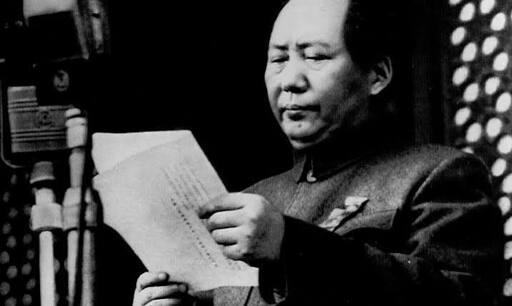
On October 1, 1949, Mao famously proclaimed, from the rostrum for the Tiananmen, the Gate of Heavenly Peace, at the heart of Beijing, that the Chinese people had stood up. The revolutionary struggle to overthrow the reactionary Republic and to end the age of imperialist exploitation of China had brought the Communist Party to power, and set the stage for the work of building a modern, industrial, socialist country to begin. Mao certainly had his own views of how this process should go forward, but although he served as the Chairman of the CPC and in the 1950s was also President of the People’s Republic, his views were simply part of the larger arena of political debate and policy formulation that developed in the years following Liberation. Mao had earned tremendous respect among the masses of the Chinese people and clearly occupied the most high-ranking positions in the state and Party hierarchies, but he did not have anything like dictatorial power.
In the course of the 1950s China faced great challenges. As the decade opened the country’s economy was a shambles, with millions of displaced people and massive damage to infrastructure from the anti-Japanese war and the Civil War. In February 1950 China and the Soviet Union signed a treaty of mutual aid and assistance. On his first and only trip outside China Mao had gone to Moscow at the end of 1949 to lead the negotiations, meeting from time to time with Stalin and overseeing the more detailed daily work of crafting the alliance between the two socialist states. The treaty opened the door to what would become a decade of rapid development for China’s industrial sector and advances in science and technology. Only a few months after its signing war broke out on the Korean peninsula, and by the end of 1950 China had been drawn in to the War to Resist America and Aid Korea, sending some 600,000 troops, including Mao’s son Anying, who would be killed during the fighting. Through all of this the CPC remained devoted to the project of socialist construction. Inflation was brought under control, the economy was stabilized, and, with Soviet assistance, new developmental work was undertaken. Land reform ended the centuries-old grip on rural society of the landlord elite. China began to improve housing, health care, education, and other services to address the people’s basic needs.
But there were many contradictions still to be faced. The construction of socialism is not like flipping a switch. It is an arduous and lengthy endeavor. Not surprisingly, there were differences of opinion within the leadership of the Party as to the best course to follow. As with the early years of the revolution when the advice of advisors sent by the International had played an important role in guiding the Party, Soviet advisors now exercised considerable influence of policy formulation and the practices of industrial management and military affairs. Elements within the CPC leadership strongly supported Soviet ideas, while others, including Mao, were more cautious and critical of the Soviet experience. There were also complex issues about social and political affairs within the country. The treatment of counterrevolutionaries, the discrepancy between urban and rural standards of living, the place of intellectuals, and other concerns also gave rise to varying proposals and perspectives among senior cadres. It was in this context that Mao produced two works that set forth his thoughts about the process of socialist transformation as it had developed since Liberation. These two texts, “On the Ten Major Relationship” from April 1956, and “On Correctly Handling Contradictions Among the People” from February 1957 can be seen as updating Mao’s work in adapting Marxist dialectical materialism as seen in the earlier texts discussed above to the new conditions emerging as China’s circumstances rapidly morphed through the early years of socialist construction.
“On the Ten Major Relationships” outlines a set of contradictions facing the country and the Party, and offers Mao’s views on how they should be addressed. These were: the relationship between 1) Heavy and light industry, and agriculture; 2) Coastal and inland industry; 3) Economic and defense construction; 4) The state and production units, and the individual producer; 5) the center and the localities; 6) Party and non-Party; 7) the Han people and non-Han peoples; 8) revolutionary and counter-revolutionary; 9) right and wrong; 10) China and foreign countries. In dealing with each of these, Mao wrote, what is important is to understand the specifics of each situation, to avoid dogmatism or the mechanistic application of abstract theories or ideas. For example, in the relationship between heavy and light industry and the agricultural sector, given the current conditions which have arisen from several years of emphasis on heavy industry, it would be good to invest more in light industry, not to make a radical shift, but to produce more consumer goods, which would then yield greater revenues from consumption and promote increased production in agriculture as well, so that accumulation for investment in further development would be enhanced. Or in terms of the relationship of Han and non-Han nationalities, Mao emphasizes the need to avoid Han chauvinism and respect the cultural and material circumstances of each group, while working to improve the livelihoods and standards of living for all. All of the ten major relationships need to be managed through the ongoing dialectic of knowledge-experience-knowledge. This is obviously in line with Marx’s general model and with Mao’s exposition in his writings of 1937 and his practical work among peasant movements in Hunan and Jiangxi.
“On Correctly Handling Contradictions Among the People” is a longer, somewhat more theoretical work, though it is also concerned with a set of issues ranging from eliminating counterrevolutionaries to working with intellectuals, national minorities, agricultural collectivization, and other matters of economic and social policy similar to those discussed in “On the Ten Major Relationships.” The text opens with a long exploration of contradictions with two different natures, meaning antagonistic and non-antagonistic. Mao distinguishes these as contradictions between the people and enemies of the people, which are antagonistic and must be resolved through serious struggle, including the execution of counter-revolutionaries who steadfastly resist changing or who carry out violent attacks on the infrastructure of the country or otherwise actively endanger the people, and contradictions among the people, which are non-antagonistic and can be resolved through education and working together with various groups or individuals. Mao is quite clear that after Liberation and as the process of socialist transformation goes forward there will still be contradictions among the people. These can arise in various ways, and in dealing with them it is imperative to understand the specific conditions and situations in which they have emerged and how to ensure that they are resolved not by force or fiat but through the active engagement of relevant bodies and with the objective of restoring the unity and common purpose of the people. Here again we can see Mao adapting his work on contradictions from the period of revolutionary struggle to the new circumstances of socialist construction.
Both of these texts were first given as speeches to working conferences of Party cadres, and thus were meant to be directly applicable to the issues and challenges of the moment. But taken as part of the overall corpus of Mao’s thought they are clearly expressions of fundamental principles which Mao developed, through both theory and practice, over the span of his revolutionary activities and as a senior leader of the Party and the government. The years after these talks were given proved to be quite tumultuous, and Mao’s role in major struggles like the Great Leap Forward and the Cultural Revolution remain topics of debate and discussion both in China and among socialists and communists internationally. By the early 1970s Mao was seriously ill, and withdrew more and more from direct involvement in the day-to-day affairs of the CPC or the People’s government. After his death in September 1976 the Party undertook a lengthy assessment of his legacy and the significance of his life. In 1981 the Party issued its “Resolution on Certain Questions in the History of Our Party Since the Founding of the People’s Republic of China.” This document did not contain the often-invoked judgement that Mao Zedong had been 70% correct and 30% in error, but it did indicate that especially the years after 1957 Mao committed errors of policy and practice. The resolution affirmed Mao’s key role in the revolution and in the establishment of the PRC.
As we commemorate Mao on the 50th anniversary of his death it seems appropriate to take careful note of his critical role in the transformation of China from a suffering victim of foreign imperialism and domestic exploitation into a modernizing socialist state that rapidly and dramatically improved the lives of hundreds of millions of people. His ability, through careful investigation into the actual material conditions of economic and social life in China, to recognize the class position of the vast majority of the peasantry as proletarian brothers and sisters of the industrial working class and to be able to lead that class to victory in the fight for liberation must be at the forefront of any consideration of his legacy. It is without irony that the Chinese say, “Without Mao Zedong there would be no New China” (Meiyou Mao zedong jiu meiyou Xin Zhongguo).
The post Commemorating Mao Zedong on the 50th anniversary of his death first appeared on Liberation School.
From Liberation School via This RSS Feed.