

A historical look at Plan Colombia, regional base agreements, and the shifting balance of U.S power in Latin America’s security.
The diplomatic history between Colombia and the United States has been shaped by the foreign policy doctrine known as Respice Polum, or “Look toward the North.” Formulated in the early 20th century, the Respice Polum doctrine positioned Washington as the principal axis of Colombia’s international relations, trade, and domestic security strategy.
RELATED:
U.S. Secretary of State to Visit Colombia, Ecuador, Peru Next Week
Over the past century, this orientation has established a structural asymmetry. Colombian foreign policy has consistently aligned with U.S. geopolitical objectives, ranging from Cold War counter-insurgency doctrines to global anti-narcotics frameworks.
This bilateral dynamic prioritized security agreements, military aid, and trade integration. In exchange for political backing, market access, and financial assistance, successive administrations in Bogota adapted domestic law enforcement and defense operations to fit U.S. security guidelines.
Trade relations between the two nations reflect this imbalance. While the United States provided substantial funding through foreign assistance programs, economic exchanges relied on Colombia exporting raw materials, agricultural commodities, and fossil fuels, while importing manufactured goods and agricultural products from the United States.
Plan Colombia: Militarism, Forced Eradication, and Institutionalized Violence
Initiated in 1999 under Colombian President Andrés Pastrana and United States President Bill Clinton, Plan Colombia served as the cornerstone of bilateral relations at the turn of the 21st century.
Designed as a multi-billion-dollar package, Plan Colombia officially aimed to combat illicit drug trafficking, revitalize the economy, and strengthen state institutions.
In practice, most funds went to military hardware, training, intelligence sharing, and aerial crop eradication. Between 2000 and 2015, the U.S. directed over 10 billion dollars in assistance to Colombia, making the country one of the largest recipients of U.S. military assistance outside the Middle East.
Aerial spraying using glyphosate was a core component of Plan Colombia’s strategy to destroy coca crops. The program targeted vast rural areas, particularly in departments such as Putumayo, Caquetá, and Nariño.
Government data and independent researchers documented significant environmental and public health impacts in rural communities, including crop destruction, water contamination, and health complaints among peasant and Indigenous populations.
Despite years of intense fumigation, coca cultivation figures fluctuated, demonstrating that forced eradication failed to eliminate illegal drug production, as cultivation shifted to new territories.
Plan Colombia coincided with an escalation of internal armed conflict and widespread human rights violations. State security forces, equipped with enhanced military capacity, expanded operations across the country.
Official investigations by Colombia’s Special Jurisdiction for Peace later confirmed that thousands of civilians were extrajudicially executed by military personnel between 2002 and 2010, a crisis known as the false positives (falsos positivos) scandal, to inflate casualty counts in exchange for administrative rewards.
Additionally, military operations during this era frequently overlapped with paramilitary activities, leading to mass forced displacement and severe land concentration throughout the Colombian countryside.
SOUTHCOM says Plan Colombia was “so successful” that it’s become an example for the rest of the region and that Ecuador could benefit from a ‘Plan Ecuador’. pic.twitter.com/hYEdGrctUa
— Kawsachun News (@KawsachunNews) May 20, 2024
U.S. Military Bases and the Legal Vacuum
Bilateral security collaboration reached a legal and political juncture in 2009 with the signing of the Defense Cooperation Agreement (DCA) under Colombian President Álvaro Uribe and U.S. President Barack Obama.
The agreement granted U.S. military personnel and private defense contractors access to seven Colombian military installations. These locations included key air force and naval facilities, such as Palanquero Air Base in Cundinamarca, Malambo Base in Atlántico, and the Apiay Base in Meta.
Officially, the stated objective was to enhance joint intelligence gathering, bolster logistics for counter-narcotics operations, and curb organized crime across the region.
The military agreement generated intense domestic and regional controversy regarding national sovereignty and territorial autonomy. Critics pointed to provisions that granted broad diplomatic privileges and jurisdictional immunity to U.S. military service members and contractors stationed within Colombian territory.
Under this framework, American personnel accused of crimes or civil violations on Colombian soil were subject to United States military jurisdiction rather than the Colombian legal system.
Human rights organizations argued that this legal structure created an accountability gap, complicating legal recourse for local civilians in cases of alleged misconduct or human rights violations.
From a broader geopolitical perspective, the foreign military personnel across multiple installations positioned Colombia as a central hub for U.S. defense operations in South America.
Neighboring nations and regional blocs, including the Union of South American Nations (UNASUR), expressed concern that the bases extended Washington’s power projection across the Amazon Basin and the Andes.
In 2010, Colombia’s Constitutional Court ruled that the agreement was unconstitutional because it had not received formal approval from the Colombian Congress, forcing both governments to adjust the operational framework of their security cooperation.
The Interregnum of Disruption: Gustavo Petro’s Progressive Mandate
In August 2022, Gustavo Petro’s presidency shifted the traditional orientation of Colombian foreign policy. As the country’s first left-wing president, Petro sought to rebalance relations with Washington by moving away from automatic alignment with United States security priorities.
Petro’s administration advocated for a structural revision of global drug policy, arguing that decades of prohibitionist measures and forced crop eradication had disproportionately harmed rural peasant communities without dismantling international trafficking cartels.
Petro introduced the “Total Peace” initiative, which prioritized negotiated settlements with armed groups, voluntary crop substitution programs, and social investment in rural regions over military-led forced eradication.
In international forums, including the UN General Assembly, Petro called on developed nations to re-evaluate the global war on drugs and emphasized the need to address climate change.
Petro proposed financial mechanisms such as debt-for-climate swaps to protect the Amazon rainforest, presenting environmental protection and agrarian reform as essential components of national and regional security.
These policy changes introduced new friction into bilateral diplomatic channels. While the United States government maintained working relations on issues such as environmental conservation and clean energy transition, conservative lawmakers in Washington and domestic political opponents in Colombia criticized the reduction in forced coca eradication targets.
Divergences also emerged on international policy, including Colombia’s decision to suspend diplomatic relations with Israel over the conflict in Gaza and Petro’s support for broader Latin American integration independent of Washington’s foreign policy consensus.
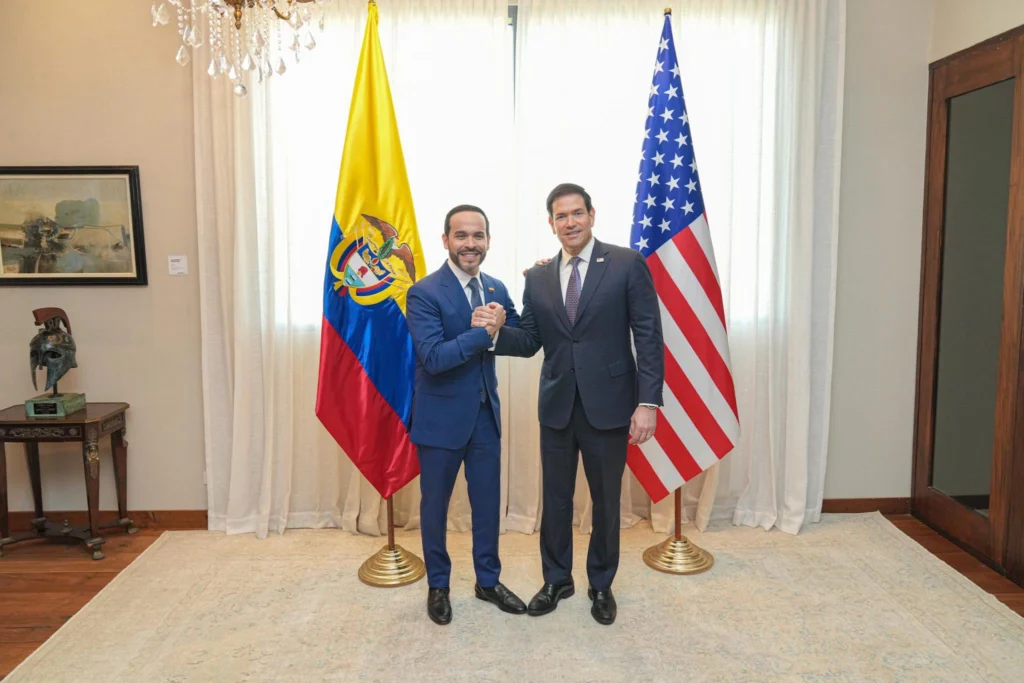
Secretary of State Marco Rubio arrives in Colombia where he was greeted by Colombian Foreign Minister Omar Bula Escobar. pic.twitter.com/XXi9uVpOyR
— CSPAN (@cspan) September 8, 2026
The De la Espriella Administration: Realignment and New Security Pacts
With President Abelardo de la Espriella’s inauguration in August 2026, Colombia’s foreign policy suffered a realignment with Washington.
Moving away from the Petro administration, de la Espriella re-established a close political and strategic partnership with the U.S. De la Espriella’s platform prioritized traditional security frameworks, economic liberalization, and an explicit alignment with conservative political movements across the Western Hemisphere.
Upon taking office, de la Espriella formally integrated Colombia into regional security initiatives led by Washington, including the Shield of the Americas Cartels Coalition and broader defense networks targeting transnational organized crime.
The de la Espriella administration reversed prior restrictions on counternarcotics operations, committing to expanded forced eradication protocols and enhanced intelligence sharing with U.S. defense agencies.
Furthermore, de la Espriella signaled major shifts in international relations, announcing plans to restore full diplomatic ties with Israel, withdraw from international legal petitions regarding Gaza, and sever ties with left-leaning regional governments.
This diplomatic pivot impacted trade, energy, and security arrangements. The government sought to attract foreign investment by facilitating access to domestic resource extraction, including mining and fossil fuel infrastructure, while expanding operational access for foreign military contractors.
Critics and political opposition figures noted that these policies prioritized external security commitments and foreign investment guarantees, reshaping domestic security priority settings to align closely with Washington’s broader geopolitical objectives in Latin America.
The Visit of Marco Rubio: Strategic Alliances and Trade Agreements
U.S. Secretary of State Marco Rubio conducted an official diplomatic visit to Colombia on September 8, 2026, marking the first stop on a multi-nation Latin American tour.
Meeting with President de la Espriella at the Batallón Paraíso military complex in Barranquilla, Rubio reaffirmed Washington’s strong backing for the new administration’s security and economic agenda.
The summit highlighted a mutual focus on combating illicit trafficking, expanding bilateral trade, and countering regional geopolitical competitors.
During the visit, high-level officials signed strategic bilateral agreements focused on economic cooperation, energy, and defense. These arrangements included agreements covering potential civilian nuclear power cooperation and measures aimed at securing supply chains for critical minerals necessary for technology and defense industries.
Colombian Foreign Minister Omar Bula emphasized that the meetings signaled the renewal of a core strategic alliance, while United States officials underscored Colombia’s strategic role within Washington’s regional security architecture.
The bilateral summit generated significant political debate within Colombia. Supporters praised the agreements as essential steps for restoring international investor confidence, strengthening law enforcement capacity, and securing foreign financial assistance.
Conversely, opposition figures and legal analysts expressed concern over the long-term implications for national sovereignty, warning that committing critical mineral resources and defense infrastructure to foreign security frameworks risks reinstating the historical asymmetry that has long characterized Colombia’s diplomatic history.
Sources: RTVC – Radio Nacional Colombia – La Silla Vacía – Vorágine – RUMS – Rutas del Conflicto – Volcánicas – El Tiempo – El Espectador – TeleSUR – Insight Crime – BBC – CNN – Democracy Now – RT – AP News – New Herald
From teleSUR English via This RSS Feed.