

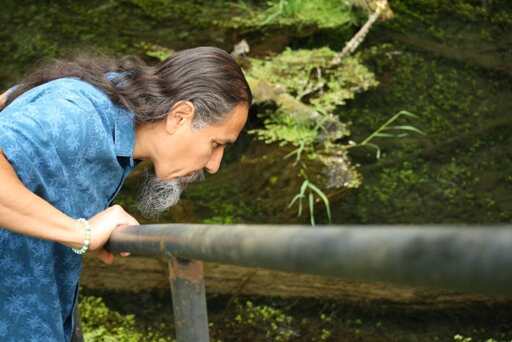
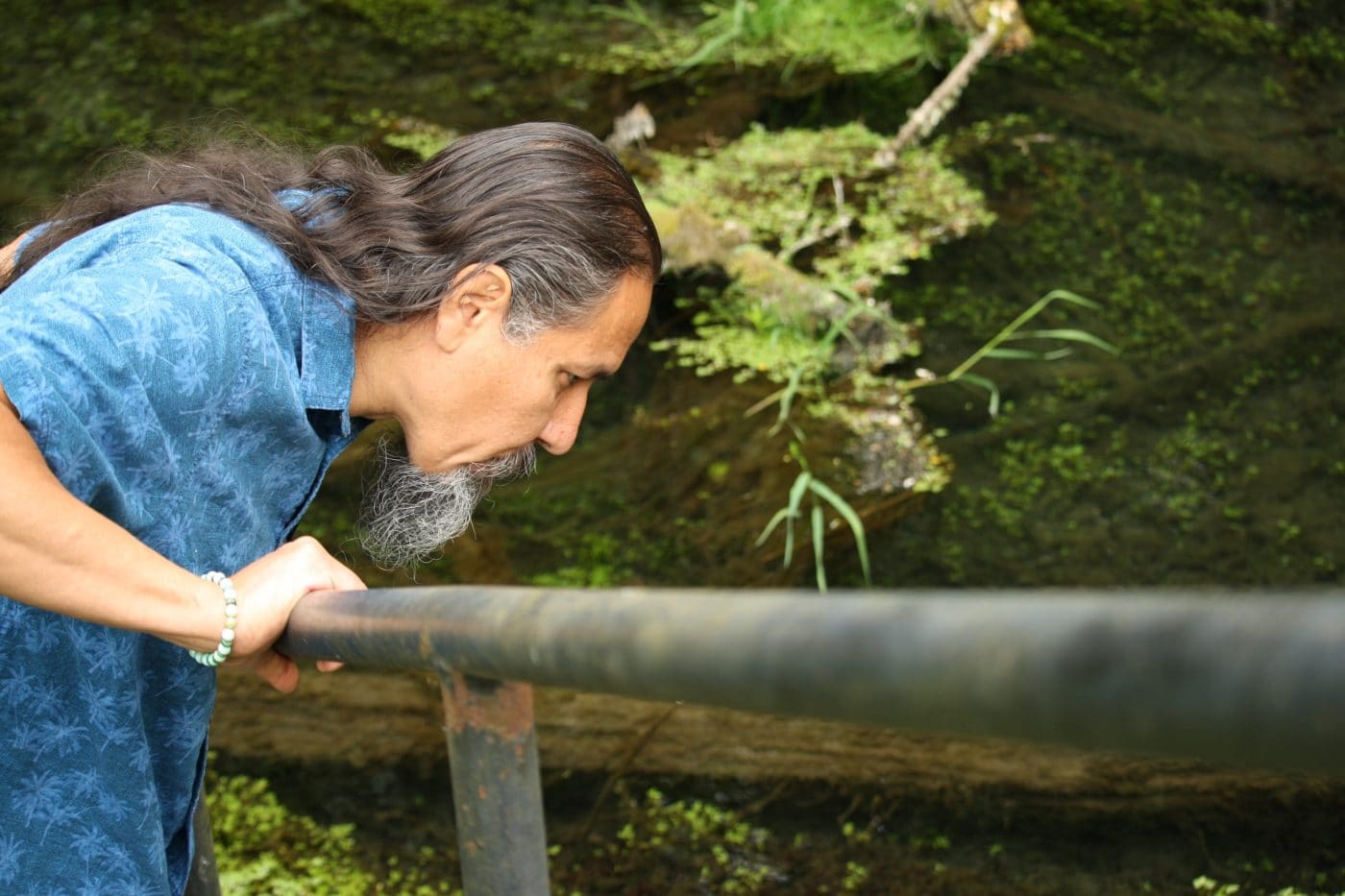
It was 6 a.m. when Qutxulenuhw Tim Kulchyski got the call.
On the phone was Elder Siilh’na’mut Ken Elliott, a fellow member of Cowichan Tribes. Elliott had been working in a place known as Fish Gut Alley, named after the abundant salmon that spawned and then decayed there. It’s a naturalized wetland spread out over nearly four hectares of Duncan, B.C., within Rotary and McAdam Parks, just north of the Cowichan River on Vancouver Island. It was June 2007, and he was restoring the natural habitat around the city’s sewage lagoons — essentially, large pond-like areas that local wastewater flows into.
That morning, Elliott, a Quw’utsun Knowledge Keeper and expert on native plants, had been taking inventory along Fish Gut Alley. As he moved downstream, a strange cacophony grew louder and louder.
“Crows, ravens, kingfishers — just an incredibly large amount of bird activity. Everyone was squawking and making a lot of noise,” he said.
Following the sounds, Elliott came across a scene that was “a blow to the gut,” he said.
From bank to bank the river was filled with thousands of juvenile coho salmon on their sides, swimming in circles, mouths wide, gasping at the surface. Birds had descended on the area to feast on the dead and dying fish.
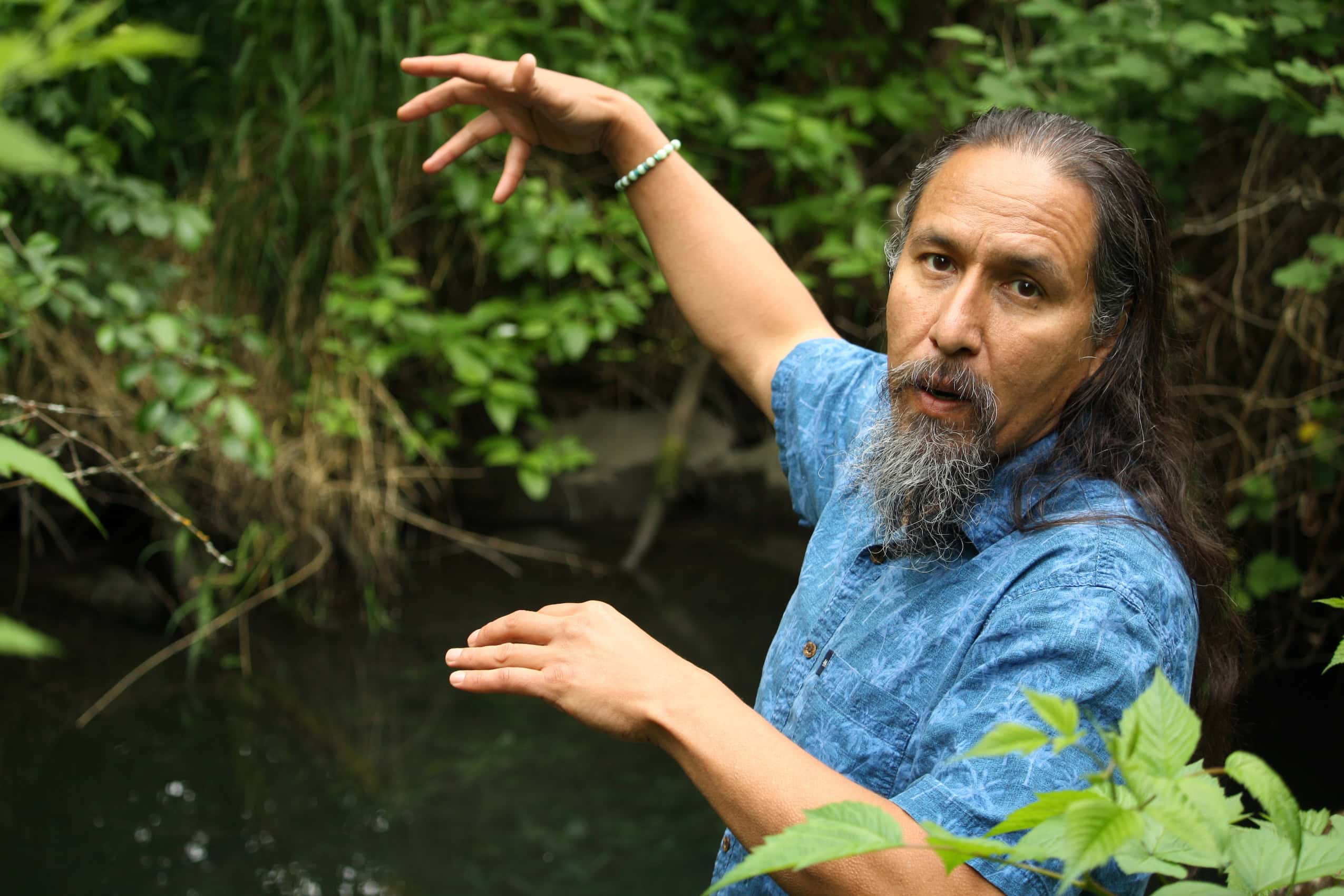
Cowichan biologist Qutxulenuhw Tim Kulchyski got a call one morning in 2007 from a friend down in Fish Gut Alley in Duncan, B.C., to investigate a mass of dying juvenile coho salmon. Now, Kulchyski thinks he’s figured out what caused the die-off.
Elliott called Kulchyski, a biologist, and told him to get down to the river quickly.
Once he arrived, the two men began looking for the cause of the mass casualty event. “We ran up and down the stream looking for something that may have poisoned them, but we couldn’t find any gasoline or anything like that,” Elliott said.
Before leaving to meet Elliott, Kulchyski had phoned Willi Aquino, a local fishery officer with the Department of Fisheries and Oceans, who soon joined them at the river.
“You could see where the fish had died,” recalled Aquino. “It was very close to this storm drain. So, it’s like, ‘OK, something’s coming out of there.’ ”
There had recently been significant rainfall in the area, Elliott recalled. At first, he thought maybe one of the local businesses had dumped something toxic into the storm drain system, which the rain could have washed into the river. Later that day he drove around to ask at dry cleaners, car washes and gas stations, but he found no leads.
Around the same time that Kulchyski, Elliott and Aquino were scratching their heads over the dead coho on Vancouver Island, marine researchers and streamkeepers in Washington state were investigating a similar phenomenon in their own neck of the woods: for decades, they had noticed dramatic die-offs of coho salmon in urban areas, close to roadways, but couldn’t figure out the cause. It wasn’t until 2020 that the Washington researchers hit on a major discovery — one that not only connected the dots for Kulchyski but solved an environmental mystery that had been puzzling scientists for decades.
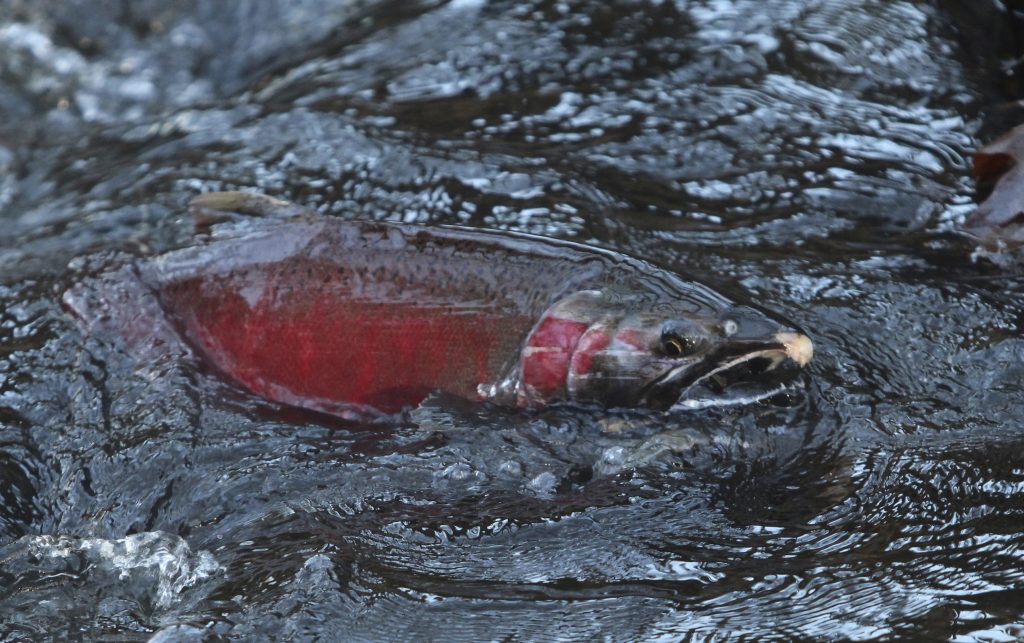
Coho salmon have been hit by a host of different challenges over the years, including habitat destruction, pollution and climate change. By 2005, they were classified as an endangered species in the United States. Photo: Manuel Valdes / The Associated Press
The culprit: a highly toxic chemical compound called 6PPD-quinone. It comes from the breakdown of a compound called 6PPD, a preservative added to car tires to prevent the rubber from cracking as a result of ozone in the air.
Anti-ozonants like 6PPD came into widespread use in the 1960s so the rubber of car tires wouldn’t crack and wear down so fast. These days, each time a car is driven, its tires shed tiny amounts of 6PPD-infused rubber onto the roads. When it rains, the particles wash into nearby fish habitat, where UV exposure causes it to break down into 6PPD-Q, which can be lethal even in tiny amounts.
Kulchyski had started to hear “murmurs” in the scientific community about a compound that was killing coho salmon just as COVID-19 restrictions began to spread across the world.
Now, after years of research and testing in the area, he has no doubt this was what killed the salmon in Fish Gut Alley. And he’s on a mission to help the world understand the colossal problem 6PPD-Q presents, and how First Nations are on the front lines of dealing with it.
The salmon mystery solved
To understand how 6PPD-Q was discovered, one needs to travel back to the central California coast during the 1990s, when a host of different challenges meant coho salmon were driven nearly to extinction. By 2005, they had been classified as an endangered species in the United States.
This led to an influx of resources aimed at habitat restoration in urban streams throughout the Pacific Northwest. And more boots on the ground meant more scrutiny, according to aquatic toxicologist Jenifer McIntyre. She’s an associate professor at Washington State University and researches Seattle-area streams in the Puget Sound.
As researchers tromped around in streams, squinting into turbid waters watching, waiting, McIntyre and others began to notice something odd: large numbers of dead coho piled up along the sides of creeks that were still filled with eggs. This meant they had died before getting a chance to spawn.
“If you’re used to salmon and salmon fisheries, then you’re not surprised by dead fish in the fall, but the fact that they haven’t spawned is like … ‘Oh,’ ” McIntyre said.
Across seven years of field studies, a pattern emerged. The dead salmon were primarily coho, in the most urbanized areas of the Puget Sound. The deaths typically happened during or just after heavy rains, and as they died the fish exhibited a strange, specific behaviour: swimming in circles at the surface of the water, mouths gaping, spiralling and gasping. And the phenomenon was widespread: about 40 per cent of the Puget Sound area was affected and between 40 to 90 per cent of those salmon were dying before they spawned, within hours of being exposed.
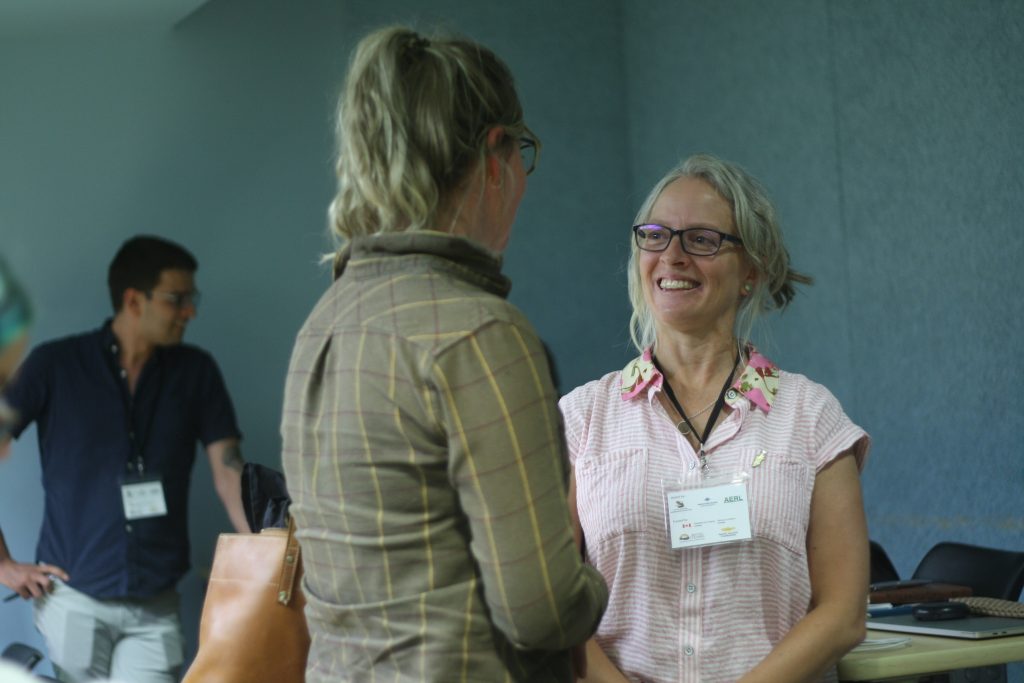
Aquatic toxicologist Jenifer McIntyre was part of the team of researchers who discovered the cause of mysterious coho salmon deaths in the Pacific Northwest in the early 2000s.
The weight of the evidence at this time suggested their deaths were somehow being caused by stormwater runoff, McIntyre said.
At first, researchers faced a long list of potential causes. Was it pesticides from a nearby golf course, or low oxygen? Could it be parasites? As they dug in and began to eliminate each of these factors, they slowly narrowed in on a possible cause.
Cars.
But there were so many chemicals associated with cars. The first year they began running tests on salmon, in 2016, McIntyre figured they only had the capacity to run tests on two things, and decided to look into car tires and exhaust particles. But it eventually proved to be too much to do two things, so they decided to focus on car tires.
When her team passed water through a mulch of worn tire particles to make a solution, it killed all of the coho salmon tested in their lab. That’s when they knew they were onto something, she said, though at first they didn’t know exactly what.
“Something about stormwater — okay. Something about roadway runoff — all right. Something about tires,” McIntyre recalled. “That’s when Ed joined the picture.”
Ed Kolodziej, a water and ecosystem health researcher and professor at the University of Washington, brought in critical chemistry expertise and a dream team of biologists and chemists. Assembled from government departments and universities from across the Pacific Northwest, they set to work trying to figure out what it was in the tires that was killing the fish.
“Out of the hundreds to thousands of chemicals that we were detecting in these samples, there were 57 chemicals that were always present when the coho salmon died, so we started to identify them,” Kolodziej said.
Over time, the list of chemicals got smaller and smaller until they managed to identify the composition of what they thought was the culprit, but there was one problem: it didn’t correspond to any known tire ingredients, McIntyre said.
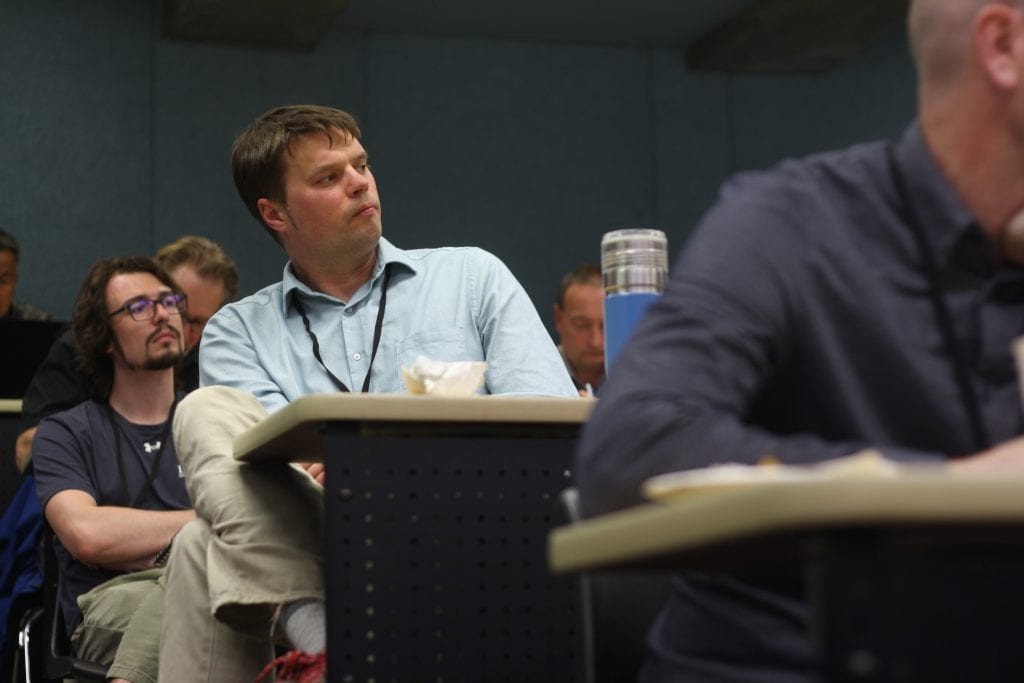
Ed Kolodziej, a water and ecosystem health researcher and professor at the University of Washington, joined the salmon research team to attempt to understand what in car tires was poisoning coho.
An environmental chemist on the team named Zhenyu Tian noticed that the carbon and nitrogen in the molecule of their mystery chemical matched some of those on the tire list, though it differed in other ways.
Then Tian had a lightbulb moment: what if they were searching for a chemical that transformed into something else once it entered into the environment and broke down?
In the mountains of research materials, Tian found an old industrial rubber paper from 1983 that talked about a chemical added to tires called 6PPD. When it was ozonated — exposed to air and sunlight — the paper stated that it changed into the exact chemical formula they were searching for: 6PPD-quinone.
To confirm their theory, the scientists bought some 6PPD and tested it on the salmon in their lab. They died, showing the same characteristic twisting and gasping behaviours that had been seen in wild salmon.
The group’s evidence was compiled into a groundbreaking paper published in the journal Science at the end of 2020. It was a sensation in the scientific community, in part because it finally offered an explanation for a phenomenon that wasn’t new, and in part because it sounded an alarm over how toxic and widespread 6PPD-Q is.
One of its most remarkable — and alarming — features is just how little it takes to kill coho salmon. As one researcher put it, the equivalent of a grain of rice in an Olympic-sized swimming pool is enough to make the water lethal.
And it’s not just fish that have been exposed. A recent study out of China shows that 6PPD-Q has been detected in human urine and breast milk, though it’s not yet clear what effect, if any, it has on humans or other mammals. Researchers are also finding it not just in water but in air, dust and snow — basically everywhere there are tires.
“It is among the most toxic chemicals that we know of for aquatic life,” McIntyre said. “We reasoned that you would expect to find this chemical anywhere where tire particles were getting into the water.”
But the researchers still had questions to answer. Why were certain fish species, such as coho and coastal cutthroat trout, so uniquely sensitive to 6PPD-Q? How does it kill them? And, perhaps most important, how can its risks be contained?
Finding 6PPD-Q hotspots
In February 2026, about 165 people attended the third and final Protecting Salmon From Tire Wear Toxicants workshop in downtown Nanaimo.
Workshop presentations ranged from practical to dizzyingly technical, and represented an unusual cross-collaboration across disciplines, all focused on solving the same problem.
“If everyone’s a silo, we’re all probably trying to look for the same answers to the same questions, and you’ll get it from many different places, but it’ll happen a lot faster if you’re talking to people,” said Angelina Jaeger, a researcher with Vancouver Island University’s Centre for Health & Environmental Mass Spectrometry (CHEMS), one of the groups that organized the workshop series. “That’s what science should be.”
Like many researchers at the workshop, Jaeger is focused on finding solutions. One problem her team decided to focus on was implementing widespread 6PPD-Q testing in local streams and creeks.
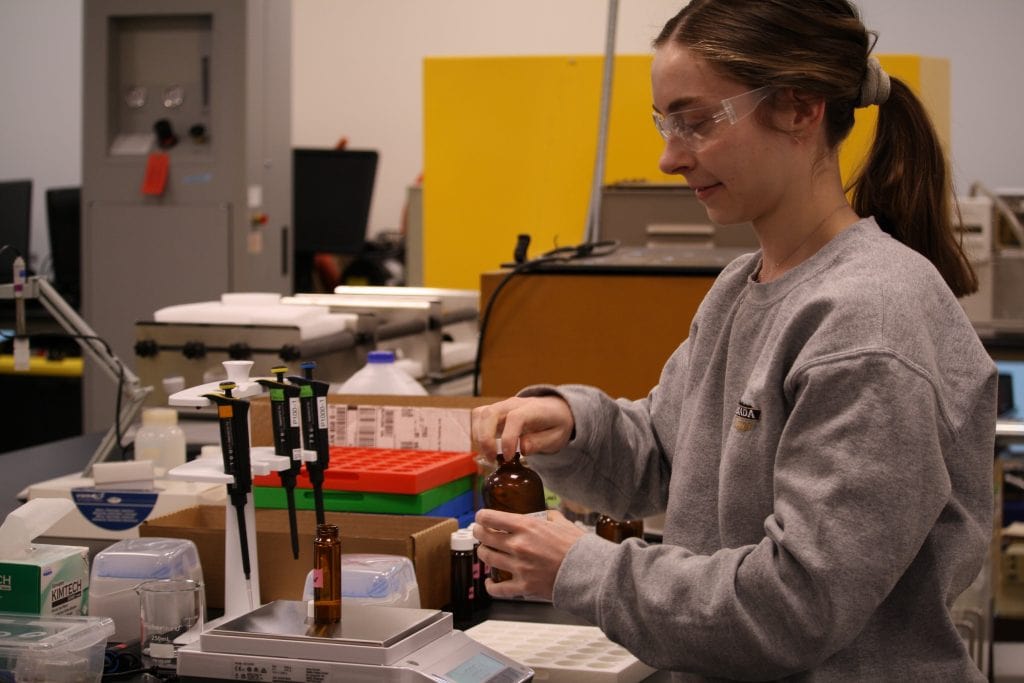
Researcher Angelina Jaeger processes water samples at Vancouver Island University’s CHEMS lab, testing them for 6PPD-Q. They’re testing local streams and creeks to see if the chemical is in the water.
It all started with that seminal 2020 Science paper, said Erik Krogh, a chemistry professor and co-director of Vancouver Island University’s CHEMS lab. Though he read it with a sense of dread, Krogh immediately saw a use for the technology his team had been working on for more than a decade, which would make it “faster, better and cheaper” to test water samples.
Already developed as a way to test for carcinogens in oilsands process water, the test dips a membrane into a water sample and, using a repurposed 3D printer to mix it around, it pulls out the chemical and sends it to be measured. Within a few months, they had repurposed this technology to mass-test for 6PPD-Q.
Soon, researchers were able to process up to 100 samples a day and get results within minutes.
With hundreds of volunteers taking samples in waterways across Vancouver Island, over the last three years their lab has gathered what Krogh believes is the single largest dataset of 6PPD-Q samples in the world.
When Kulchyski heard about the team’s goal of finding 6PPD-Q “hotspots” on Vancouver Island, he put Fish Gut Alley onto their radar.
Kulchyski and the researchers wanted to understand what was going on in the area, past and present. Since their bleak early-morning discovery in June 2007, Kulchyski, Elliott and Aquino had witnessed other, similar fish kills in the area. At times, researchers say they can recognize urban stormwater that likely contains 6PPD-Q, visible as a cloudy sediment or sometimes an oily sheen.
“To us it’s like a horror film, because you just see this big dark cloud, and then six or seven or eight thousand fish are dead,” said Kulchyski.
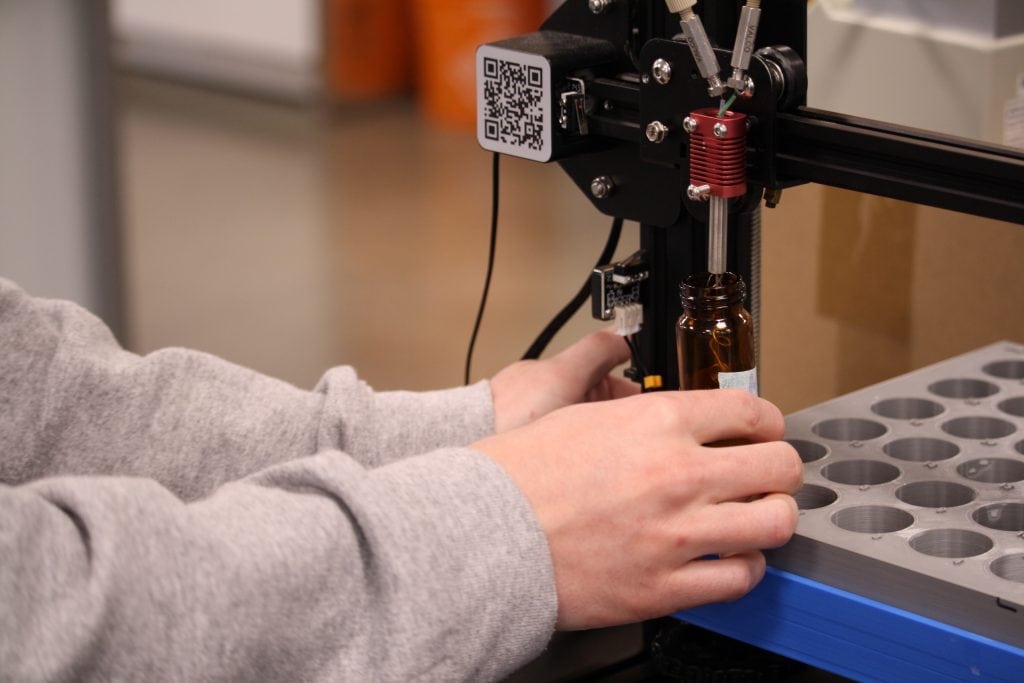
Once it became clear that a chemical from car tires, 6PPD-Q, was causing issues for salmon, researchers at Vancouver Island University began processing samples as quickly as possible to assess just how big the problem is.
Initially, everyone involved in the original Fish Gut Alley incident thought low oxygen levels must have been the culprit, and Elliott said he is still convinced that’s the case.
In this case, stormwater sits in a reservoir before being pumped out into the environment and bacteria end up growing in there and consuming the oxygen, and then when it is released it can kill the juvenile salmon, Elliott said.
But Aquino ran on-site tests at the time, and though oxygen levels were low, she said in her estimation they weren’t low enough to kill the fish. She also took a gasping, dying fish out to the Pacific Biological Station in Nanaimo to run tests, but nothing came of it.
“We could never really figure it out,” she said. “There was no real smoking gun.”
But in March of 2024, the researchers at Vancouver Island University finally found a clue that connected everything.
After several days of rain, a stormwater sample taken in the morning at Fish Gut Alley measured levels of 6PPD-Q at hundreds of nanograms per litre, far beyond the concentration that had killed coho in the lab.
“That concentration is certainly higher than most,” Jaeger said. And it’s not the only sample in the area that has tested well above what is safe. As a result, the team designated Fish Gut Alley a priority site and installed an automated collector there last summer to take samples every hour during rain events.
“It’s a great example where we’ve identified a hotspot, and so now we can work to solve it,” Krogh said. Urban streams can have dozens of storm drain outfalls, which means measuring stormwater for 6PPD-Q levels can be a huge task, he said. “Where do you start? Can we fix them all? I mean, that’s overwhelming. Let’s find which ones are problematic, and let’s address them.”
Can it be stopped?
Because 6PPD-Q is hydrophobic, like oil, it tends to stick not only to the test membranes used by the university researchers, but also to soil. And it turns out this is an important part of how the chemical might be mitigated.
Tests being run by researchers at the University of British Columbia in Vancouver show an approximate 90 per cent removal of 6PPD-Q from stormwater when they run it through “rain gardens.” These are green areas near roads that filter runoff through soil and plant roots before re-entering the environment. Krogh is currently working with his research partners on three rain gardens planned for various locations around Vancouver Island, and a fourth is already under construction in Langford, just outside of Victoria.
Promising results have also come from using filters made from coconut husks and biochar — a carbon-rich, charcoal-like substance made from dried plant waste.
At Washington State University, when roadway runoff went through a bioretention system made from 18 inches of sand and compost, it prevented salmon deaths for the entire 13 years the study ran, McIntyre said.
The upside of the whole thing is that researchers already know so much more about the problem now than they did even two or three years ago, Krogh said. For example, their team recently found that even when fresh water is repeatedly run through collected tire sediment samples, it doesn’t seem to dilute the concentration of 6PPD-Q. This means that when tire particles are sitting at the side of a creek, they remain a long-term contamination source despite repeated rains.
“It’s not just one and done. So we really have to deal with the particles and make sure that we handle those carefully, so that we’re not putting them somewhere else in the ecosystem or in the watershed and then they become a source somewhere else.”
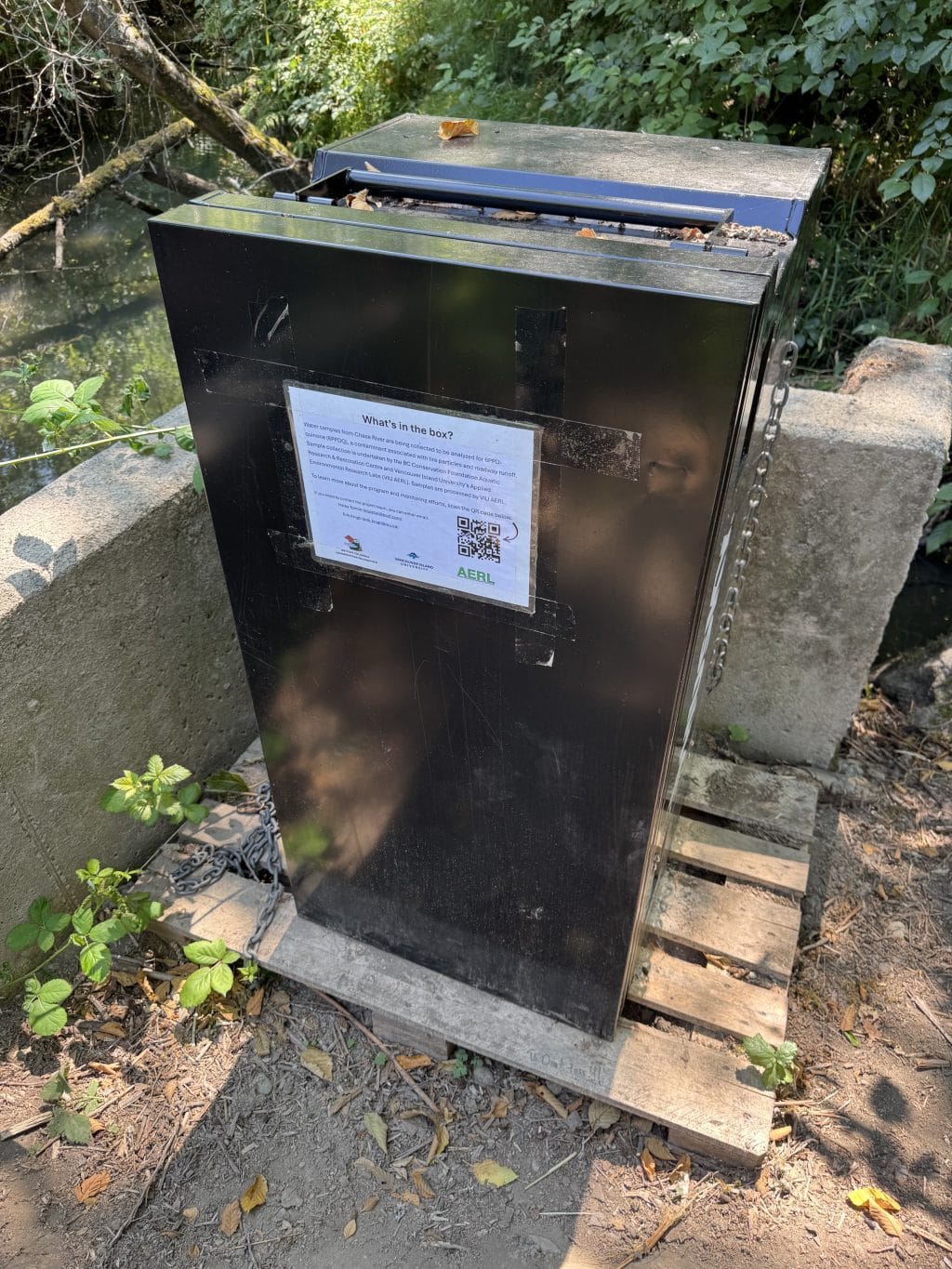
An automated water collector installed by Vancouver Island researchers at Fish Gut Alley in Duncan, B.C., collects water samples to determine when water is contaminated and poses a risk for salmon in the area. Photo: Tim Kulchyski
Krogh maintains a cautious sense of optimism that the problem is “solvable.” However, hurdles still exist. Regulating the high volume of 6PPD-Q in the environment is difficult, and finding an alternative chemical with the same properties, but less harmful, is also tricky.
The Canadian government included 6PPD and 6PPD-Q on a priority list for assessment starting in the winter of 2025. This is a step towards the chemical’s possible regulation, under the Canadian Environmental Assessment Act.
However, the Tire and Rubber Association of Canada (TRAC) tried to delay a potential assessment in 2024 to see what regulation happened in the U.S. first, according to documents obtained by The Narwhal through a freedom of information request.
Governments should not prematurely restrict the use of 6PPD as it could “have enormous public safety and economic consequences,” wrote association president Carol Hochu to then-environment and climate change minister Steven Guilbeault, in an April 1, 2024 letter.
The association believes a deferral of regulation is still the best approach, given the “extensive regulatory activity” underway in the U.S., which includes a search for safe alternatives to 6PPD, communications manager Michal Majernik told The Narwhal by email.
Potential alternatives to 6PPD are being explored by the U.S. Tire Manufacturers Association, which releases a yearly analysis on its findings.
In response to the hurdles, researchers also published a paper in the scientific journal Environmental Science & Technology Letters in the summer of 2025, outlining what an international regulatory framework for 6PPD-Q might look like. It also highlighted some of the broader political issues at play.
For example, vehicle pollution disproportionately impacts “under-resourced and underserved communities, who tend to live closer to traffic.” The paper notes it also affects food sources for Indigenous Peoples, and describes this higher level of tire chemical exposure as an act of “environmental injustice.”
A warning for salmon
Kulchyski caught his first fish at eight years old — a coho salmon, with a spear he made himself. He gave it to his Elders, because that’s what you do when you catch your first fish, he said. It’s a cultural practice and a full-circle philosophy of generational caretaking.
“If you look after your family, when you become an Elder, then your family will look after you,” he said. “If we don’t look after them, it’s a sign that we’re not looking after ourselves. And so if we look after salmon, not only are they healthy and happy, they return and nourish us. It’s a pretty simple system.”
He caught the coho in Fish Gut Alley, when historical runs of salmon were once so abundant the area was named after the mounds of decaying salmon that died there after spawning. That’s how it was when he was a kid, Kulchyski remembers. But in the decades since, things have changed.
In the broader Cowichan River system, coho numbers have shown a steady decline of more than 90 per cent since the 1970s, though they’ve rebounded somewhat in the last five years.
“How we’ve treated the landscape, how we’ve treated the land, the dyking and all these other issues, have really pushed almost every pressure that there is that you can exert on fish and fish habitat on this one little stretch,” he said.
A verdant gem hidden in plain sight, Fish Gut Alley is nestled into a suburban neighbourhood in Duncan, and most of the dog walkers and joggers that use its wide gravel trails nearby are likely unaware they’re only steps away from crucial juvenile salmon rearing and spawning habitat.
Though unremarkable to the untrained eye, the area’s shallow protected pools, fallen logs and slow-moving streams are ideal for juvenile coho to hang out in and get strong before heading out to the ocean, Kulchyski said.
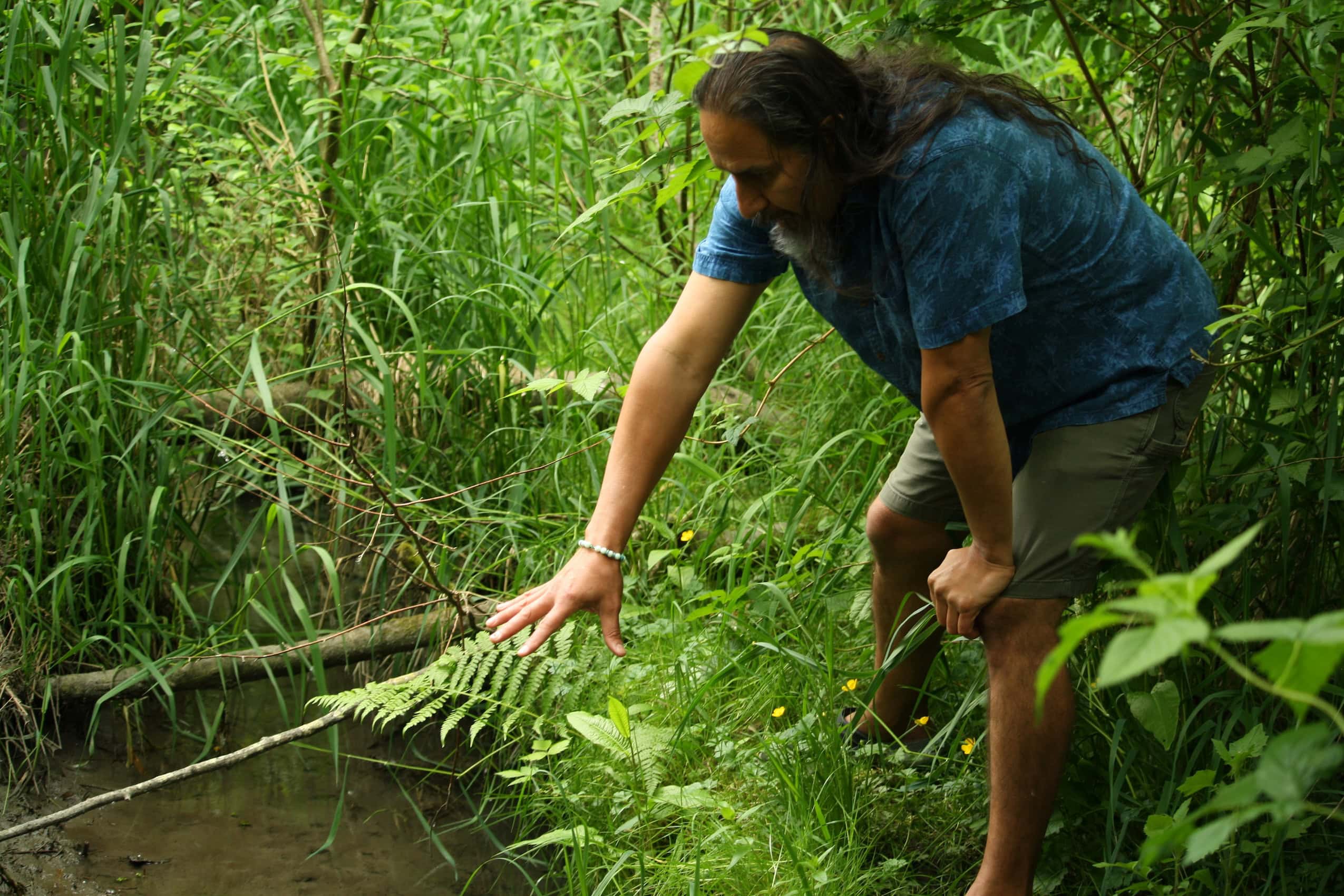
Fish Gut Alley, though nestled in a suburban area in Duncan, B.C., provides the perfect breeding and spawning grounds for salmon, with its shallow protected pools, fallen logs and slow-moving streams.
It’s hard to get around the negative mindset that things are hopeless, that everything could crash and salmon could just stop existing, Kulchyski said. But for him, giving up is simply not an option.
“That doesn’t exist in our mental scenario of the world. It’s kind of like saying, ‘Hey, you know what? You’re gonna lose one of your children,’ ” he said. “I don’t think so.”
Though 6PPD-Q is not the only problem facing salmon in the area, he views it as something that could change the way people think about environmental protections, “sort of a stepping stone to introducing us into a new thought process and a new methodology that allows us to do things differently, treat these systems differently, think of fish differently,” he said.
At present, Kulchyski is working with university researchers and the City of Duncan to look at mitigating 6PPD-Q at source, by targeting the stormwater gathered from nearby streets that is held in reservoirs before flowing into salmon habitat.
“We are treating our water so poorly, and not looking after all the issues we bring forward. On all of the bridges and all of the highways, there’s 6PPD-Q coming in everywhere,” he said.
“I certainly don’t know all of the solutions, but I know if we actually start incorporating these concerns and these issues in building new bridges and building new treatment systems, it will immediately make a huge difference.”
On-the-ground reporting for this story was made possible with support from Carleton University’s Leonard Shifrin and Louise Dulude Canadian Social Policy Emerging Reporter Fund. As per The Narwhal’seditorial independence policy, no foundation or outside organization has editorial input into our stories.
The Narwhal’s reporters are telling environment stories you won’t read about anywhere else. Stay in the loop by signing up for our free weekly dose of independent journalism.
From The Narwhal | News on Climate Change, Environmental Issues in Canada via This RSS Feed.