

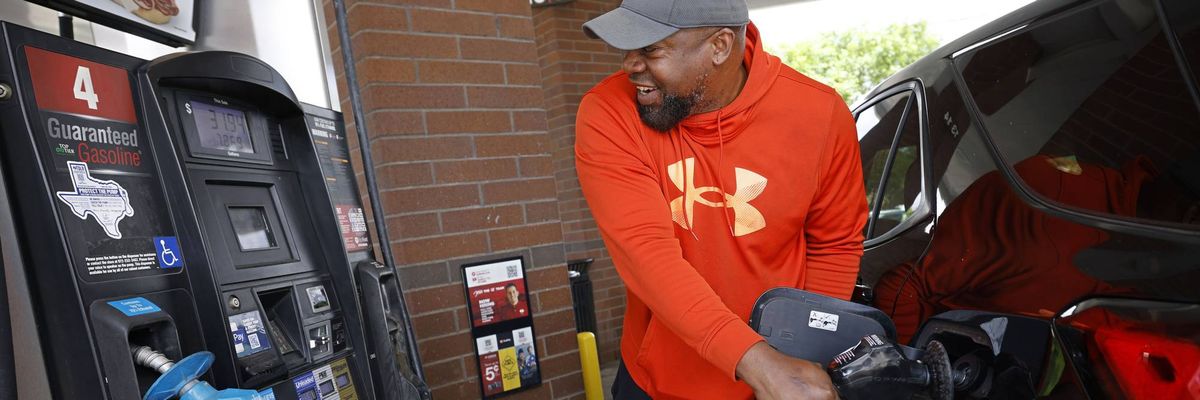
The global price of oil jumped above $100 per barrel on Wednesday for the first time since July as US President Donald Trump’s illegal and deeply unpopular war on Iran continued with no end in sight, imposing an increasingly painful burden on American consumers.
A running tracker maintained by the Watson School of International and Public Affairs at Brown University estimates that US consumers have collectively spent more than $101 billion—roughly $776 per household—extra on gasoline and diesel fuel since the start of the Iran war in late February.
Trump administration officials and the president himself have publicly downplayed high gas prices, suggesting Americans should be grateful they aren’t even higher and that the Iran war is worth paying a bit more at the pump. Labor Day weekend saw the highest gas prices ever recorded for this time of the year, according to the American Automobile Association.
The Iran War Energy Cost tracker has surpassed $100 billion. That’s $100 billion dollars in extra fuel costs for U.S. households since the start of the war with Iran on February 28, 2026. https://t.co/VsJ1YSSqea pic.twitter.com/s5RARUNNOs
— The Costs of War Project (@CostsOfWar) September 8, 2026
Trump, a billionaire whose fossil fuel stock holdings have grown substantially during the war, predicted earlier this week that oil prices would “drop precipitously” once “we WIN the war with Iran,” contradicting his previous statements in which he claimed the US was already victorious.
The president has also repeatedly declined to call the onslaught a “war,” even as it has killed thousands of Iranians and at least 18 US servicemembers, and wreaked havoc on the global economy. Last week, Trump called the war “small potatoes.”
“Everyday Americans are grappling with gas prices that just keep getting more expensive. Instead of providing any relief to working families, or fixing the mess they created, Republicans are focused on inflating Trump’s ego,” Kendall Witmer, the Democratic National Committee’s rapid response director, said in a statement on Wednesday, referring to the GOP’s “Trumpapalooza” midterm convention.
“Voters will remember who is fighting to lower costs come November,” said Witmer.
The latest jump in global oil prices came after the US military said it “forces destroyed five Iranian crude oil carriers” connected to the Islamic Revolutionary Guard Corps (IRGC).
The IRGC said it responded by targeting “two US vessels, eight oil tankers, and 10 other ships attempting to pass through the prohibited zone of the Strait of Hormuz.”
“The heroic IRGC Navy, in response to the aggression and hostility of the terrorist US military in its attack on five Iranian oil tankers in the Persian Gulf, targeted two US vessels and eight oil tankers in the area, inflicting heavy damage on them,” the IRGC said in a statement.
The National Iranian American Council (NIAC) noted in a blog post on Tuesday that “disrupted shipping through Hormuz” is one contributor to record-high US fuel prices, whose impacts go far beyond the costs paid by consumers at the gas pump.
“Diesel costs have implications beyond motorists because trucking and freight networks pass higher fuel expenses through the wider economy,” NIAC observed. “The effects of constrained energy flows extend well beyond the immediate combat zone.”
From Common Dreams via This RSS Feed.