

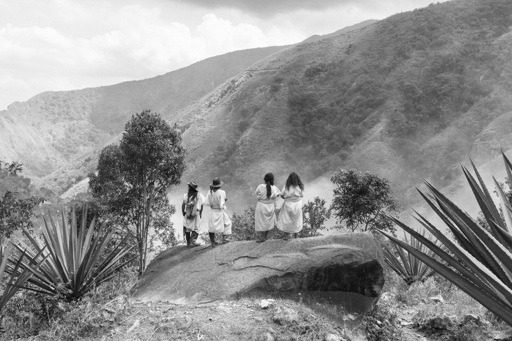
RIOHACHA, Colombia — Amid the low slopes of a tropical dry forest, families from the Wiwa community of Gomke are building a new home. Their ancestral settlement lies higher on a lush mountain in the town of Dibulla, overlooking the Caribbean coast in Colombia’s Sierra Nevada de Santa Marta. Across this region, many Indigenous communities have been forcibly displaced by climate-related disasters or uprooted by armed actors. Gomke’s move to lower terrain, however, is described by community representatives as voluntary: a collectively led adaptation strategy to protect social, educational and spiritual cohesion amid intensifying climate pressures and the presence of paramilitary groups. They call their new settlement Shegunamke. Shegunnamke is a recently rebuilt Wiwa village. Severe weather events and the spread of paramilitary violence have made their home village increasingly isolated and dangerous. In response, the community is building a new settlement in a safer and more accessible location in order to preserve its social and spiritual structures. Image by Roberto Maccariello. The Wiwa have also acquired other parcels of land elsewhere in the Sierra, including at higher elevations. “We have left [those] untouched so that rivers, springs and bodies of water do not die,” said Roberto Carlos Coronado Calvo, rector of Shenzhawimaku, the Wiwa educational institution that combines conventional learning with the community’s language, culture, knowledge systems and relationship to the territory. “If we begin clearing and cutting into the páramo [ecosystem], how can we guarantee life for those living below?” Across the Sierra Nevada de Santa Marta, known…This article was originally published on Mongabay
From Conservation news via This RSS Feed.