

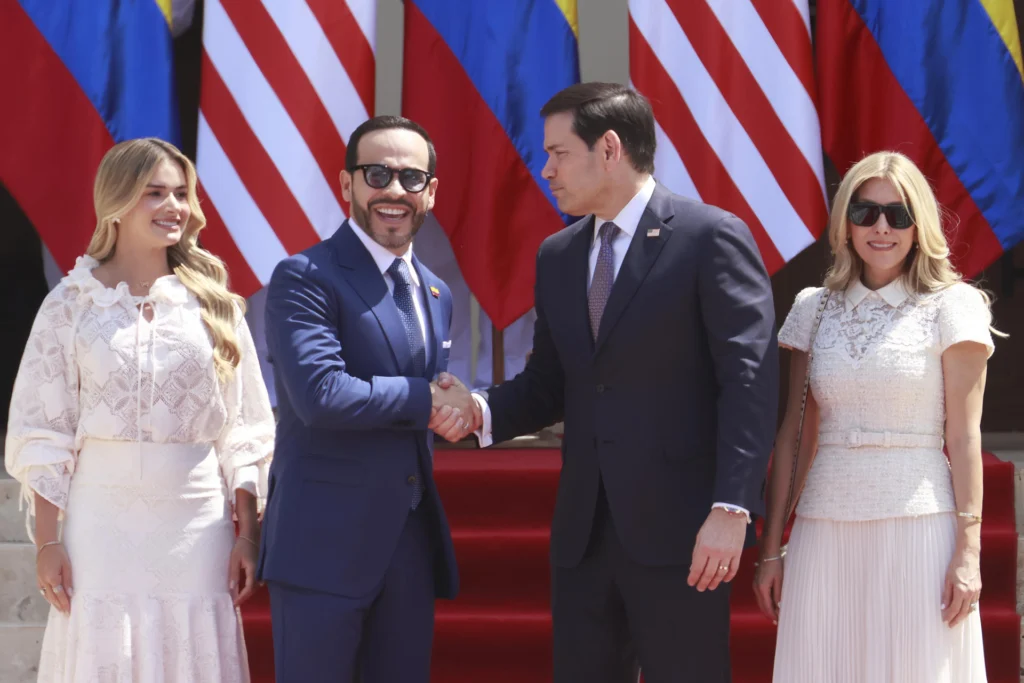
U.S. Secretary of State Marco Rubio met with Colombia’s President Abelardo De la Espriella in Barranquilla on Tuesday, and both signed a series of agreements covering critical mineral supply chains, civilian nuclear cooperation and regional security.
The visit of U.S. Secretary of State Marco Rubio to Colombia marks a significant milestone in the bilateral relationship between the two countries. This encounter, held in Barranquilla, signifies the first high-level meeting between the Trump administration and the newly elected government of Abelardo De la Espriella. It also marks the first in-person meeting between the Trump administration and De la Espriella’s government.
The visit is part of a tour of Rubio’s region that will continue in Ecuador and Peru, where the U.S. Secretary of State will meet with presidents Daniel Noboa and Keiko Fujimori.
RELATED: Colombia Lifts Ban on Firearm Carrying: De la Espriella’s New Decree
U.S. Secretary of State, Marco Rubio, emphasized the importance of strengthening the alliance between the two nations, stating that the natural state of affairs is for the U.S. and Colombia to be strong allies.
For his part, De la Espriella highlighted what he described as a turning point in bilateral relations, saying the two countries are “beginning a historic and close relationship that was interrupted for four years” and calling the rapprochement “a new rebirth” for Colombia.
The Colombian President, in turn, requested the opening of a U.S. consulate in Barranquilla, which he called “the alternate capital” of the country.
Recibí en Barranquilla al secretario de Estado de los Estados Unidos, Marco Rubio, y a su esposa, Jeanette Rubio.
Este encuentro de alto nivel ratifica, con hechos y absoluta determinación, que la alianza estratégica entre Colombia y los Estados Unidos está más firme que nunca.… pic.twitter.com/EF2fGZGfq0
— Abelardo De La Espriella (@ABDELAESPRIELLA) September 8, 2026
Text reads: “I received in Barranquilla the Secretary of State of the United States, Marco Rubio, and his wife, Jeanette Rubio. This high-level meeting confirms, with facts and absolute determination, that the strategic alliance between Colombia and the United States is stronger than ever. We move forward on a joint agenda to strengthen regional security, fight narco-terrorism head-on, comply and collaborate on border issues, and open new opportunities for investment, development, and prosperity for our peoples…”
The Bilateral Agreements: 3 Main Pillars
De la Espriella presented reporters with the so-called “Barranquilla Agreements,” a roadmap built around three main pillars: rebuilding the country after the August 10 earthquake, reviving the economy, and strengthening regional security.
“From this meeting has emerged a road map that we have called the ‘Barranquilla Agreements’, around three major issues that are of substantial importance for our country and the hemisphere: rebuilding the homeland, recovering the economy and armoring the hemisphere”, he expressed.
As a concrete outcome of the talks, the governments formally signed two memorandums of understanding, which cover critical mineral supply chains, civilian nuclear cooperation and regional security
The first addresses the securing of supply chains for critical minerals and the processing of rare earths, an area Washington has increasingly prioritized amid global competition over materials essential to defense and technology manufacturing. The second establishes a framework for strategic civilian cooperation in nuclear energy, opening the door to future collaboration on nuclear infrastructure for non-military purposes -though no further technical or financial details were disclosed at the time of signing.
Beyond the two signed memorandums, President De la Espriella detailed that the discussions also covered a full-scale fight against narco-terrorism, cooperation on border security, and the opening of new investment and development opportunities between the two countries.
Marco Rubio, for his part, characterized Colombia’s needs in terms of military equipment, radar systems, intelligence sharing and specialized training for Colombian security forces -items he said had been presented by De la Espriella as options for review by U.S. authorities, though he stressed no formal commitments had been finalized on those fronts.
Productive meeting with President @ABDELAESPRIELLA in Barranquilla, where we discussed security cooperation, trade, and ending illegal immigration in our region.
I also signed MOUs on critical minerals and civil nuclear cooperation with Colombian Foreign Minister Bula.
It’s a… pic.twitter.com/fudjht40fX
— Secretary Marco Rubio (@SecRubio) September 8, 2026
Wink to Eventual U.S. Base
The security dimension of the meeting also touched on the broader Shield of the Americas initiative, a Washington-backed regional strategy aimed at coordinating alleged efforts against drug trafficking and transnational criminal networks across Latin America, to which Rubio later announced Peruvian incorporation following Keiko Fujimori’s rise to the presidency.
Rubio suggested the agreements signed in Barranquilla should be understood as part of a wider push to restore the kind of close security partnership the two countries maintained for nearly two decades before recent years of friction. “We have a great foundation to build on, because for nearly two decades the closest security cooperation in the entire hemisphere was between the United States and Colombia,” Rubio said.
According to Rubio, Colombian President De la Espriella presented a list of alternatives for review by U.S. authorities, including military equipment, radar systems, intelligence sharing and specialized training programs for Colombian forces.
“They need our help with equipment. They need our help with intelligence. Sometimes they need our help with specialized training,” Rubio said, adding that responsibility for confronting criminal organizations should rest primarily with Colombian authorities, with targeted U.S. backing.
U.S. Secretary of State Marco Rubio clarified on Tuesday that no decision has been made and no formal request exists for a U.S. base on Colombian soil, stressing that any such initiative would have to originate with Bogotá before undergoing technical, financial and institutional review in both countries.
“We have to study whether that’s feasible. In many cases, those bases are joint bases,” Rubio said, adding that Washington would need to evaluate costs, operational conditions and overall viability before moving forward. He was careful to frame U.S. involvement as responsive rather than unilateral, telling reporters, “Everything they ask us for, we’re willing to provide, if possible, given the importance Colombia has.”
Any eventual base would carry legal weight in Colombia: a similar 2009 agreement granting U.S. personnel access to Colombian military facilities was ruled by the Constitutional Court to require treaty-level approval from Congress, meaning a decision of this kind could not rest solely with the sitting government.
Rubio insisted that Colombian sovereignty would remain central to any future talks. “What there’s absolutely no doubt about is that the United States is going to cooperate with the Colombian government in everything necessary to confront this regional threat,” he added.
Today marks an important and renewed commitment to our long-standing relationship with the great people of Colombia.
— Secretary Marco Rubio (@SecRubio) September 8, 2026


Neither side detailed a timeline for implementing the memorandums, and questions remain over financing, regulatory approval and the scope of foreign involvement each agreement will ultimately allow related pacts with Washington to constitutional and congressional review. Even so, officials on both sides presented the signings as a tangible first step, distinguishing Tuesday’s meeting from purely rhetorical statements about renewed alliance and giving the “golden era” language used by Rubio at least an initial institutional backing.
Together, the tone of the meeting and the agreements signed suggest both governments are eager to present the encounter as the start of a substantially closer relationship -though, as with any newly announced framework, the coming months will show whether the pledges translate into concrete follow-through on security, trade and investment commitments.
Rubio’s stops in Ecuador and Peru are expected to advance similar goals, including mineral-processing agreements and expanded maritime military coordination, against the backdrop of intensified U.S. strikes on vessels in the Pacific and Caribbean. In Colombia, the visit drew criticism from the country’s largest labor federation, the Workers Union, who accused De la Espriella’s government of “absolute subordination to the imperialist policies of the White House” and vowed continued opposition to joint military and intelligence operations on Colombian soil.
From teleSUR English via This RSS Feed.