

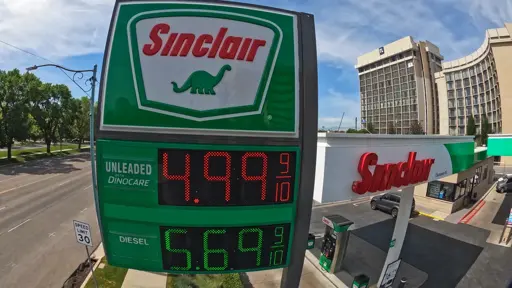
Motorists seeking to travel for the holiday weekend are seeing record-high gas prices with ‘no end in sight’ as Iran maintains control of the Strait of Hormuz
US gas prices have reached record highs for the Labor Day weekend with no relief in sight amid the ongoing US war on Iran and the closure of the Strait of Hormuz, AP reported on 7 September.
The average price of regular gas was $4.14 a gallon heading into the holiday weekend, when many families travel to see friends and relatives or enjoy the country’s natural areas.
“Gas prices are nearly a dollar higher than last year and well above the Labor Day weekend record of $3.82 from 2012,” AP wrote.
The news agency spoke with Nicole Collins, who planned to head from Philadelphia to South Carolina to visit friends. She said her family has spent most of the summer at home on the weekends, rather than taking their typical weekend trips due to high fuel costs.
“Gas is pretty high right now. It doesn’t help that we also have a baby, so we also have to pay for that,” Collins said outside a gas station in Claymont, Delaware.
“It doesn’t really seem like there’s an end to it,” she added.
Prices surged after the US and Israel launched an unprovoked attack on Iran in February, killing Iranian leader Ali Khamenei and top commanders of the Islamic Revolutionary Guard Corps (IRGC).
The IRGC responded by striking US bases in the nearby Gulf states and by attacking ships in the Strait of Hormuz, effectively closing the strategic waterway and slashing oil exports from the region.
“Everything points to the Iran War and the Strait of Hormuz,” said Tom Seng, a professor of energy finance at Texas Christian University.
Reporter asks if the administration has a timeline for when gas will return to $3 a gallon.
Vance refuses to provide one: “The fundamental reality is that the reason gas prices are so high right now is because the Iranians are shooting at commercial shipping.” https://t.co/YCVM3fJI4C pic.twitter.com/cFJByo3w91
— Furkan Gözükara (@FurkanGozukara) September 4, 2026
“Yes, they’re higher today, but we’re doing everything we can to push them down,” claimed Energy Secretary Chris Wright on ABC’s “This Week” news program on Sunday.
The price of diesel also hit a record Friday, averaging $5.85 a gallon.
The US relies heavily on diesel for shipping goods, including food, across the country by truck.
While US oil companies and refiners make record profits from the higher energy prices, frustration among voters is expected to damage US President Donald Trump’s Republican Party in the upcoming midterm Congressional and Senate elections this November.
The US war on Iran has stalled militarily, as the military suffers from shortages of both defensive Patriot and THAAD missile interceptors to defend US bases from Iranian missile and drone attacks, and from offensive, long-range Tomahawk missiles.
Trump has instead turned to escalating the economic war on Iran.
The Treasury Department has imposed what it calls “D-Day” sanctions on Iran in recent weeks, including secondary sanctions on foreign countries and entities trading with the Islamic Republic.
Though the sanctions are damaging to Iran, Tehran has long experience countering them with the help of Russia and China.
Further, Iran is a large country with significant domestic resources, making reliance on external trade and obtaining foreign currency less crucial for Tehran than for other countries targeted for regime change by US sanctions in the past.
From Orinoco Tribune via This RSS Feed.