

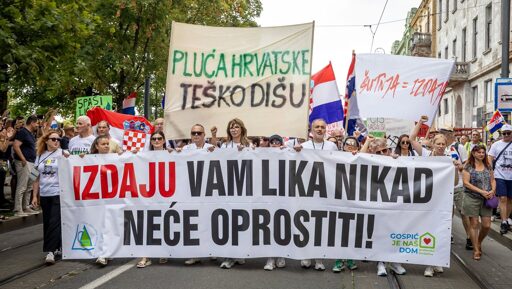

On Saturday, September 5, around 100,000 people took to the streets of Zagreb to protest against illegal toxic waste disposal in the Lika region. The mobilization, one of the most notable in recent years, brought together diverse networks from all over Croatia.
Protesters demanded not only the clearing of the affected areas in Gospić, but also accountability from the government and a pledge to temporarily halt waste imports into the country. This final demand relates to the fact that tens of thousands of tons of illegal waste found at several dumping sites across the country originated from Slovenia, Italy, and Germany.

Zagreb’s central square was filled with protesters on Saturday. Source: Gospić je naš dom/Facebook
The protest built upon over a year of campaigning by local groups in Gospić. These initiatives have been fighting for the urgent removal of approximately 37,000 tons of waste, including hazardous material, exposed during a EU corruption investigation in early 2025. State institutions’ records indicate complaints were filed locally as early as 2023 and 2024 but received minimal, if any, reaction from authorities.
The government’s inaction is particularly striking given that the region is a traditional stronghold of the ruling Croatian Democratic Union (HDZ). On the ground, many perceived their stance – implicitly or explicitly – as profound betrayal and arrogance, likely compounding political headaches for party leadership. In practical terms, this widened the protest’s political spectrum, bringing together an unusually broad group of demonstrators.
The notable lack of official response continued even as it became apparent that the dumping site is likely to have long-term impacts not only in the area immediately surrounding it, but also in downstream regions through underwater pollution. Materials found at the site included shredded plastic from electronic components and medical-grade waste. In addition to having been left lying around, they were also buried underground.
Read more: Local communities in Croatia oppose mega-farm project
Locals raised environmental and health alarms from the beginning, including concerns about soil pollution by heavy metals and PFAS contamination of the area. Only after a long period of pressure, authorities published related analyses. All showed local concerns were grounded, recording high levels of metals like zinc, lead, and chromium, as well as PFAS presence in water courses. The most recent of these reports, made publicly available by the Office for the Suppression of Corruption and Organized Crime (USKOK) on Monday, September 6, confirmed microplastic presence in water samples taken downstream of the illegal dump, adding urgency to demands for removal.

Protester holding banner “This is not patriotic” on Saturday, September 5. Source: Gospić je naš dom/Facebook
For its part, after a year and a half of alarms sounded by the community in Gospić, the government announced it would cover the waste with foil as a first step of the sanitation process. They claimed further steps would follow, yet without guarantee of timing.
On Monday, Gospić je naš dom reasserted the planned actions were not enough. “The liner can reduce the amount of rainwater entering the landfill from above, but the waste is buried an average of three meters deep in karst rock” they wrote. “Groundwater flows in from below and through cracks in the rock from the sides. A surface liner cannot stop this. Covering the waste will make it less visible, but all 37,000 tons will remain in the ground.”
“Last Saturday, on Zagreb’s central square, before tens of thousands of people from across Croatia, we presented our demands to the Government of the Republic of Croatia. These were not a negotiating position, but a minimum we refuse to go below. After this latest finding, that minimum remains unchanged, but the urgency can no longer be disputed.”
“Eighteen months later, we are still waiting for answers,” they added. “How did 37,000 tons of waste end up buried underground? Who brought it? Who took it? Who was paid for it? […] There is also the question of responsibility for what happened after the waste was discovered. Who knew, and when? Who decided it was not urgent? Who decided to withhold the initial analyses?”
From BT News via This RSS Feed.