

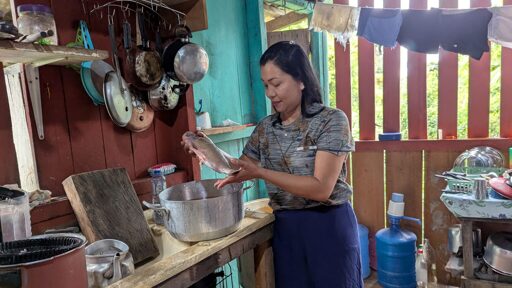
LAGO DO PURUZINHO/KARIPUNA INDIGENOUS TERRITORY/CALAMA, Brazil — The Lake Puruzinho community sits on a clear, fish-rich lake in the Brazilian Amazon, an area that, at first glance, resembles paradise. Just 20 kilometers (12 miles) from the city of Humaitá in Amazonas state, the community is soundtracked by two contrasting noises: the song of birds like the crested oropendola as it flies in search of fruit, and the thunderous engines of vessels plying the Madeira River. For decades, the approximately 170 residents of the riverside community ate fish from the lake, but that changed when they learned about mercury — and discovered that large quantities of the heavy metal were being dumped into the Madeira by illegal gold mining. The river, which feeds Lake Puruzinho and is a tributary of the Amazon, receives an estimated 10-50 metric tons of mercury from dredges used in gold mining. “There was a lot of mercury in our hair [because] of the fish, the tucunaré, which we eat a lot,” says Maria Rogelina Soares da Silva dos Santos, a fisher and homemaker, at the door of her house, located on the shore of Lake Puruzinho. “It was a huge scare.” She’s referring to studies by researchers at the Federal University of Rondônia (UNIR), in which she has participated for 26 years. The research examines how mercury contamination affects fish and, ultimately, human health, focusing on pregnant women, breastfeeding women, and children in communities along the Madeira River. The studies revealed, in recent years, the presence…This article was originally published on Mongabay
From Conservation news via This RSS Feed.