

General Tiani maintains state control while facing deep operational divisions within the armed forces defense structure.
On the night of August 28, heavy gunfire and explosions disrupted the capital city of Niamey, Niger, marking a significant challenge to the ruling military regime. Strategic locations across the city became active combat zones, including Air Base 101, the state television and broadcasting headquarters of the Office of Radio and Television of Niger (ORTN), and the surrounding areas of the presidential palace.
RELATED:
Niger Accuses France of Involvement in August Destabilization Attempt
The Niger military government, known as the National Council for the Safeguard of the Homeland (CNSP) and led by General Abdourahamane Tiani, moved quickly to lock down key infrastructure, deploy armored vehicles, and restrict civilian movement across the capital.
The armed uprising emerged just over a year after the July 2023 coup that removed democratically elected President Mohamed Bazoum from office.
The incident demonstrated that despite shifts in foreign policy and regional alliances, structural instability and military dissatisfaction remain central issues in Niger’s political landscape.
Chronology and Operatives — The 24-Hour Uprising
The tactical offensive began late on August 28 and extended into the early hours of August 29. A dissident faction of the Niger military calling itself the Armed Forces for the Restoration of the Fatherland (FARP) coordinated the operation.
The primary participants were not high-ranking generals, but rather junior officers, non-commissioned officers, and rank-and-file soldiers deployed from frontline garrisons in regions such as Tillabéri, Dosso, and Téra, including specialized elements from the Agali unit.
The insurgent forces focused their initial movements on communication channels and high-value military assets. By targeting the ORTN headquarters, the dissidents sought to control national broadcasts and declare a change in military leadership.
At the same time, troop movements toward Air Base 101, a critical facility housing air assets and foreign security personnel, aimed to neutralize rapid deployment by loyalist units.
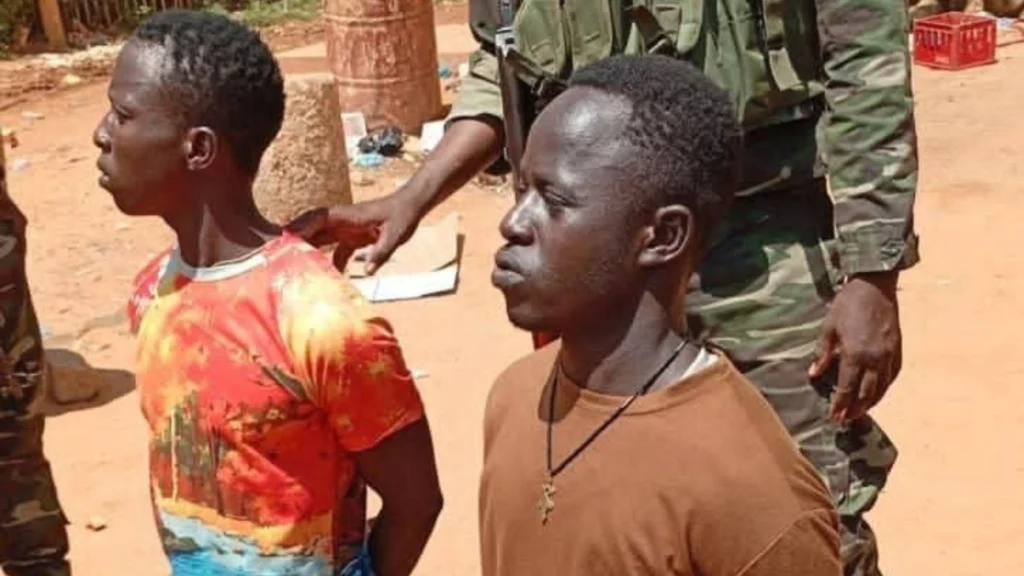
However, elite forces from the Presidential Guard, loyal to General Tiani, engaged the dissident troops. By mid-day on August 29, loyalist units had secured the targeted facilities, repelled the insurgent forces, and initiated widespread arrests across the capital, bringing the 24-hour uprising to an end.
This attempted coup resulted in casualties on both sides. The Nigerien government confirmed the deaths of at least three members of the Presidential Guard. Meanwhile, Nigerien state television (RTN) reported that dozens of soldiers were killed or arrested on the side of the rebels, though no official information was provided on the exact number.
The attempted Coup d’Etat in Niger republic failed, these are the weapons seized by the government pic.twitter.com/JRF0TRpJy9
— For God And Country Nigeria
(@TheShehus) September 3, 2026
Class Grievances and Military Discontent
The media said that the motivations behind the August 28–29 uprising stemmed from structural inequality and operational neglect within the Niger Armed Forces (FAN).
For a decade before the 2023 coup, General Abdourahamane Tiani served as commander of the elite Presidential Guard. Upon seizing power, the Tiani military regime maintained significant disparities in pay, equipment, and logistical support between the Presidential Guard in the capital and regular troops fighting on the frontlines.
Soldiers stationed in high-risk conflict zones such as Tillabéri, Dosso, and Téra faced daily casualties from non-state armed groups while operating with limited resources and minimal institutional support.
In contrast, units stationed in Niamey received prioritized funding, advanced weaponry, and political protection. Dissatisfaction deepened among frontline personnel due to the lack of medical care, inadequate supplies, and unacknowledged battlefield casualties.
In a declaration circulated by the Armed Forces for the Restoration of the Fatherland (FARP) during the assault, the dissidents stated their goal of removing General Tiani from power. The FARP criticized the military leadership for consolidating power in the capital while abandoning troops in active combat zones.
The mutiny was not an ideological shift away from national defense, but an internal response to the elite status of the capital’s command structure relative to the material realities of frontline service members.
Foreign Influence and Security Alliances
The attempted coup d’état in August highlighted the geopolitical dynamics in the Sahel following the expulsion of French troops and the pivot toward new security partnerships.
In the immediate aftermath of the uprising, official statements from the ruling military government and regional allies in the Alliance of Sahel States (AES) framed the mutiny as part of a foreign-backed destabilization effort.
Authorities pointed to historical French military influence in training facilities, such as the Upper Barracks, to suggest external intelligence involvement, though no direct evidence was presented to verify external command.
Tiani’s military government explicitly accused “Mr. Macron’s French government” of leading the attempt to destabilize the nation. According to Niamey, the French intervention aimed to regain control of resources.
In response, the French government, through Foreign Minister Jean-Noël Barrot, categorically rejected the accusations, calling them “pure fantasy” and asserting that France had no intention of launching the operation.
Decades of French military presence and resource extraction, particularly involving uranium mining by state-controlled enterprises, had left Niger’s defense and political infrastructure deeply dependent on foreign frameworks.
While the ruling regime severed formal defense ties with France in late 2023, the underlying economic dependencies and institutional vulnerabilities persisted.
The Tiani military response during the uprising demonstrated the direct involvement of new international security partners. Stationed at Air Base 101 alongside domestic forces, personnel from Russia’s Africa Corps provided ground and aerial assistance to the Presidential Guard during the clashes.
Russian forces deployed armored vehicles and drone support to help clear dissident positions around the airport complex and secure the perimeter of the presidential palace.
The engagement marked a shift in foreign military involvement in Niger, moving from advisory and intelligence support to direct participation in domestic security operations.
Following the attempted coup d’état in Niger
, the Nigerien population mobilized in large numbers to support the government of Niger
— African Revolt (@Africarevolt) August 29, 2026
Domestic Resistance and Regional Support
The August 2026 uprising failed because of the elite loyalist units’ reaction and strong backing from regional allies. The Presidential Guard, which had served as the power base for General Abdourahamane Tiani during his twelve-year tenure as its commander, acted as the main defensive force in Niamey.
Equipped with superior firepower and stationed at key government installations, these loyalist forces contained the insurgent units before they could establish control over primary state organs.
Support for the ruling Tiani regime extended beyond the capital through the mutual defense mechanisms of the Alliance of Sahel States (AES). Neighboring military governments in Mali and Burkina Faso issued joint statements condemning the mutiny, reaffirming their security commitments to Tiani’s government, and placing their own regional forces on alert.
International actors, including Turkey and Qatar, also released official statements condemning the violence and calling for the preservation of state stability and order in Niger.
The Qatari government reacted swiftly, stating this through its Ministry of Foreign Affairs. In the statement, Qatar expressed its condemnation of the incident and its support for Niger’s sovereignty, as well as all legitimate measures taken by the authorities to safeguard its security and territorial integrity.
In the case of Turkey, given the strong alliance in defense and cooperation, the Erdogan government reaffirmed its commitment to monitoring events and rejected any actions that would destabilize existing security agreements.
Within Niger, civil society reactions remained mixed. While pro-junta coalitions and grassroots anti-imperialist organizations rallied in support of national sovereignty and the CNSP, trade unions and human rights groups expressed growing concern over prolonged military rule.
The opposition to the coup among these factions did not signal complete approval of the military regime, but rather reflected widespread apprehension toward further armed instability and civil conflict in the capital.
Limits of Military-Led Sovereign Transitions
While the ruling National Council for the Safeguard of the Homeland successfully repelled the attempted coup, the uprising exposed deep, unaddressed internal fractures within the nation’s security architecture.
The grievances of frontline soldiers regarding resource allocation, operational neglect, and command-level inequality remain unresolved, presenting an ongoing risk of future internal mutinies.
Furthermore, the events of August highlighted the complexities of shifting foreign partnerships. While the expulsion of French forces and traditional Western allies marked a dramatic political transition, the reliance on Russian paramilitaries to secure state power demonstrates that external security dependencies persist.
Securing long-term national stability requires structural adjustments that go beyond replacing external security partners.
Ultimately, the August uprising demonstrates that the Niger top-down military rule alone cannot guarantee political or economic stability. Achieving lasting sovereignty requires addressing the material needs of the armed forces and the civilian population, establishing transparent governance, and restoring democratic participation capable of resisting both internal division and external geopolitical pressure.
Sources: TeleSUR – Al Jazeera – Press TV – Anadolu Agency – El País – France 24 – EFE – SwissInfo – Resumen Latinoamericano – The objective – DW – La Vanguardia – Egmont Institute – Modern Ghana – Premium Time Nigeria
From teleSUR English via This RSS Feed.