

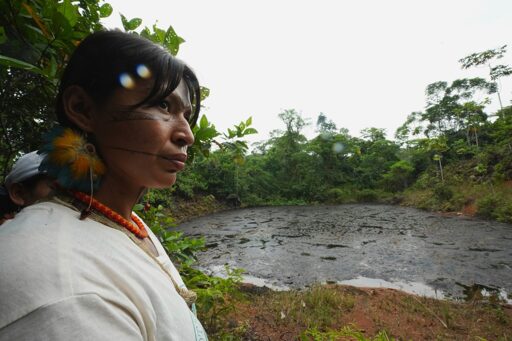
A new study has found that in Ecuador’s Amazon, Indigenous territories without formal conservation contracts maintained forest conditions just as well as formal protected areas. Ecuador has three different approaches to forest governance: Forests protected by government institutions, forests managed by local communities under formal conservation agreements and Indigenous territories without formal conservation agreements. To find out the state of forests under these different policies, researchers used satellite data to examine three metrics: Long-term changes in vegetation greenness as an indication of degradation or improvement in forest cover; abrupt changes in forest condition due to more acute disturbances like human settlements, roads and agricultural fields; and how forest productivity responded to the 2015-2016 El Niño drought — a climate phenomenon that causes extreme changes in rainfall and temperature patterns. They found that community-protected forests performed best overall in some measures, particularly resilience after drought. However, Indigenous territories without similar formal conservation agreements and who can use natural resources for subsistence and cultural preservation also had forest condition patterns comparable to the other governance regimes. In fact, they had the greatest proportion of areas showing positive long-term trends in vegetation greenness. “From a practical perspective, our results suggest that conservation is not only about drawing lines on a map,” lead author Fernando Troya, currently based in Ecuador, who conducted this study as part of his doctoral studies at the KU Leuven University in Belgium, told Mongabay in an email. “It is also about governance, local participation, and creating systems that help…This article was originally published on Mongabay
From Conservation news via This RSS Feed.