

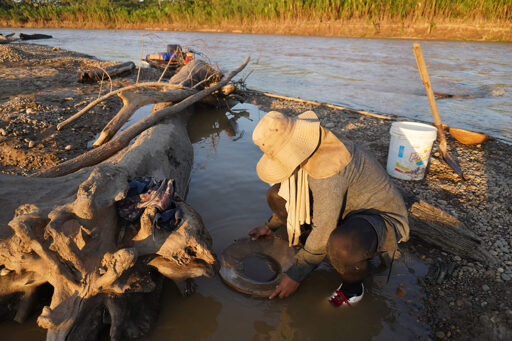
BENI, Bolivia — Gilberto Vaca Muiba fears that the mercury in his body will end his life. Yet, the fear does not change his routine. He takes his old fishing rod, walks toward the river, and waits patiently for the meal of the day. He is on his knees on one of the shores of the Beni River, in the Bolivian Amazon, waiting for a fish to bite — so he can take the food home. It is a July afternoon in the Bolivian community of Puerto Yumani, and he has just caught a small surubí. The local fish is likely contaminated with mercury, but he brings it to his table nonetheless. Puerto Yumani is one of the five Indigenous communities Mongabay visited along a 41-kilometer (25.48 miles) stretch of the Beni River. The other four are Carmen Soledad and Puerto Motor, in the municipality of Rurrenabaque (in the Beni department), and Eyiyoquibo and Buena Vista, in the municipality of San Buenaventura (north of La Paz department). All these territories, belonging to the Tacana, Leco, and Ese Ejja Indigenous peoples, are exposed to mercury contamination arising in the river. Because of that, the Beni River is perceived in two ways: As a source of subsistence for the communities but also as the center of all their ills. “We eat fish every day; it is our common diet because buying meat or chicken is too expensive for us. In the rivers, we have our food, but this very food is contaminated.…This article was originally published on Mongabay
From Conservation news via This RSS Feed.