

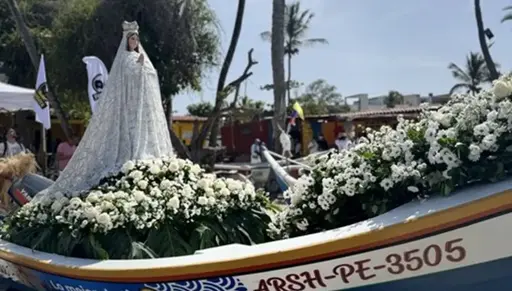
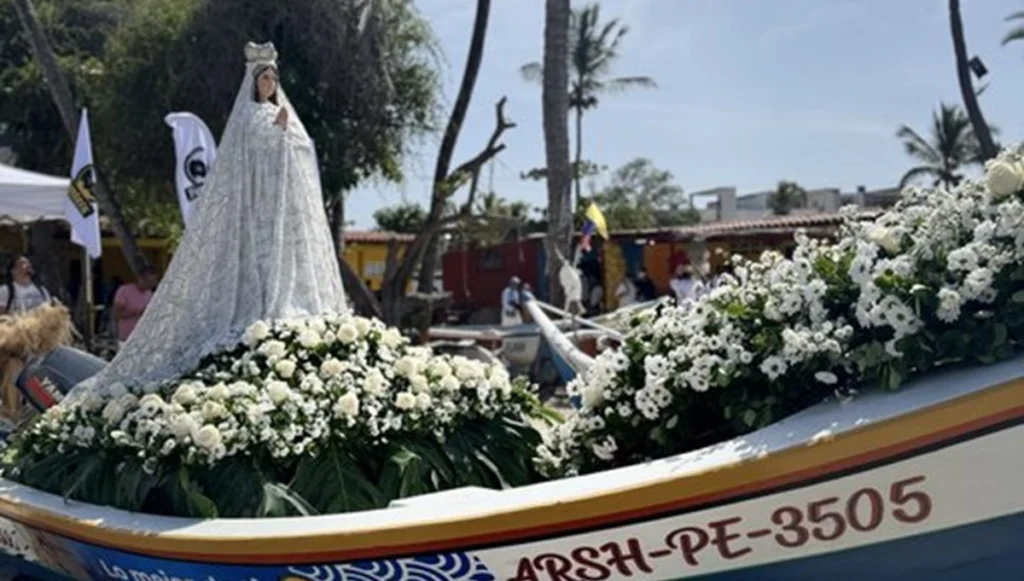
On September 8, thousands of pilgrims travel to Margarita Island to honor the patron saint of fishermen.
On Tuesday, Venezuelan Acting President Delcy Rodriguez sent a message of popular solidarity and identity on the occasion of celebrations honoring the Virgin of the Valley (la Virgen del Valle).
RELATED:
Margarita: The Caribbean Pearl Striving to Regain Its Shine
“The faith of our people once again comes together today at the feet of the Virgen del Valle, Patron Saint of eastern Venezuela, protector of our fishermen and our Bolivarian Navy,” she posted on social media.
“A devotion that brings together generations, families and entire communities. May her light always illuminate our Venezuela, and may we never lack hope, unity and strength to continue moving forward together,” Rodriguez stressed.
In the early hours of Tuesday, Nueva Esparta Gov. Marisel Velasquez joined thousands of pilgrims who celebrated a Mass for the Nativity of the Virgin at the Eucharistic field of the Valley of the Holy Spirit.
“Christ is our peace,” priest Milton Correa said, urging the faithful to maintain a living, humble faith guided by fraternal love to overcome difficulties, making an implicit reference to the challenges facing the Venezuelan nation in connection with the June earthquakes.
During events held in her state, Gov. Velasquez highlighted the presence of 595 families affected by the earthquakes on Margarita Island and reaffirmed Nueva Esparta as a territory characterized by solidarity, integration and peace.
Venezuelan authorities also paid tribute to the men and women who go out to sea every day to fish, support their families and contribute to the country’s food sovereignty.
Hoy celebramos tu día Virgen del Valle, derrama tu gracia sobre Venezuela, protejenos y cubre a tus hijos con tu manto. pic.twitter.com/h66L4L5sQE
— Isabel (@iberra61) September 8, 2026
The text reads, “Today we celebrate your day, Virgin of the Valley. Pour out your grace upon Venezuela, protect us, and cover your children with your mantle.”
One of Venezuela’s Most Enduring Symbols of Faith and Memory
The history of the Virgen del Valle reaches back to the earliest decades of Spanish colonization. The image of the Immaculate Conception was brought from Spain to the island of Cubagua, where the settlement of Nueva Cadiz was flourishing in the early 16th century because of the pearl trade.
Historical sources place the arrival of the image around 1530. In December 1541, a devastating hurricane destroyed Nueva Cadiz and scattered much of its population.
The image survived and was subsequently taken to the nearby Margarita Island, where it was placed in a chapel in the Valley of the Holy Spirit. There, in the landscape that would give her a new name, the image gradually became known as the Virgen del Valle.
The Venezuelan Episcopal Conference describes her as a presence in the religious life of eastern Venezuela since the earliest years of evangelization.
As the centuries passed, the Virgin’s history became intertwined with the collective memory of Margarita Island. Her reputation grew through stories of answered prayers and miracles, including a celebrated account from 1608, when a severe drought afflicted the island.
Residents carried the image in procession toward La Asuncion, and according to the tradition preserved by the Church, rain began to fall as the procession reached the city.
Such stories helped transform the small shrine in the Valley of the Holy Spirit into a place of pilgrimage and established the Virgin as a protector whose devotion extended beyond a single community.
By the 17th century, historical references already described the sanctuary as a place of great devotion and miracles. Over time, fishermen and other communities along Venezuela’s eastern coast came to regard the Virgin as a particular protector, strengthening her connection to the sea and to the maritime life of the region.
The devotion acquired formal recognition in the 20th century when Pope Pius X authorized the canonical coronation of the image in 1910. The ceremony took place on Sept. 8, 1911, conducted by Bishop Antonio Duran and attended by large numbers of clergy and faithful.
Since then, Sept. 8 has remained the principal feast day of the Virgen del Valle, drawing pilgrims to her sanctuary on Margarita. Yet her importance extends beyond the boundaries of religious observance.
For generations of Venezuelans, particularly in the country’s east, the Virgin has represented one of the most enduring symbols of faith, memory, and regional identity.
teleSUR/ JF
Sources: teleSUR – Episcopal Conference – Diocesis de Ciudad Guayana
From teleSUR English via This RSS Feed.