


A group of transphobic activists came to Portland this weekend looking for a confrontation, and they found one. Led by TERF (trans-exclusionary radical feminist) activist Amy Sousa, the group first showed up at Providence Park on Sunday for the Portland Thorns’ match against the Washington Spirit, wearing transphobic shirts and distributing materials. Eight members of the group were removed from the stadium. After the match, the group went to The Sports Bra, Portland, Oregon’s queer women’s sports bar, where they were again confronted and ultimately asked to either cover their transphobic shirts or leave the bar. What happened next was predictable: the ejections became content, the content became outrage, and the outrage became another round of political propaganda about supposedly persecuted women.
A Portland Thorns spokesperson told media that the group was removed for distributing “unapproved materials,” a violation of the stadium’s Fan Experience Guidelines. “During our September 6 match against the Washington Spirit, individuals were removed from Providence Park for distributing unapproved materials, a violation of the Fan Experience Guidelines at the stadium,” the spokesperson said. “Our priority remains fostering a safe, inclusive, and respectful environment for every fan at Providence Park.” That account is considerably less dramatic than the persecution narrative now being built around the incident, but it is important to start there because the entire political strategy depends on collapsing the distinction between being removed from a private venue for violating its rules and being persecuted for expressing a political belief.
What makes this episode particularly revealing is that the people manufacturing that narrative have already told us exactly what they are doing. Sousa has explicitly described her campaign as political theater. In a post celebrating the strategy on Twitter, she wrote, “Yes! This is political theater!!” She explained that she is a former NYU Tisch School of the Arts theater major with an emphasis in political theater and invoked Augusto Boal, Bertolt Brecht, Joan Littlewood, Bread and Puppet Theater and Dario Fo as influences. The purpose, she explained, is to use “images and spectacle” as tools for political persuasion, consciousness-raising, protest and social change. She then celebrated the media attention generated by the campaign, declaring, “And guess what? IT’S WORKING.!!” and pointing to the coverage as evidence that the actions were forcing institutions to have conversations about “what defines women’s sports.” She concluded by promising that the campaign was only beginning.
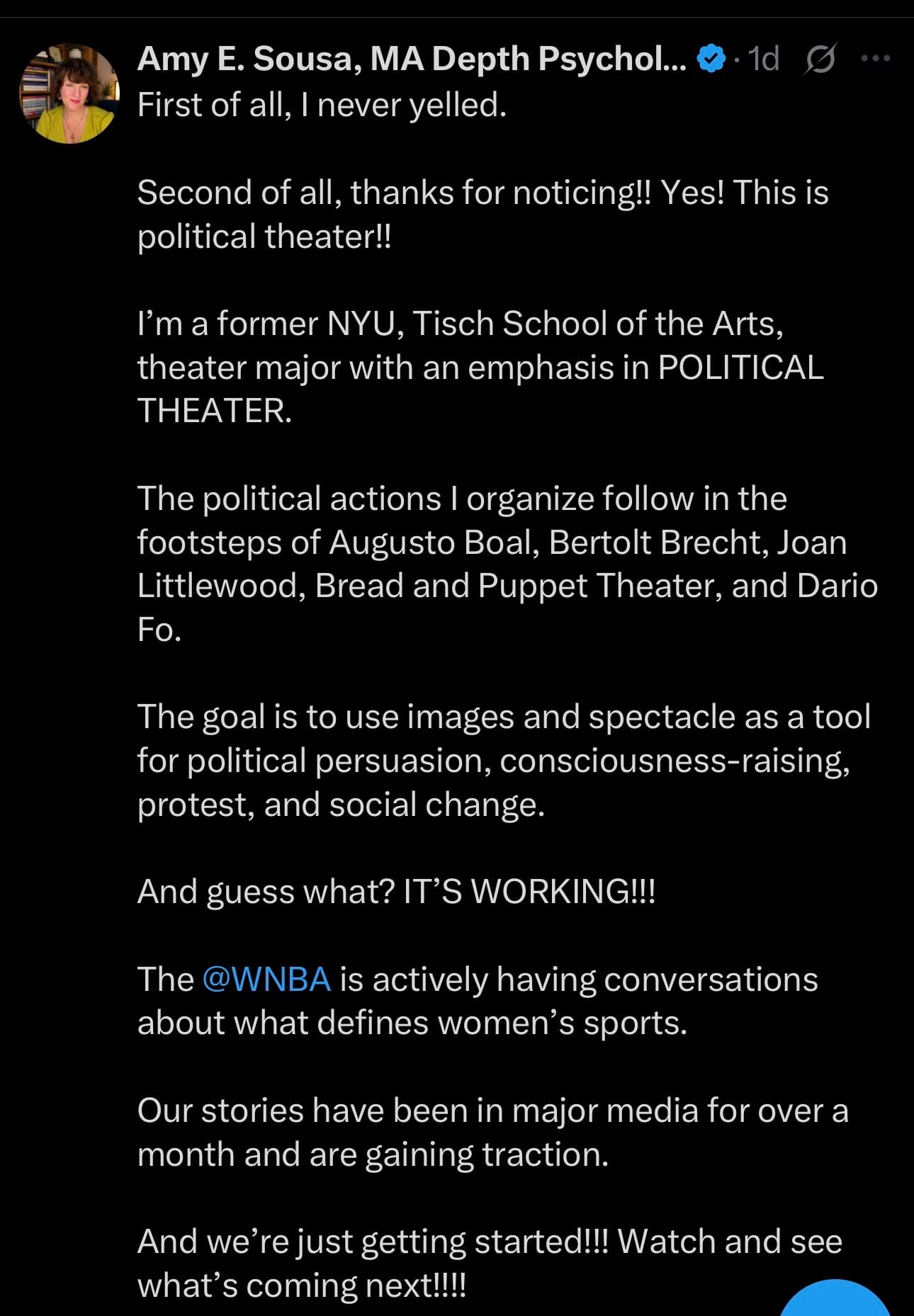
Screenshot from the transphobes Twitter account
That admission should fundamentally change how these incidents are covered. Sousa is not describing a campaign in which activists innocently encounter persecution and then happen to document it. She is describing a political strategy in which spectacle itself is the organizing method. The confrontation is useful because the confrontation generates images; the images generate media coverage; the media coverage creates a national audience; and that audience becomes evidence that the campaign is succeeding. The removal is not an unfortunate interruption of the political action. The removal is the political action.
That is why the increasingly familiar images of these activists being escorted from venues deserve to be understood as political propaganda rather than simply consumed as documentation of persecution. Sousa has even been resharing AI-generated images depicting the transphobes in handcuffs, transforming the fantasy of their own arrest into part of the campaign’s visual language. There is something almost perfectly illustrative about an AI-generated image of an activist in handcuffs circulating alongside real footage of venue ejections: the image does not document oppression; it dramatizes the oppression the campaign wants its audience to imagine. The handcuffs become a prop, the ejection becomes a scene, and the resulting outrage becomes the product being distributed.
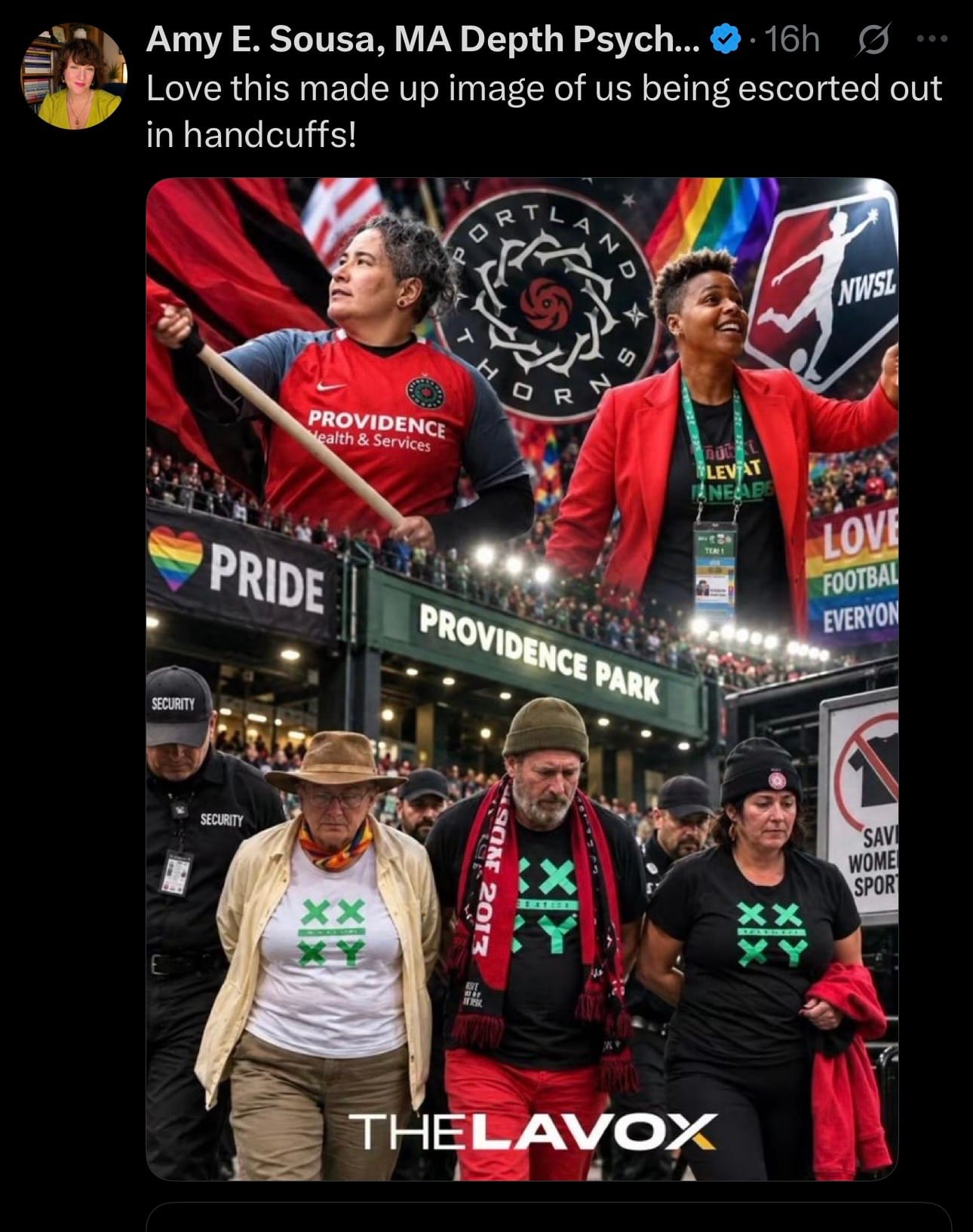
Oppression fantasy and transphobic AI slop
The chronology itself makes the political-theater framing worth examining. The group went first to Providence Park for a professional women’s soccer match, intentionally wearing transphobic merchandise and distributing materials in a venue whose culture is deeply associated with queer fandom and where LGBTQ+ identity is not incidental to the experience of supporting the Thorns. After being removed, they went to another venue explicitly built around women’s sports in the same city: The Sports Bra, a queer-inclusive women’s sports bar whose stated mission is to “support, promote, and empower ALL girls and women in sports.” The bar has also emphasized that it was built as an inclusive alternative to the traditional sports bar, specifically welcoming people who may not feel comfortable in those spaces, including members of the LGBTQ+ community. By the time the group arrived at The Sports Bra, then, they were not stumbling into some unexpected disagreement about their clothing or political message. They were carrying the day’s first confrontation with them into a second venue whose entire purpose is to create an inclusive home for women’s sports, including for people who have historically felt unwelcome in traditional sports spaces. Whatever precisely happened at the bar, the broader context is difficult to ignore: this was a transphobic campaign moving from a professional women’s soccer match into a queer-inclusive women’s sports bar, deliberately entering spaces with very different institutional cultures and documenting the reactions its presence generated along the way.
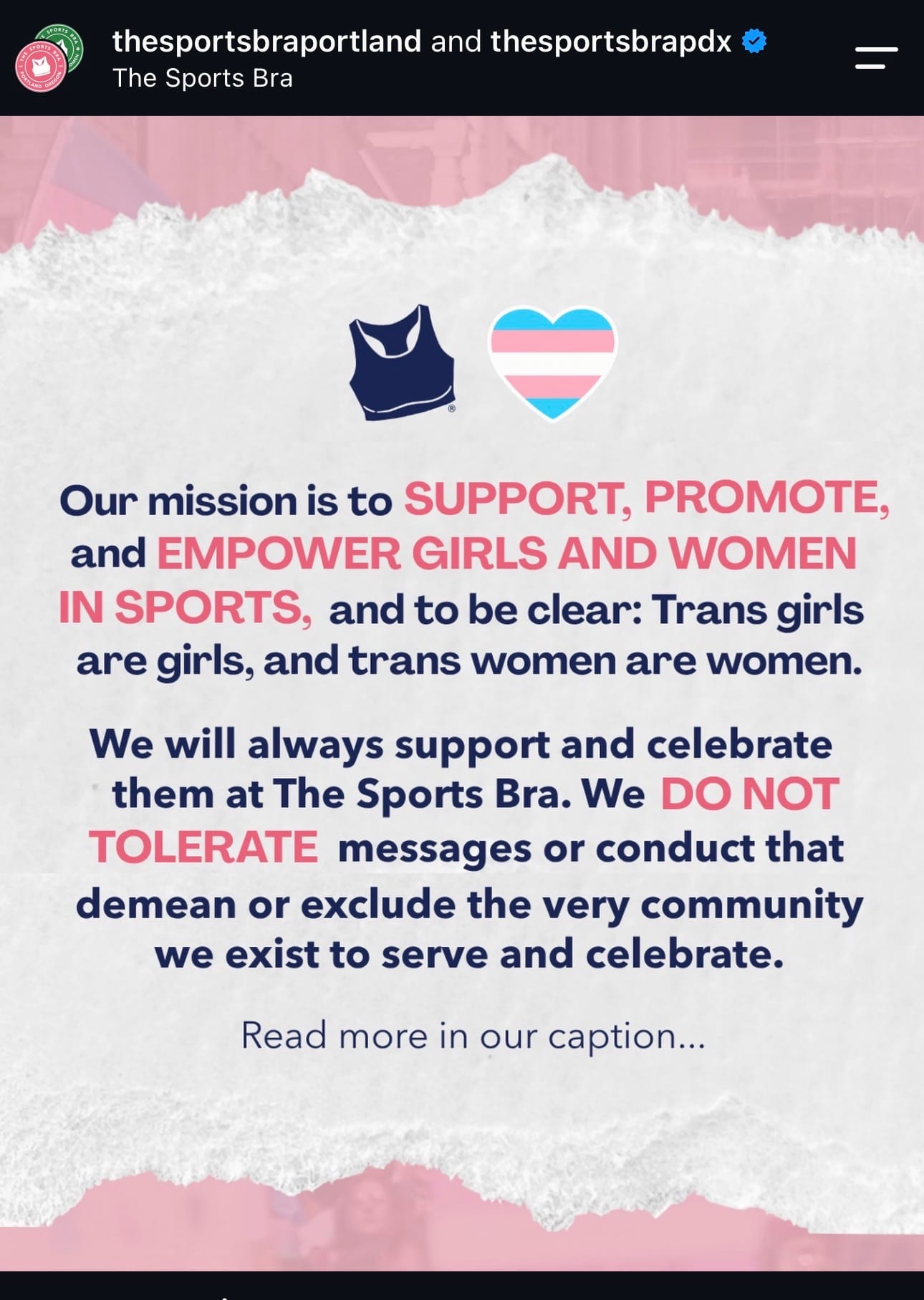
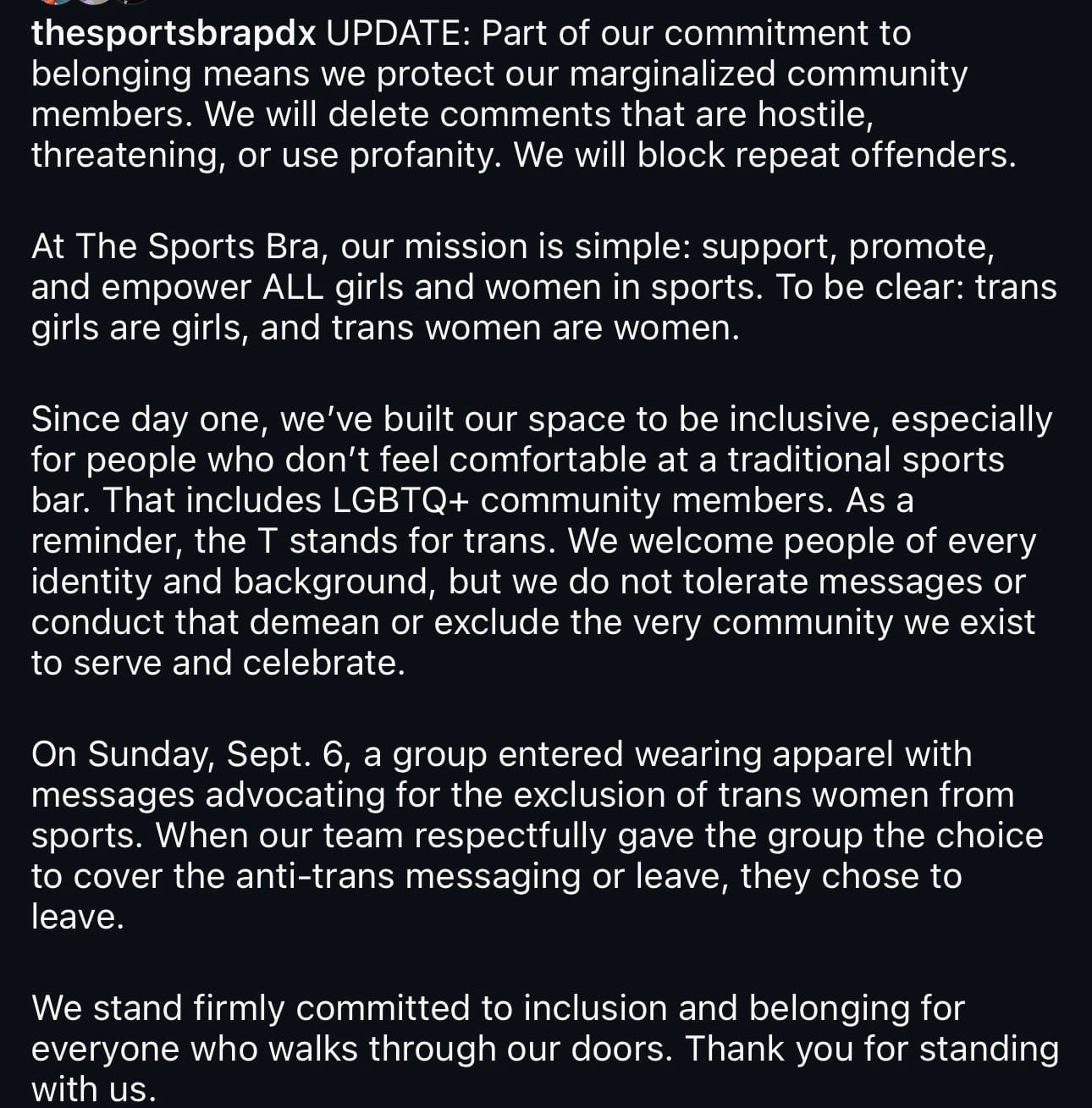
Statement from The Sports Bra
The strategy is remarkably straightforward. Show up somewhere associated with queer and trans inclusion wearing deliberately provocative transphobic merchandise. Distribute transphobic material. Get challenged or removed. Record the confrontation. Circulate the most emotionally useful images. Describe the removal as evidence that transphobic people are being silenced. Encourage sympathetic accounts and media outlets to repeat that framing. Then point to the resulting headlines as proof that the campaign is gaining traction and that the supposed silencing itself is newsworthy. What begins as a dispute over the rules of a private venue is transformed into a national culture-war narrative in which the people who deliberately created the confrontation become its alleged victims.
It is a persecution feedback loop, and Sousa has openly acknowledged that the loop is working.
That makes the media’s role in this especially difficult to ignore. The activists do not have to conceal the strategy because much of the coverage does the work of concealment for them. A group that explicitly calls its actions political theater can be presented as though it simply wandered into a hostile environment. An activist who celebrates media attention as evidence of success can be described as though she is reluctantly enduring unwanted scrutiny. A deliberately provocative transphobic shirt can be reproduced and even identified by brand while the politics behind it are softened into the vague language of “women’s sports.” The spectacle is stripped of its production history and presented as spontaneous conflict.
The result is propaganda laundering: activists manufacture a dramatic political image, media outlets reproduce the image without adequately interrogating how it was produced, and the activists then point back to the resulting coverage as evidence that their political message is breaking through. The media becomes both audience and distribution network, while the activists get to maintain the fiction that they are simply reporting what happened to them.
The politics behind this campaign also did not emerge from nowhere. Sousa has been a guest speaker for Women’s Declaration International USA, or WDI-USA, a trans-eliminationist pseudofeminist organization that has made opposition to trans inclusion a central component of its political organizing. This is relevant because the campaign now being staged in Portland exists within a broader political network that has spent years developing ways to package transphobic politics as a supposedly respectable defense of “women’s rights” and “women and children,” while presenting its opponents as the aggressors.
WDI-USA’s Portland organizing has previously offered an unusually revealing example of that approach. Leaked planning materials for a Portland event organized by WDI-USA and Women’s Liberation Front described a deliberate effort to make “protecting women and children” the public-facing focus while avoiding overt references to transgender people. Organizers anticipated counterprotesters and discussed how to present themselves as peaceful, defenseless women while portraying their opponents as violent extremists. One organizer, Irene Lawrence, reportedly argued that keeping the event’s rhetoric sanitized would “make the crazies look even crazier.” The strategy described in those materials is strikingly consistent with what Sousa is now openly describing herself: politics packaged for maximum visual impact, confrontation anticipated rather than unexpected, and images designed to carry a political message beyond the words actually spoken. The point is not simply that confrontation may happen when transphobic messaging enters a contested space; it is that the confrontation itself can become part of the message, with the resulting images circulated as evidence of persecution and used to generate another round of media attention.
The point is not that every person who encounters these activists is somehow participating in their production. The point is that the activists themselves understand confrontation as useful political material. If they are allowed into a venue, they have obtained a platform. If someone objects, they have obtained a confrontation. If they are removed, they have obtained footage of apparent persecution. If the footage spreads, they have obtained media attention. The conditions are therefore unusually favorable to the campaign: almost any outcome can be converted into content.
And the media attention is substantial precisely because the story fits an existing culture-war narrative. Once the image of women being “kicked out” of women’s spaces is established, the underlying circumstances become secondary. Whether the group violated venue rules, whether the material was authorized, whether the venue is private, and what the political organizers were actually attempting to accomplish can all disappear beneath the much more emotionally efficient story of brave women being silenced for saying something controversial.
That is where journalists need to exercise considerably more skepticism. There is nothing inherently remarkable about someone being removed from a private business for violating its rules, nor is a stadium enforcing its fan conduct policies evidence of government censorship. The fact that the people being removed have chosen to frame the experience as persecution does not make that framing true. And when those same people have explicitly said that creating political spectacle is their strategy, journalists have an obligation to report that fact alongside the spectacle rather than simply reproducing the spectacle as though it speaks for itself.
Some of the local coverage surrounding this episode demonstrates precisely the opposite approach. Rather than interrogating the political campaign behind the shirts, coverage has sometimes effectively advertised the merchandise by identifying the brand and sharing pictures of the graphic with a link of where to purchase in the caption, turning the activists’ chosen visual symbols into additional free promotion. One report also attempted to draw a comparison to the 2020 controversy surrounding Timbers Army supporters and the Iron Front, describing the symbol as something associated with anti-fascism that had supposedly been “appropriated by some in the antifa movement.” That formulation deserves scrutiny on its own terms. The Iron Front was an explicitly anti-fascist organization; describing anti-fascists as having “appropriated” an anti-fascist symbol is an absurd inversion of its history, one that treats opposition to fascism as though it were a suspicious political brand later claimed by an unrelated movement.
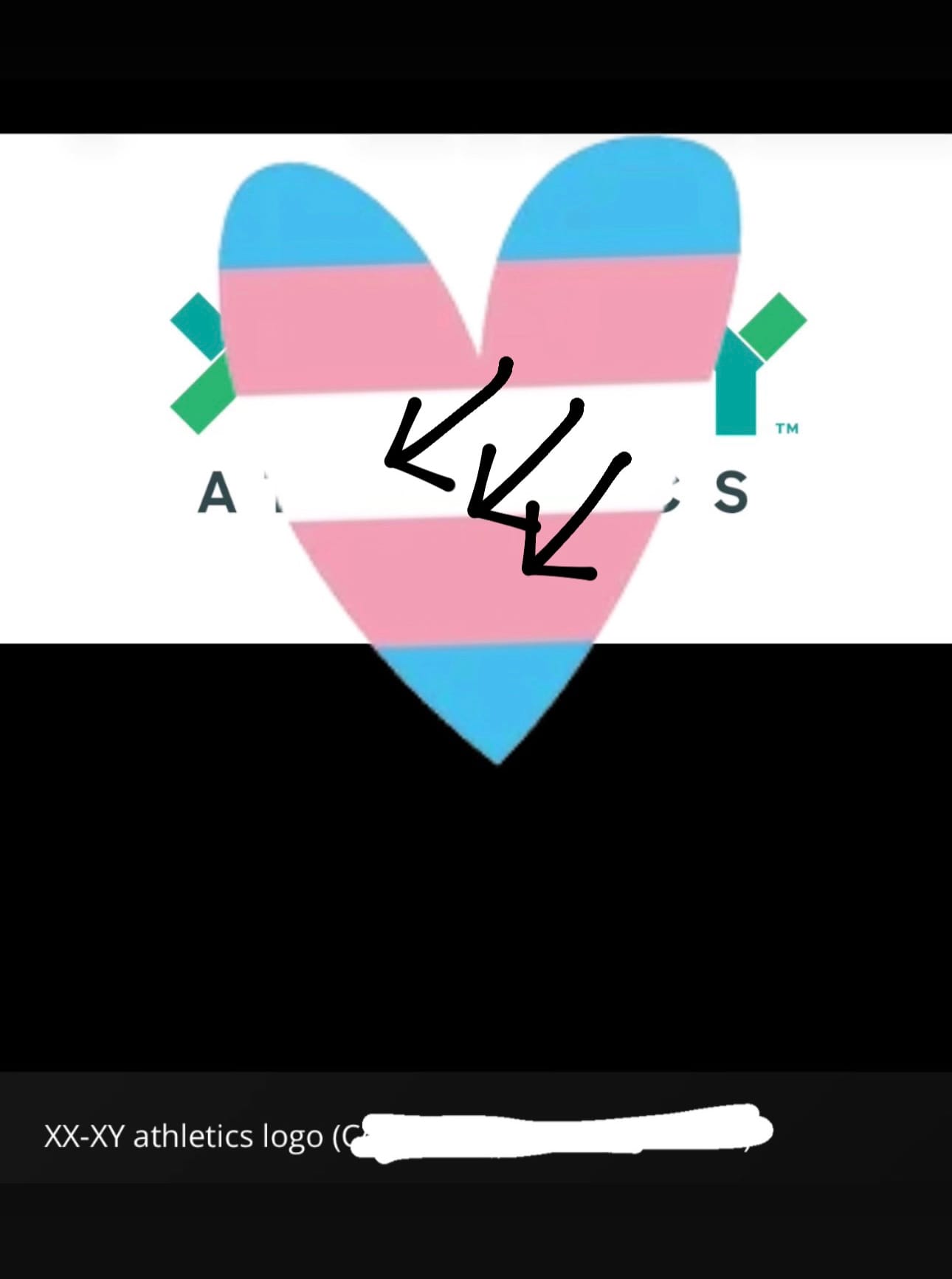
screenshot from Katu’s website where they share the transphobic shirt and link to the website. WWFU has covered their logo with a trans flag heart and an iron front
This kind of false equivalence matters because it helps construct the very media environment in which transphobic activists can present themselves as embattled outsiders while their opponents are reduced to interchangeable “extremists.” Transphobic political organizing gets repackaged as women’s advocacy. Organized transphobia becomes a disagreement over sports. A campaign explicitly designed to provoke confrontations becomes a story about people being unable to express their beliefs. And an activist who openly describes her work as political theater becomes the sympathetic protagonist of a persecution narrative that the media then helps distribute.
The attention is real. Sousa is right about that. The headlines are real, the social-media circulation is real, and the campaign is clearly reaching an audience it wants to reach. But that does not mean the persecution narrative is true. It means the propaganda strategy is effective. There is an enormous difference between successfully generating attention and successfully establishing the truth of the story being told.
In fact, the campaign’s success should make the media more skeptical, not less. When an activist tells you that spectacle is the method, tells you that media coverage proves the method is working, and tells you that more spectacles are coming, the appropriate journalistic response is not to become an unpaid distributor for the next one. It is to examine the machinery producing the spectacle.
That means calling the politics what they are. These are not simply “women’s sports activists” whose beliefs have accidentally placed them in conflict with Portland’s queer community. They are anti-trans political organizers engaged in a campaign against trans inclusion, and they are using deliberately provocative appearances, confrontation and the resulting media attention to advance that campaign. There is nothing courageous about manufacturing a persecution narrative and then demanding that everyone else accept it at face value.
Trans people and queer communities are not obligated to provide these activists with a platform in their own spaces. The Sports Bra does not owe a political campaign access to its customers. Providence Park does not owe transphobes the right to distribute bigoted materials in violation of its rules. And journalists do not owe anyone a sympathetic narrative simply because they have successfully generated dramatic footage.
Most importantly, there is no reason to participate in the fiction that this persecution narrative emerged organically. The activists themselves have explained the mechanism. They call it political theater. They say they use spectacle for political persuasion. They celebrate the media attention. They point to that attention as proof that the strategy is working. They circulate imagery of themselves in handcuffs and build their politics around the spectacle of being rejected by institutions they deliberately enter.
They told us what they were doing, and then they did it.
The real story, then, is not that a group of transphobes was mysteriously persecuted in Portland. The story is that a group of transphobic political organizers deliberately turned confrontation into content, successfully generated a media cycle around that content, and then used the existence of the media cycle as proof of their political relevance. They came looking for a scene, they got one, and too much of the media was willing to play along.
The least the media can do now is stop pretending it was fooled.
From We Will Free Us via This RSS Feed.