

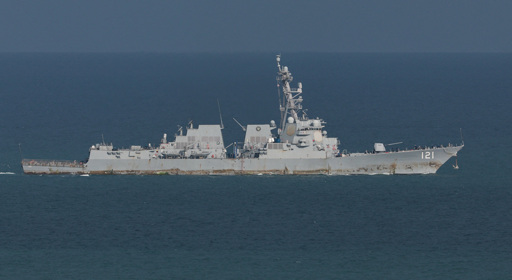
Iran’s top security official says Washington has received a “clear warning” from the Islamic Republic’s new missile capabilities, after Tehran tested a new anti-ship missile near a US warship in regional waters.
Major General Mohsen Rezaei, secretary of Iran’s Supreme National Security Council, said in a post on X early Tuesday that Iran has recalibrated its military posture against US warships.
“In recent days, Washington has received a clear warning from Iran’s new missiles,” General Rezaei wrote.
“The operational posture toward US warships and bases has been fundamentally recalibrated,” he added.
His remarks came after a televised interview on Sunday in which he said an Iranian missile had forced a US warship to flee the engagement zone.
“For the first time, we tested our anti-ship missile above an American warship,” General Rezaei said. “This special missile created hell for the Americans, and they fled.”
He said even US Central Command could not conceal the incident, describing it as a warning that Washington’s naval blockade of Iran is vulnerable.
Economic war’s response
He added that the Islamic Republic’s response to the US economic war and naval blockade would include the establishment of a restricted maritime zone across the Persian Gulf up to the US Navy’s blockade line.
“Economic warfare will be met by a maritime exclusion zone across the Persian Gulf to the blockade perimeter,” he said.
General Rezaei previously announced that any vessel entering the designated area without coordinating with Tehran would be placed on an Iranian sanctions list, with consequences for insurance coverage and future passage.
Iran has restricted passage through the Strait of Hormuz since the early days of the US-Israeli war on Iran, which began on February 28 and came to a temporary halt under a ceasefire in early April after Iran’s retaliatory operations.
Iran Strikes 3 US-Linked Vessels, 3 Trespassing Oil Tankers in Retaliation for US attacks
On June 17, Tehran and Washington signed the Pakistan-brokered Memorandum of Understanding, whose Article 5 places responsibility for reopening and managing the strait in Iran’s hands.
The United States later violated the agreement by attempting to undermine Tehran’s authority over the strategic waterway, establishing an unsafe corridor near Omani shores, resuming aerial attacks on Iran, and reimposing an illegal naval blockade.
Tehran has repeatedly stressed that the reopening of the Strait of Hormuz depends on Washington’s full compliance with its obligations under the MoU.
Iran has rejected US President Donald Trump’s claim that the Strait of Hormuz has been opened, calling it a lie.
(PressTV)
From Orinoco Tribune via This RSS Feed.