

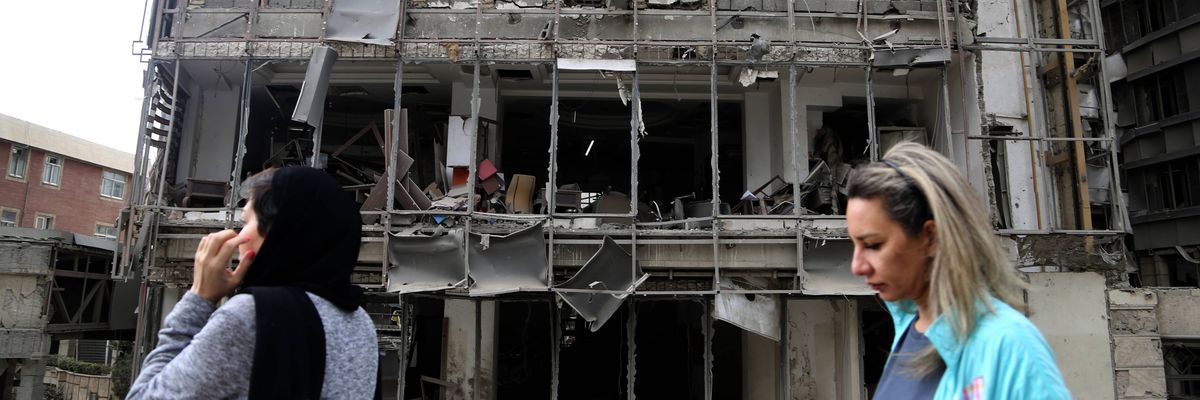
The recent resumption of US airstrikes in Iran, including on a wedding party where at least 25 civilians were killed last week, made Amnesty International’s Tuesday report on previous suspected US-Israeli attacks in Tehran in the early days of the war all the more urgent, said the organization as it pointed to new evidence of potential war crimes by the American and Israeli militaries in the densely populated Iranian capital.
Amnesty analyzed US-Israeli airstrikes on three residential neighborhoods—Resalat, Niloufar, and Javadieh—between March 1-13, in which the coalition used “explosive weapons with wide-area effects,” killing at least 41 civilians and damaging multiple homes, a school, businesses, and other civilian infrastructure.
“Amid the resumption of US strikes in Iran and renewed threats by US President Donald Trump to target civilian infrastructure, it is imperative that the US and Israel end all unlawful attacks and strictly comply with international humanitarian law, including by taking all feasible precautions to avoid, and in any event minimize, incidental loss of civilian life, injury to civilians, and damage to civilian objects during the planning and execution of military operations," said Agnès Callamard, secretary general of Amnesty International.
The group noted that military infrastructure and police stations—which could be considered legitimate military targets in Iran, as the police forces are part of the broader armed forces there—were struck in the attacks in question. Israel and the US have not publicly claimed responsibility for the three specific attacks, but they announced strikes against Iranian “regime” targets in Tehran at the time of the airstrikes.
Amnesty emphasized that even if military and police buildings were the primary targets, “a large presence of civilians was clearly foreseeable” when the US and Israel evidently carried out the attacks in the three neighborhoods, which “resulted in devastating and yet entirely predictable consequences for civilians.”
International law demands that warring parties do not carry out “indiscriminate or disproportionate attacks” that could harm civilians across the surrounding area, said the group.
Military leaders, said Amnesty, are also obligated to “choose weapon types and attack methods that reduce the risk of harming civilians and destroying civilian objects.”
“The use of explosive weapons with wide-area effects in the vicinity of concentrations of civilians has foreseeably indiscriminate effects and as such is prohibited under international humanitarian law,” the group stated. “Additionally, an attacking party remains at all times bound by the principle of proportionality, weighing the concrete and direct military advantage anticipated from an attack against the expected harm to civilians and civilian objects, including the reverberating humanitarian consequences resulting from the attack.”
“Launching indiscriminate attacks that kill or injure civilians and disproportionate attacks are war crimes,” said Amnesty.
The group analyzed satellite imagery and verified 60 videos of the three attacks, as well as reviewing public statements from officials in the US, Israel, and Iran to reach the determination that US and Israeli forces had potentially committed war crimes in the Tehran neighborhoods—a possibility the group said must be independently investigation.
In Niloufar, where at least 20 civilians were killed on March 1, eyewitness accounts described two explosions at around 9:00 pm local time, when restaurants and other businesses were open in the bustling neighborhood.
The attack directly struck a police station, but residential buildings and businesses were also struck.
A shop owner told Etemad Online that “before the attack… dozens of people were sitting in front of the cafés in the square. All the shops were open… When the police station was struck, those who were sitting on the pavement in front of the cafés were killed.”
“The whole street was full of blood,” they added. “I saw one person whose chest had been pierced by broken glass. Many children, women, and young people were killed here that night.”
Callamard said that “the civilian death toll, the scale of destruction, the timing of the attacks, the impact on nearby civilian structures, and the lack of effective advance warnings point to alarming failures by the US-Israeli coalition to abide by the obligations to take all feasible precautions to minimize civilian harm and spare civilian objects.”
At least 16 people were killed in Resalat on March 9, in an attack that heavily damaged a building belonging to the Basij battalion of the Islamic Revolutionary Guard Corps (IRGC), as well as three buildings adjacent to the facility. Amnesty International confirmed that at least one of the buildings, known as Number 12, was a residence.
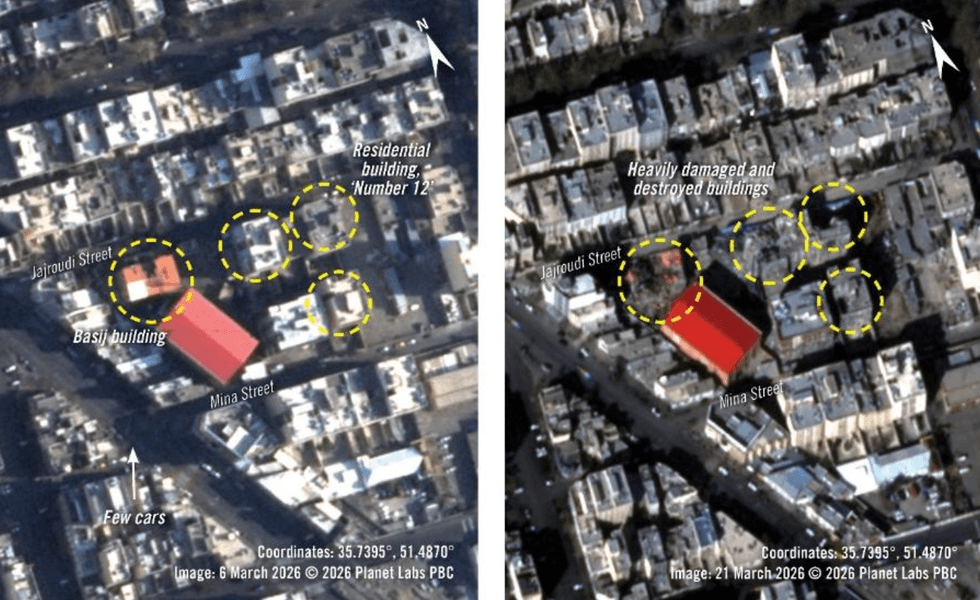 Satellite imagery from March 6, 2026 (left) shows the Basij facility and nearby buildings in the Resalat neighborhood. On March 21, 2026 (right), imagery shows four distinct buildings with heavy damage and destruction. (Photo by ©Planet Labs PBC)
Twelve members of the same family were killed when Number 12 was struck, and an informed source identified as Payam told Amnesty that “there were no military people, no special individuals, no one connected to the government, no important person” in the building.
“Everyone living [in Number 12] was ordinary civilians,” he said. "The whole building was families.”
The husband of a 26-year-old woman who was killed in the attack told Etemad Online that the scene of the bombing was “so horrific that they will never leave my mind. Body parts were found separately… A hand had been thrown to the entrance of the road or onto the roof of a house.”
The attack in Javadieh, a densely populated low-income neighborhood in Tehran, took place on March 13 and killed at least five civilians, with a police station on Ghorbani Street a possible target.
“The destruction and damage extended well beyond the police station, and affected homes, businesses, and other civilian structures across the surrounding neighborhood,” said Amnesty. “State media reported that several nearby residential buildings were also destroyed and many others severely damaged.”
Videos verified by Amnesty show the impact of the blast extending up to more than 50 meters (164 feet) away from the police station. A restaurant, bakery, and motorcycle shop were all damaged, as well as a number of residential buildings.
Amnesty called on the US, Israel, and Iran to coordinate inquiries by the International Humanitarian Fact-Finding Commission regarding allegations of “serious violations of international humanitarian law by all parties.”
Tens of thousands of US and Israeli attacks on Iran have killed at least 1,469 civilians, including hundreds of children. Israel has also killed at least 4,333 people in Lebanon since early March, in retaliation for Hezbollah’s strikes in response to the assault on Iran. In retaliatory strikes across the region, Iran has killed at least 50 people civilians, according to Amnesty.
“The US/Israeli strikes in Tehran investigated by Amnesty International may constitute indiscriminate attacks and amount to war crimes," said Callamard. “They must be the object of independent, impartial, effective, and transparent investigations.”
From Common Dreams via This RSS Feed.