

The conventional timeline of World War II treats France as one of the great Allied powers. Western textbooks seat Paris with London and Washington at the victory table and leave the Red Army as a footnote. That is stolen valor. The Wehrmacht was broken in the East. Stalingrad, Kursk, the road to Berlin — that was the Soviet war. Britain and the United States fought in the West; they did not carry the main weight of destroying Hitler, and once a Soviet victory became inevitable their war was also a race to limit what that victory would mean in Europe.France’s chair at that table is a second fiction on top of the first.
The combat force wearing the French flag was overwhelmingly African. Native French society largely left the fight in 1940, and a part of it put on a German uniform and kept it until the bunker. The photographs of liberation were arranged so the cameras would not have to show who had actually been doing the dying.
hat collapse was not a surprise. French fascism had a head start. French fascists organised as early as 1922, the year after Mussolini’s march on Rome. By 1923, the New York Times was already reporting a fully organised fascist machine in France, with the statesman Aristide Briand publicly urging it be crushed before it grew further. It wasn’t crushed. In 1927, fascists and anti-fascists fought in the streets of Nîmes, and a bishop was struck by a stone in the crossfire. In 1934, French fascists rioted outright and burned down trade union offices. That same year, Croix de Feu leader Colonel de la Rocque declared that “our hour is nearing,” while government minister Édouard Herriot could only ask for internal disarmament in response. The February 1934 riots had already done the real work, breaking apart the governing alliance of the left and clearing the ground for the political class that would face Hitler six years later. French fascism was never hidden. It was organised, public, and tolerated for two decades before it mattered.
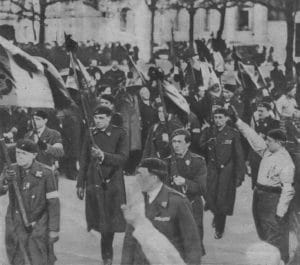
1934 Exhbition of Fascists in Paris
During the late 1930s, the ruling class directed its fury not at Berlin, but at Prime Minister Léon Blum. As a Jewish socialist leading the Popular Front, Blum earned the permanent hatred of industrial leaders by granting workers basic rights like paid leave and a forty-hour workweek. The corporate elite responded with massive capital flight to wreck the national currency, and the right did not bother to disguise where its loyalty actually sat. The slogan that circulated among French conservatives put it in four words: «Plutôt Hitler que Blum» — “Better Hitler than Blum.” A Jewish socialist premier was the enemy that mattered; the German Chancellor next door was, at worst, a lesser evil.
When German forces attacked in 1940, historian Marc Bloch noted that the military leadership simply froze. The command structure proved too slow to adapt to fast-moving attacks. France lasted about forty days. It was the speed at which a political class that had spent two decades tolerating fascists, and had preferred Hitler to Blum, got the settlement it wanted. The Republic fell. Their man, Gen. Pétain took the chair and set up headquarters in Vichy, France.
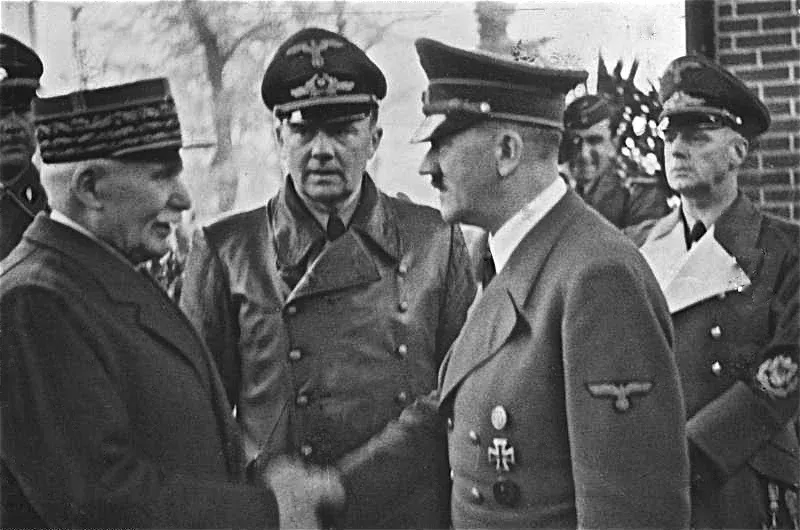
Gen. Pétain shaking hands with Hitler
The Republic fell. Their man took the chair. By the end of the war, something on the order of 130,000 to 140,000 Frenchmen had been pulled into the Axis side — in German uniform, in Vichy’s own armed formations, or in the labour machine that fed the Reich. That is not a footnote to the forty days. It is what “Better Hitler than Blum” looked like once it had a state.
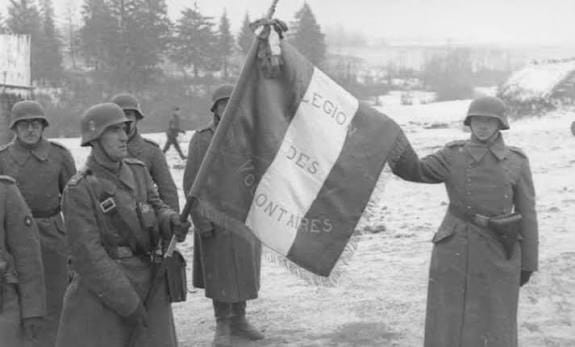
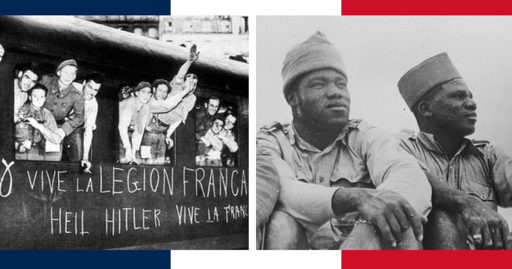
French Legion Fighting Operation Barbarossa
When de Gaulle reached London in June 1940 he had a title, BBC time, and almost no army. The troops he needed were in the colonies. The official story was that African subjects owed that service as payment for la mission civilisatrice — French schools, missions, and the rule of law.
That was the cover, not the content. In French West and Equatorial Africa the colonial state extracted labor as tax. Adult men owed days of unpaid work on local public works; in the early decades that in-kind levy was often as large as, or larger than, the entire cash budget. The roads and rails were built to move rubber, timber, and peanuts out.
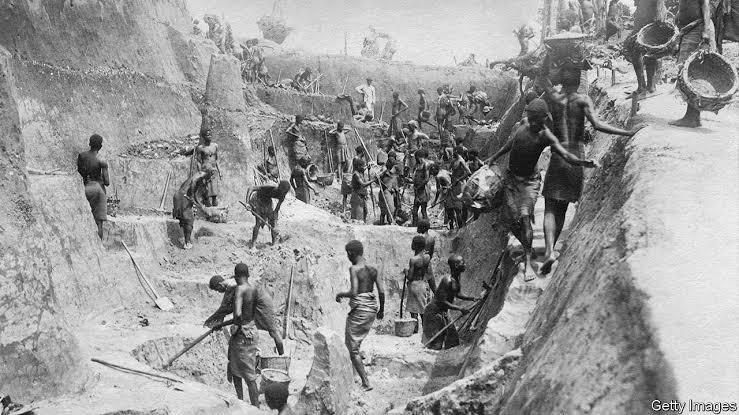
African Forced Labor Building the Congo-Ocean Railway
The Congo–Ocean railway — hailed as development — was built with conscripted African labor under conditions that killed more than 14,000 of roughly 127,000 recruits. Subjects could not vote, could not hold most administrative posts, and could not leave their circonscription without a permit. They lived under the indigénat, a separate and inferior code. Assimilation without citizenship: France demanded they die as Frenchmen while the law kept them as a fiscal resource.
That is what “French civilization” meant when de Gaulle went looking for an army.
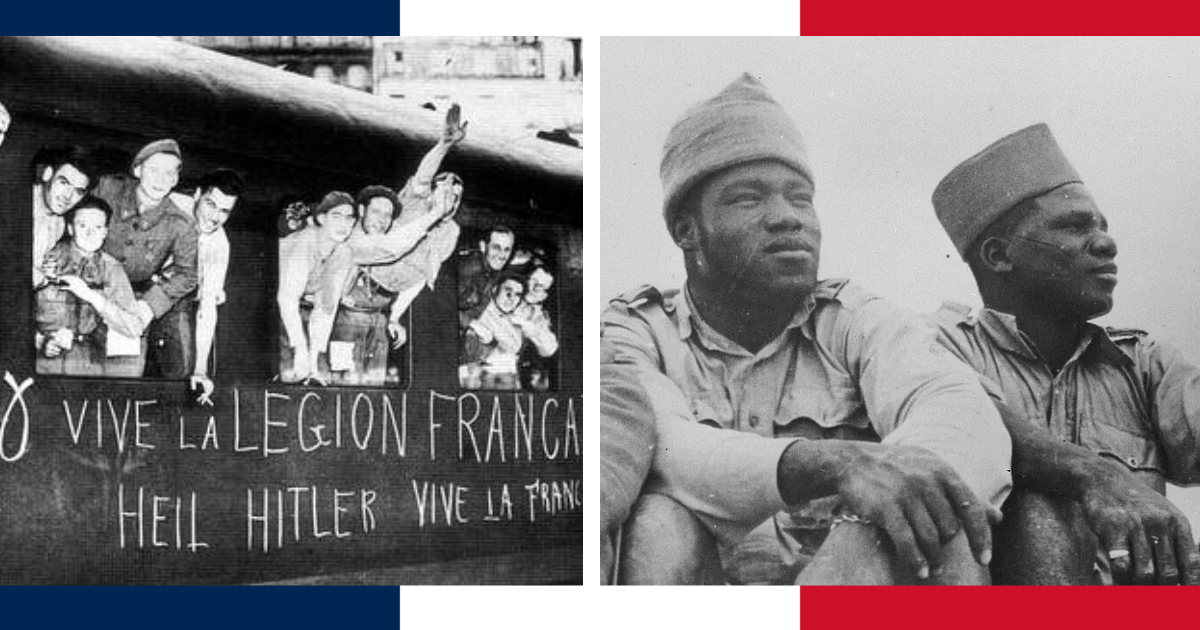
This logic allowed Paris to treat African casualties as acceptable operating costs. French West Africa alone provided roughly 200,000 soldiers to the cause. Up to 25,000 were killed in action, and another 16,000 endured years inside German prisoner-of-war camps.This entire military enterprise was justified by racist pseudoscientific doctrine. In 1910, General Charles Mangin claimed that African men had underdeveloped nervous systems and an unusually high pain tolerance, arguing they were uniquely built to serve as shock troops. General Hippolyte Langlois defended their use by citing a fatalist temperament, while General Bonnal demanded them on the front lines for their impetuosity with bayonets. Mangin famously called using Black soldiers to defend France the highest expression of the civilising mission.
None of this stopped African soldiers from fighting well beyond what the racial theories predicted. In June 1940, Senegalese Tirailleurs defending the approach to Lyon at Chasselay held their position with bayonets after running out of ammunition; the German troops who overran them executed dozens of the survivors on the spot rather than take them prisoner. Two years later, colonial troops made up a large share of the Free French garrison that held Bir Hakeim against Rommel’s Afrika Korps for sixteen days, a stand that helped buy the Allies time to regroup before El Alamein. In 1944, Moroccan Goumiers broke the German line at Monte Cassino after months of Allied failure, opening the road to Rome.
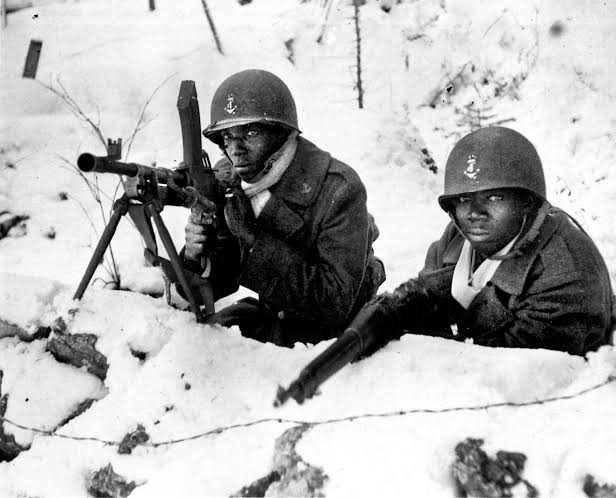
Senegalese Tirailleurs Fighting on the Mountainside in 1944
Victory did not change the race math. In January 1944, seven months before the liberation, Major General Walter Bedell Smith, Eisenhower’s chief of staff, wrote in a confidential memo:
“It is more desirable that the division mentioned above consist of white personnel. This would indicate the Second Armoured Division, which with only one fourth native personnel, is the only French division operationally available that could be made one hundred per cent white.”
British General Frederick Morgan wrote to Allied Supreme Command that the request would be hard to meet:
“It is unfortunate that the only French formation that is 100% white is an armoured division in Morocco. Every other French division is only about 40% white. I have told Colonel de Chevigné that his chances of getting what he wants will be vastly improved if he can produce a white infantry division.”
The American command told Free French headquarters that there would be no Black soldiers in the 2nd Armoured Division. De Gaulle complied. The division that spearheaded the drive on Paris — and would be photographed as the first Allied unit into the city — was stripped of most of its African soldiers and refilled with white recruits, including a company of Spanish Republican exiles who looked the part Washington wanted. A handful of African officers survived the purge only because General Leclerc personally kept them.
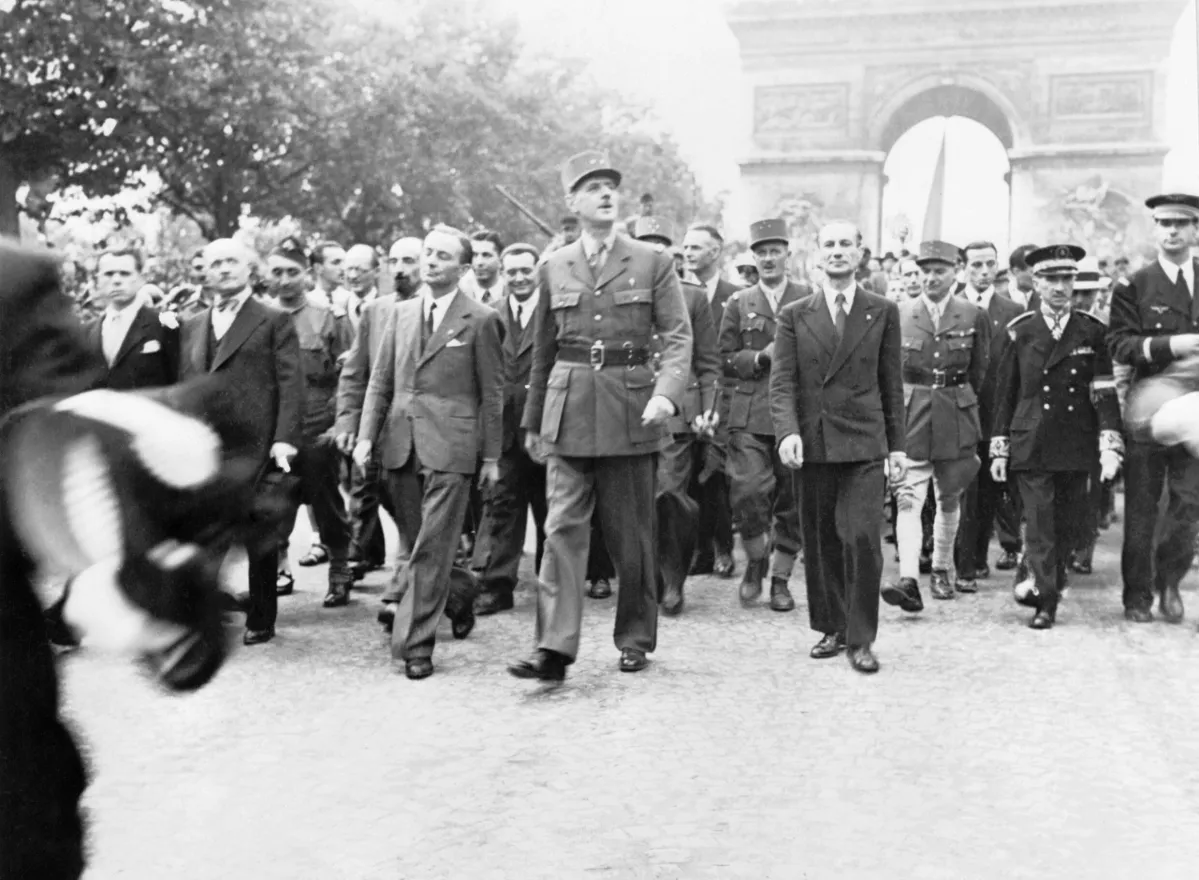
Even though Whites Made up of only 40% of French Troops, they made up 100% of the parades
The same whitening happened again before the advance into Germany, this time on France’s own initiative: no African troops in the liberation parades, so that white citizens would not have to watch Black soldiers save them. Roughly 20,000 African soldiers were pulled and replaced before the marches through Paris and the other liberated cities. The men who had carried the French flag across Africa and Europe were told, quite literally, to disappear before the cameras arrived.
By 1945 the irony had a date on it. The men France called uncivilized — subjects from Senegal, Mali, Algeria, and Morocco — had been sent to die against the Third Reich, then hidden from the photographs of its defeat. The men France called civilized were still fighting for that Reich in the week of Downfall. A remnant of the Waffen-SS Charlemagne Division was called into Berlin by the Führerbunker itself. They held the government district around the Reich Chancellery — the last screen in front of Hitler’s bunker — while he killed himself underground on 30 April. They were still on that ground on 2 May.
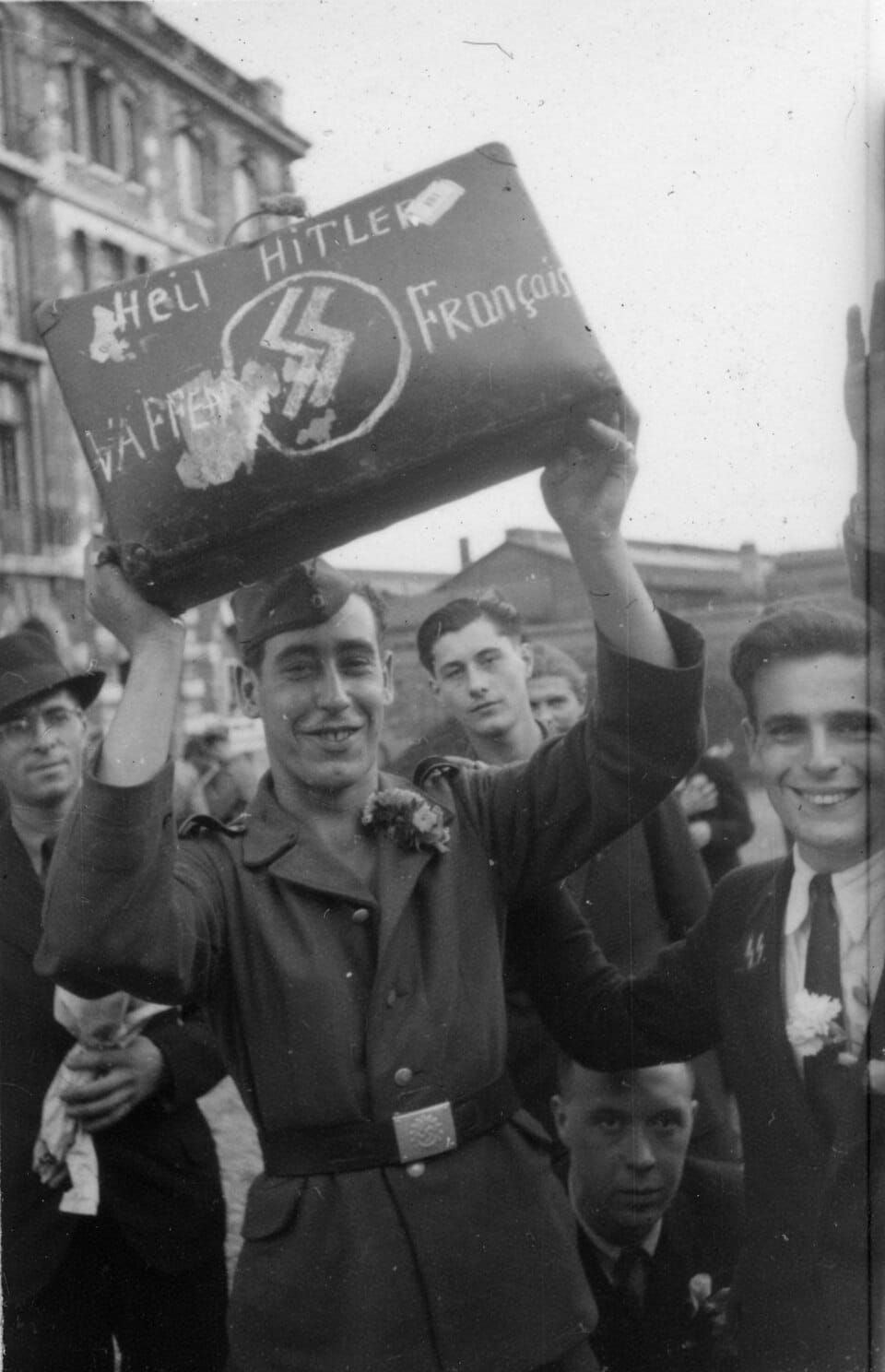
A French recruit for the SS-Volunteer Sturmbrigade France departing from Paris in October 1943
France called the Africans uncivilized and sent them to kill the Reich, then made them vanish before the parade. It called itself civilized, and its volunteers were still at Hitler’s bunker when he died.
The Africans who were sent home found that the war was not over. It had only changed rooms. When they returned home, the betrayal turned deadly on December 1, 1944, at Camp Thiaroye, a transit camp on the outskirts of Dakar, cut off from the nearest villages by bush.
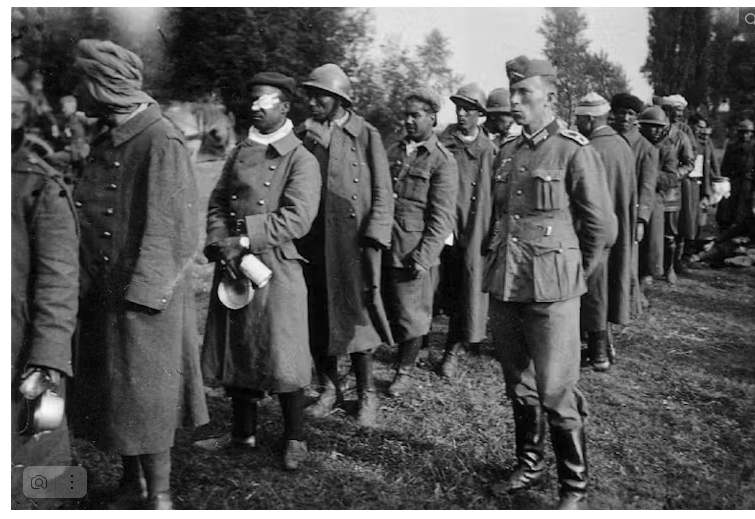
Senegalese Tirailleurs ub 1940
The men gathered there had already given France everything it asked of them. Captured in the 1940 collapse, many had spent years in German prisoner-of-war camps, watched comrades die of cold and hunger, and saved what little money they earned from forced labour, sometimes fifteen, twenty, even forty thousand francs, carried home in their pockets.
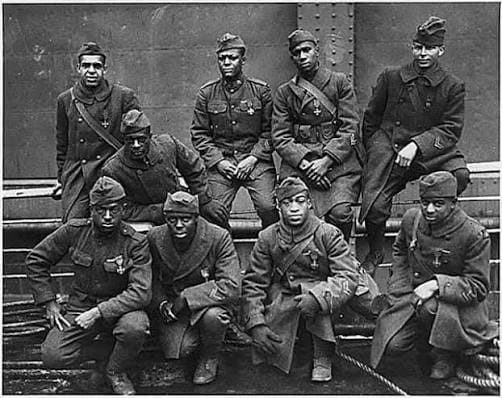
French-African Troops Captured by Germany as POW
When they were finally shipped back toward Africa, they were told the rest of what they were owed back pay, discharge bonuses, months of wages would be waiting for them at Thiaroye. It wasn’t. They were told to disperse to their home villages and collect it later. They refused. Scattered into small groups, they would have no leverage left to demand anything at all.
On the morning of December 1, French officers ordered them out of their barracks and onto the camp’s esplanade. When the men refused to march to the train station without their money, the French command treated the refusal as mutiny. Armoured cars and at least one tank moved into position. The tirailleurs had almost nothing to answer with: a couple of pistols, a few knives and bayonets, nothing that could be called an armed uprising. The order to fire came anyway. It lasted less than a minute.France’s own military records cannot agree on how many men died in that minute. General Dagnan, commanding officer for Senegal and Mauritania, reported at different times that 24 were killed and 11 mortally wounded, and elsewhere that 24 were killed and 46 wounded who later died, arithmetic that quietly moves the official toll from 35 to 70 depending on which version is read.
Survivors and later historians put the real death toll far higher, somewhere between 300 and 400. To make the smaller number stick, the French army appears to have gone further than simply picking a low estimate. Records suggest around 400 tirailleurs were struck from the ship’s manifest before it ever reached Dakar, officially left behind at a stopover in Casablanca. The officer who actually escorted the men wrote in his own logbook that nothing unusual happened at that stop. The missing men were never in Casablanca. They were subtracted from the count so the massacre could look smaller on paper.
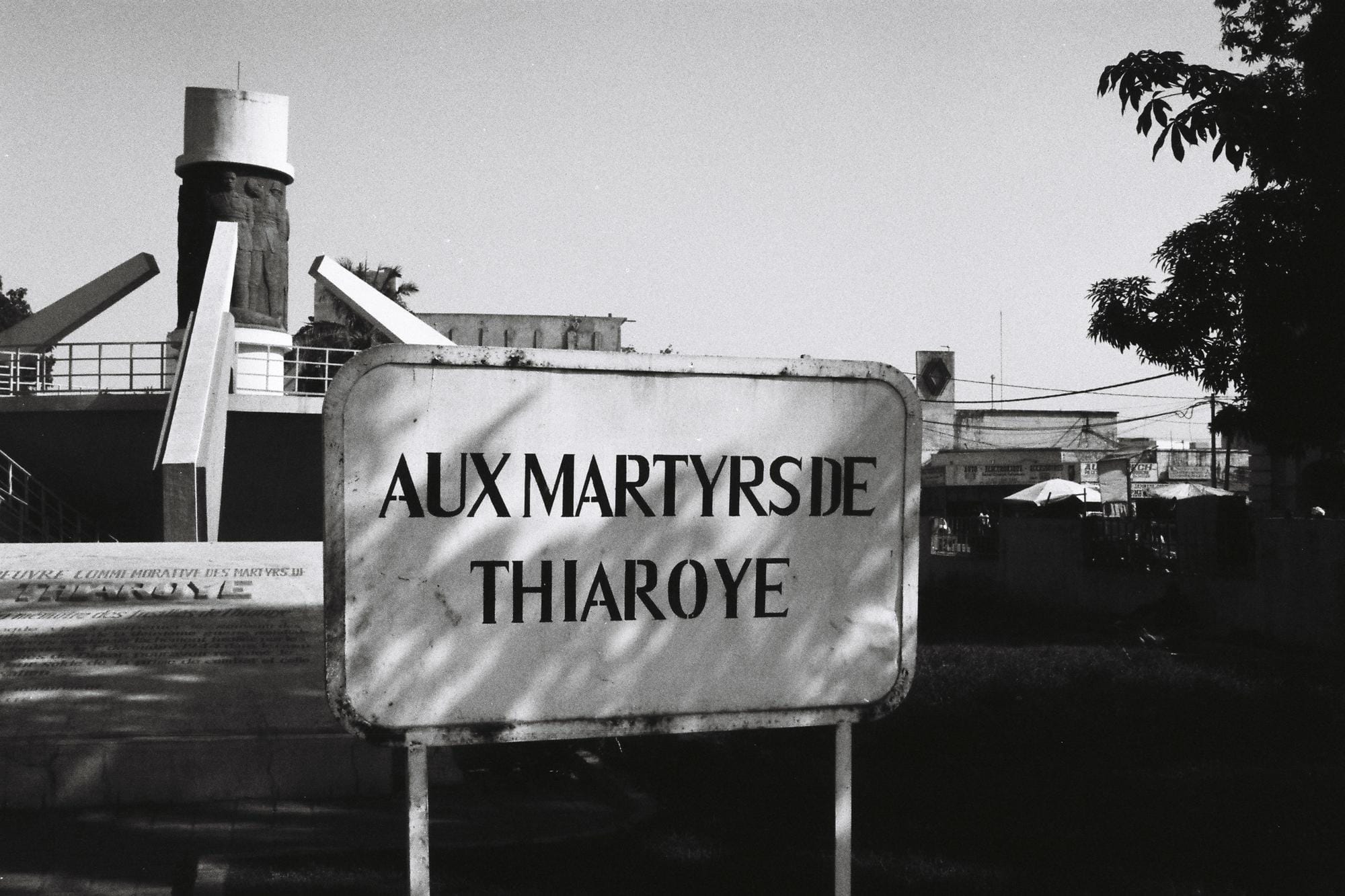
A sign stands in remembrance of the martyrs of Thiaroye
The thirty-four men accused of leading the “mutiny” were made to walk barefoot from Thiaroye into Dakar before they were tried in March 1945 and convicted, on the strength of an armed uprising that never had enough weapons to be one.
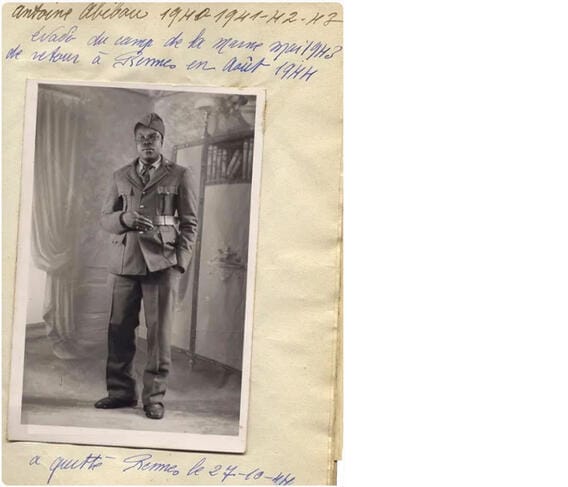
Antoine Abibou in uniform. He was charged by a military court for having led the rebellion of Thiaroye
Two months later, in Bavaria, the Americans handed about twelve French Waffen-SS from Charlemagne to Leclerc’s 2nd Armoured Division. They had been in German uniform at the end of the war. They were shot in a clearing without a trial. The rest of that division — the men who had stayed with Hitler’s bunker — went into French courts and were given a mixture of prison sentences and amnesty. Most of them were out by 1959 and integrated into civilian lives. The Africans who fought to liberate France got bullets. The Frenchmen who fought for Hitler, largely escaped unscathed.
Eighty years later, the ground is still being made to testify. In 2025, Senegalese archaeologists began excavating the military cemetery at Thiaroye, opening a handful of the site’s 202 graves to find out who was actually buried there, and how. Of seven skeletons recovered so far, one carries a bullet lodged in its left side, exactly where the heart would have been; investigators recovered rounds of different calibres from several of the bodies, some still embedded in the chest cavity, evidence that the men were cut down by more than one weapon firing at once rather than a single burst of warning shots.
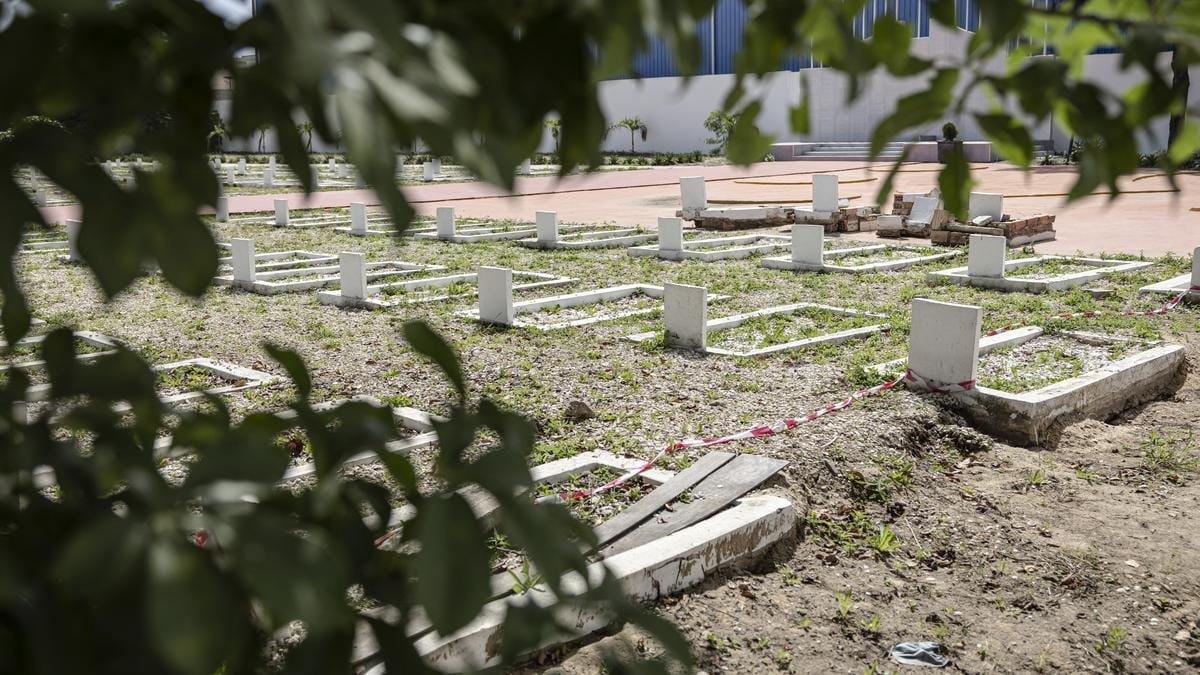
Graveyard for those unearthed at Thiaroye
Others in the same graves are missing a skull, a spine, or ribs entirely, damage inconsistent with a body laid to rest and left undisturbed. Some were found with iron chains still wrapped around their shins. Investigators now believe the graves themselves were dug after the bodies were already in the ground, staged later to look like a proper burial had taken place, with forensic and ballistic analysis of the recovered rounds still pending to establish exactly what was fired and from where.
A French parliamentary commission once opened to investigate the massacre closed without producing a single finding. A military file documenting disciplinary sanctions against Colonel Le Berre, the officer who commanded the massacre, was approved for declassification and then quietly withdrawn.
Decades later, a Senegalese rifleman named Issa Cissé remembered exactly they got in return for liberating France:“De Gaulle has blocked the way to final victory; he is a coloniser. The French are good, but their rulers were not always with us. Why? Because we are black. How many Senegalese have died? For whom? For France? For the French flag to exist.”
Interview with Issa Cise
Twelve years later the same man, Charles De Gaulle, who had hidden African fighters from the Paris cameras made the terms of “freedom” explicit. In 1958 de Gaulle offered the colonies a referendum: stay inside a French Community whose rules Paris would write later, or leave.
In Conakry he called it a choice. It was a threat. Sékou Touré answered him in the hall: no dignity without freedom; better poverty in liberty than opulence in slavery. Guinea voted no — about 95 percent. De Gaulle ordered the exit as vengeance. Over two months the French stripped the place like addicts going through a house for copper. They unscrewed the lightbulbs. They pulled the wiring out of the walls. They took the sewage plans for Conakry. They burned medicines rather than leave them. They wrecked schools and hospitals, destroyed crops, blew the roads and the rails. A CIA note at the time said Paris wanted an example.
The other territories watched and voted yes. The price of a no had been put on the table.
Algeria fought a war and took its independence in 1962. It did not take the bombs with it. The first French nuclear test, Gerboise Bleue, had already gone off in the Algerian Sahara in 1960. More followed, in the air and then underground, at Reggane and In Ekker, into 1966 — after the flag had changed. Civilian populations around the sites were not adequately warned. An estimated 40,000 Algerians were made sick by the tests. The “civilizing” power used the colony as a proving ground, then kept using the desert after it had officially left.
What followed for the ones who stayed in the arrangement was not independence in any sense that ended the books: the CFA franc, French companies on the ore and the oil, coups, and the killing of presidents who tried to walk off the reservation. Civilization, in that ledger, is the word for who keeps the accounts — and for what happens to a country that stops paying.
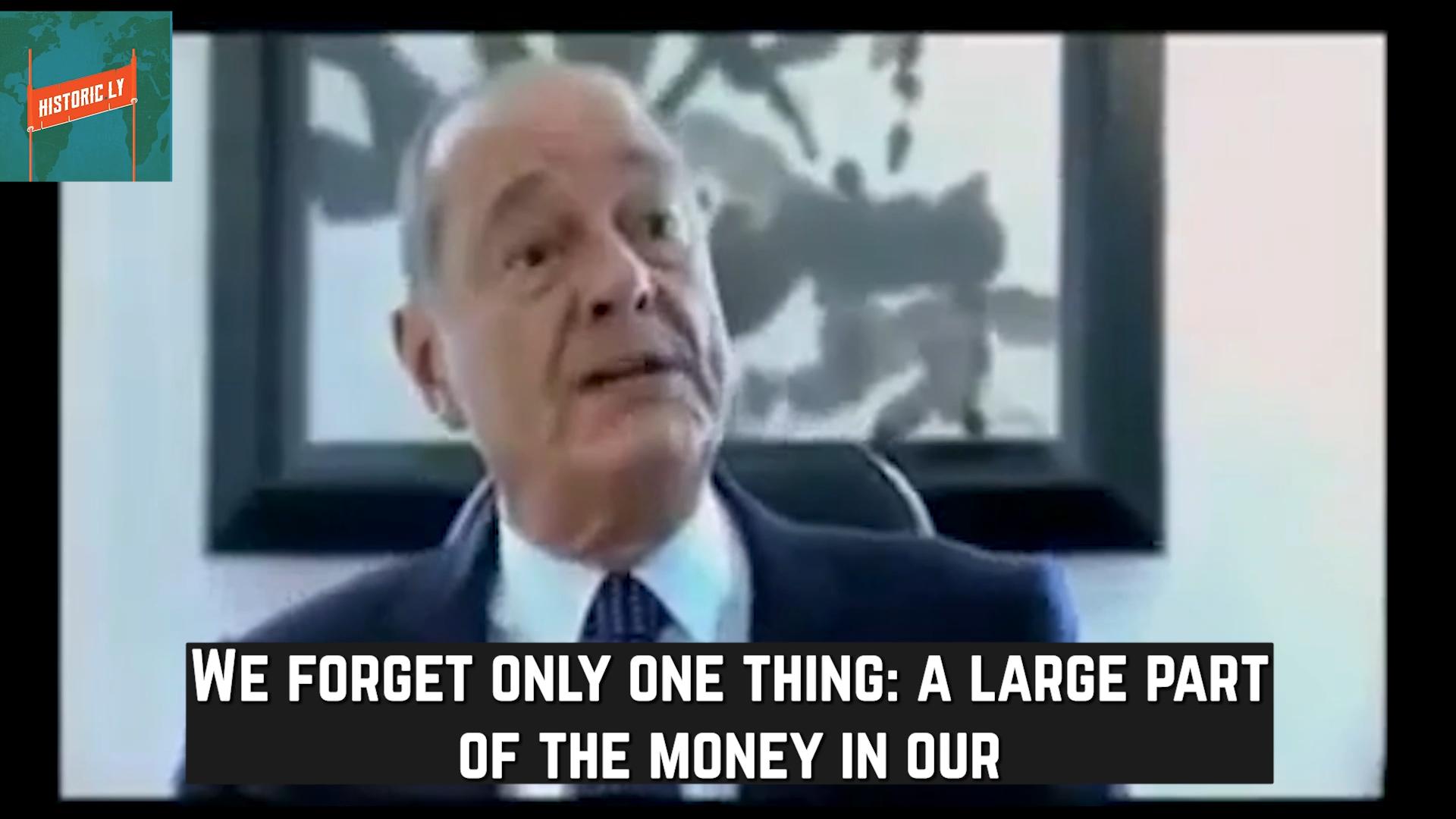
Even Chirac eventually said it out loud. A large part of the money in French wallets, he admitted, came from centuries of exploiting Africa — not generosity, he said, common sense and justice to give back what had been taken, if France wanted to avoid the convulsions that follow. He named the ledger. He did not close it.
From Historic.ly via This RSS Feed.