

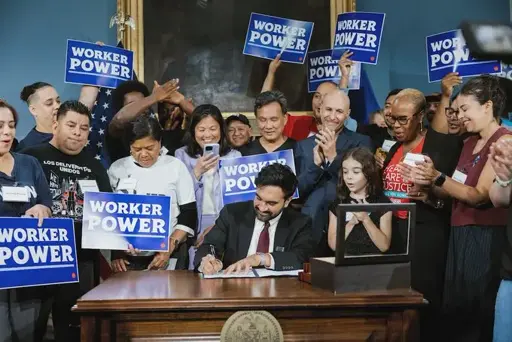
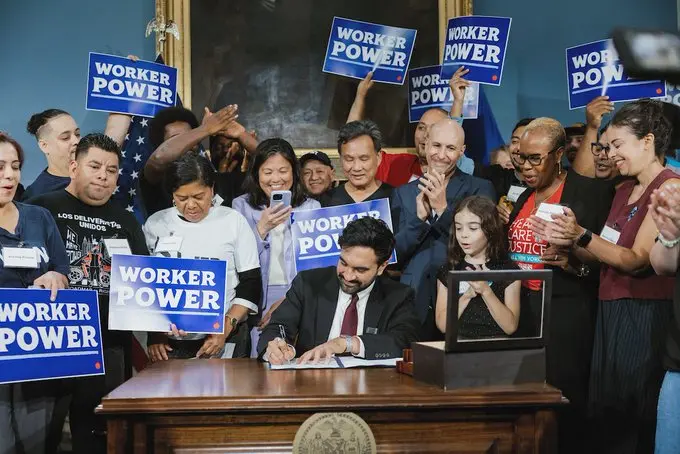
The new municipal office will help workers organize, understand their rights and connect with unions and worker centers.
New York City Mayor Zohran Mamdani has launched the Mayor’s Office of Worker Power to help workers organize and improve their working conditions, with a particular focus on immigrants and undocumented workers vulnerable to workplace abuses.
RELATED: NYC Mayor Mamdani Secures 1,000 Tickets for the US Open at $100 Each
Led by veteran union and community organizer Tony Perlstein, the new municipal office will engage workers across the city, gather information about workplace conditions and connect them with unions, worker centers and community organizations that can support their efforts.
The office will inform workers of their rights when they seek to organize and identify industries where workers face greater barriers to doing so. It will also refer workers to unions and other organizations that can help them organize and advocate for better working conditions.
Perlstein, who has more than three decades of experience in labor advocacy, will oversee the office, which will pay particular attention to workers vulnerable to abuse, including immigrants and undocumented people who may be reluctant to report workplace violations because of potential immigration consequences.
The office will not replace unions or negotiate directly with employers. Nor, under the powers announced so far, will it have authority to investigate companies or impose sanctions. Those responsibilities will remain with the Department of Consumer and Worker Protection, Economic Justice Deputy Mayor Julie Su said.
“Our work is to support, expand and coordinate with these organizations, not take their place. The right to organize, to have a safe workplace and to be protected by New York labor laws does not depend on immigration status,” Su said when announcing the new municipal office.
The initiative will work with organizations representing workers in construction, hotels, home care, restaurants, cafes and delivery platforms, among other industries with significant immigrant workforces. It will also use the powers available to the city to assist people who have become more vulnerable as a result of actions by the federal government.
In 1882, 10,000 workers marched up Broadway in the first-ever Labor Day parade. Led by democratic socialists and organized by New York’s unions, they rallied the movement that went on to win us weekends, safety standards, overtime pay, a minimum wage, and social security.
None…
— Mayor Zohran Kwame Mamdani (@NYCMayor) September 7, 2026
Worker protection amid a weakening labor market
The office is being established amid growing concern over income concentration and the loss of jobs capable of providing economic stability.
Su cited a recent report by the city comptroller showing that real earnings for 90% of New York workers stagnated or declined between 2019 and 2024. During the same period, the top 0.1% of earners accounted for more than half of the city’s total real income growth.
“When wages stagnate and workers have less money in their pockets, there is less money circulating in our economy. That means less money for small businesses and neighborhood bodegas, less demand for local restaurants and bars, and, overall, a less dynamic economy,” Su said.
The city has also seen a gradual shift from stable middle-class jobs toward precarious, temporary and part-time work, many of which do not provide health insurance, paid leave or retirement security. Those benefits were achieved through decades of labor organizing, Su said.
“The history has shown that worker power is the solution when an economy becomes too favorable to one class and stops working for the working class,” she said.
The Mayor’s Office of Worker Power will focus on helping workers understand their rights, organize and connect with organizations that can support them, while existing city agencies retain responsibility for investigating businesses and enforcing labor protections.
From teleSUR English via This RSS Feed.