

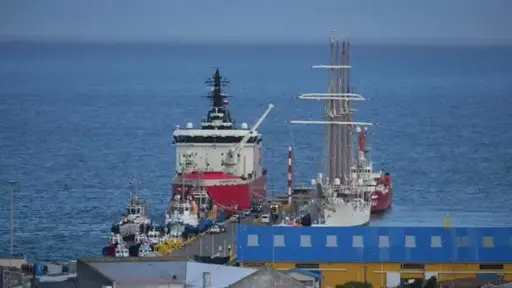
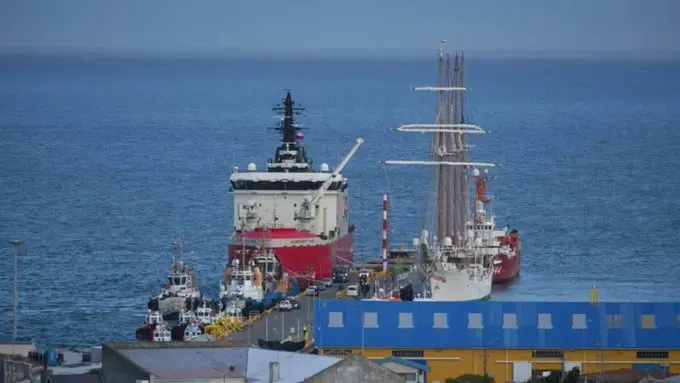
A regular shipping service from Punta Arenas is due to begin in November, amid Argentina’s sanctions over unauthorized hydrocarbon activity.
A regular maritime service linking Chile’s Punta Arenas with the Malvinas Islands is set to begin in November, establishing a new supply route for the archipelago while potentially exposing the Chilean shipping company involved to Argentine sanctions.
RELATED: Controversial Moves in Milei Malvinas Intelligence Budget Expansion 2026
The Malvinas Islands Development Corporation (FIDC) has reached an agreement with Chilean shipping company Easter Island to launch the service between Punta Arenas and Puerto Argentino. The route is expected to halve maritime transport times compared with the supply chain that has historically depended on Montevideo.
The service will carry construction materials, spare parts, food and liquefied gas to the islands, as well as supplies for projects in the northern basin.
The agreement comes as Argentina has stepped up administrative and criminal measures against what it considers unauthorized hydrocarbon activity in the Malvinas Islands. The Argentine government has formally issued 45 notices to individuals and companies linked to the Sea Lion oil field.
The flag-and-trade strategy
The new route is expected to expand commercial ties between Punta Arenas and the islands, whose annual purchases are estimated at $20 million.
A British delegation comprising FIDC Deputy Director Louise Ellis and Mike Summers, a representative of the islands’ Chamber of Commerce, is due to visit Punta Arenas on Sept. 28 and 29 to negotiate directly with local suppliers.
Initial talks began in July with Sam Cockwell, the FIDC’s strategic projects manager, focusing on meeting the technical and operational requirements of the industry in surrounding waters.
Punta Arenas Mayor Claudio Radonich has acknowledged that the new commercial route is intended to circumvent a 2011 Mercosur declaration, historically supported by Chile, that bars regional ports from receiving vessels flying the flag of the Malvinas Islands. The strategy is to use ships registered under flags of convenience to avoid those restrictions.
UNA DELEGACIÓN DE MALVINAS VISITARÁ CHILE A FIN DE MES PARA AVANZAR EN LA RUTA COMERCIAL CON PUNTA ARENAS
Una delegación empresaria de Malvinas viajará a Punta Arenas el 28 y 29 de septiembre para reunirse con proveedores chilenos y avanzar en una conexión marítima regular con… pic.twitter.com/WXcq55gzg5
— Clarín (@clarincom) September 5, 2026
Text Reads: A FALKLAND ISLANDS DELEGATION WILL VISIT CHILE AT THE END OF THE MONTH TO ADVANCE THE TRADE ROUTE WITH PUNTA ARENAS
A business delegation from the Falkland Islands will travel to Punta Arenas on September 28 and 29 to meet with Chilean suppliers and advance a regular maritime connection with the Islands. The operation has been placed in the hands of the Chilean shipping company Easter Island Naviera, and the first trip is projected for November, with food, construction materials, liquefied gas, spare parts, and other products. (…)
The development contrasts with earlier expressions of goodwill between Argentine President Javier Milei and Chilean President José Antonio Kast in Santiago, as their political alignment now faces a practical test over the new maritime link.
The planned route has also drawn attention from Chile’s military establishment. Retired Chilean Navy Adm. Julio Leiva warned publicly that the arrangement could create tensions with Argentina, which requires prior authorization for vessels traveling to the islands.
“I tend to think this is the response of the citizens and Mayor Radonich (…) and, obviously, there will be a problem,” Leiva said.
Leiva characterized the enforcement of Argentina’s controls as relatively lax under maritime law. His comments came after six former Chilean navy commanders published a letter in the newspaper El Mercurio questioning bilateral trust following recent statements about the Boca Oriental de Magallanes by Brig. Gen. Gustavo Valverde and Rear Adm. Hernán Montero.
Legal conflict and Argentine sanctions
The planned operation also directly intersects with Argentina’s legal framework governing hydrocarbon activity in the disputed territory, including Decree PEN 256/2010 and the tightening of Law 26.659 through Emergency Decree 867/2026 under the administration of Javier Milei.
The measures provide for administrative and criminal sanctions not only against oil companies operating in the area, including Navitas Petroleum and Rockhopper Exploration, but also against companies involved in the logistics, transportation and services supporting extraction activities.
Easter Island could therefore face disqualification measures, asset freezes and legal action by Argentine authorities if it transports critical supplies to the islands.
From teleSUR English via This RSS Feed.