

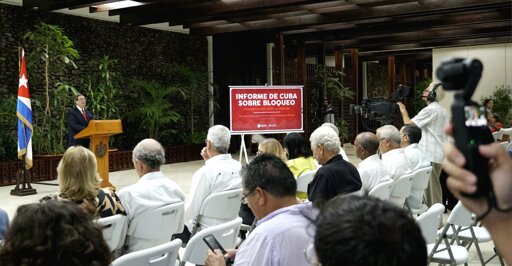
On Monday, September 7, Cuban Foreign Minister Bruno Rodríguez presented the national and international press with the report on the impact of United States sanctions. During his remarks, the minister described the US policy as a “collective punishment” that directly affects the well-being and daily life of the Cuban people in fundamental areas such as food, water, electricity, health, education, and transportation.
According to official data in the document, economic damages amounted to $8.08 billion between March 1, 2025, and February 28, 2026. This record figure represents a 7% increase from the previous period.
With this result, the accumulated impact reaches $178.7 billion at current prices, equivalent to a 4.7% increase over the last report.
Foreign Minister Rodríguez emphasized that the pressure exerted by Washington harms families’ daily stability. He explained that the population faces long periods with only two or three hours of electricity per day, leading to food loss due to lack of refrigeration and other effects of the service’s instability.
He added that the complex situation also makes nighttime rest difficult due to the heat, complicates children’s school activities, and limits communication and entertainment networks for young people and the elderly. “All family life is damaged,” he stated.
The report links the energy crisis to US President Donald Trump’s January 29 executive order, which threatens to impose tariffs on goods.
“We have rapidly changed the energy matrix with solar power. Now, shipping companies are threatened so they do not bring solar panels and batteries for the new photovoltaic parks that we have learned to install in 45 days,” reads a post by Bruno Rodríguez on his social media.
“If fuel and diesel could be imported for the generators used in distributed power generation, the blackouts could be minimized, but the fuel blockade prevents us from importing them,” added the Cuban minister.
The energy disruptions also affect access to drinking water, since pumping stations and booster systems depend on electric motors and generators weakened by the shortage of parts and fuel.
Constant power outages cause pressure to drop in the water mains, forcing the hydraulic system to undergo several hours of recovery time afterward to restore basic service to the communities.
In the health sector, the minister explained that power outages and a lack of diesel jeopardize the functioning of operating rooms and life-support equipment, such as mechanical ventilators and neonatal incubators. This forces medical staff to use manual procedures or use their cellphone flashlights during complex interventions. “Health needs resources, patients need timely treatments,” he stressed.
Additionally, he condemned the retention of over 7,000 containers of supplies and medicines due to harassment of shipping lines, a situation Rodríguez linked to the increase in infant mortality in Cuba, which went from 4 per 1,000 live births in 2018 to 9.9 in 2025. “They are children, not numbers,” he asserted.
Speaking before local and foreign press accredited in Cuba, the foreign minister announced that on October 27 and 28, the United Nations General Assembly will once again consider its agenda item titled “Necessity of ending the economic, commercial, and financial embargo imposed by the United States of America against Cuba.”
“Despite the extraordinary pressure and intimidation exerted by the US on member states, Cuba trusts in the overwhelming support for the call to end the blockade in the vote scheduled for Wednesday, October 28,” Bruno Rodríguez said on his X account.
(Telesur)
Translation: Orinoco Tribune
OT/JRE/SF
From Orinoco Tribune via This RSS Feed.